Ohio Chicken Landfill Dumping Investigation: What We Actually Know?
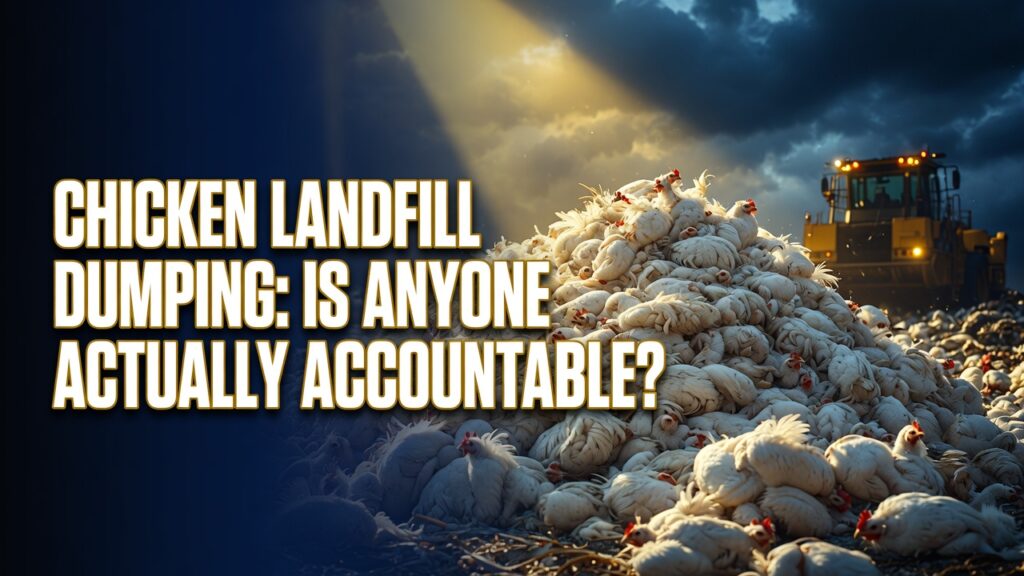
As disturbing video from a Logan County landfill spreads across social media, Ohioans are asking a simple question state regulators have yet to fully answer: how did this happen, and who’s making sure it never happens again?
A truck dumped hundreds of chickens into an Ohio landfill. Some were still walking.
The footage, recorded by a resident and posted to a local Facebook group in mid-June, shows what looks like a routine waste haul turning into something far more troubling. Within days, the Ohio Department of Agriculture confirmed it was investigating, and the story spread far beyond Logan County. This is not a story about one bad load of chickens. It’s a story about whether the systems meant to prevent this actually work.
What Actually Happened at the Logan County Landfill?
The basic facts are not in dispute. Hundreds of end-of-life laying hens from a Union County operation were transported to the Logan County Landfill, operated by Republic Services, and dumped in a manner that left some birds alive on impact [local news reporting, ABC 6 / WDTN / WKEF]. The Ohio Department of Agriculture confirmed that not all birds had been properly euthanized before transport, a direct violation of standard industry and state practice, even though disposing of properly euthanized poultry in a licensed landfill is legal under Ohio statute.
Republic Services says it has since halted shipments from the customer responsible until the company can confirm a consistent, compliant process is in place. The Ohio Department of Agriculture says its investigation is ongoing, and it has directed industry representatives to retrain personnel on euthanasia, loading, and disposal procedures. The Logan County Sheriff’s Office and the Logan County Health District have both said the matter falls outside their jurisdiction, leaving the state agriculture department as the only entity with real enforcement authority.
Support Independent Local Journalism
TheTownHall.News is a non-profit reader-supported journalism. Just $5 helps us hire local reporters, investigate important issues, and hold public officials accountable across Alameda County. If you believe our community deserves strong, independent journalism, please consider donating $5 today to support our work.Who Is Supposed to Be Watching This Process?
That’s the uncomfortable part of this story. Poultry disposal in Ohio is governed by state agricultural law, but enforcement depends almost entirely on self-reporting by the industry and, in this case, a resident with a cell phone. Logan County Health Commissioner Travis Irvan said publicly that his department has no regulatory authority here and that the Ohio EPA identified no known violations under its own rules.
If it takes a viral video for regulators to notice a compliance failure, how many go unnoticed? That’s not a rhetorical flourish. It’s the exact gap that limited-government conservatives have long warned about: rules on the books mean little without consistent inspection and consequences. Ohio’s framework technically allows for oversight, but this incident shows how thin that oversight can be in practice.
Why Does Ownership of the Landfill Matter Here?
Republic Services, which operates the Logan County Landfill, is a publicly traded national waste company. Cascade Investment, the private investment vehicle of Bill Gates, disclosed beneficial ownership of roughly 35.6 percent of Republic Services in an SEC filing earlier this year [SEC 13D/A filing, February 2026], making it the company’s largest shareholder. That stake has been building for more than a decade and is a matter of public record, not a new or hidden arrangement.
It’s worth being precise about what that ownership fact does and doesn’t tell us. There is no evidence in any public reporting connecting this specific disposal failure to corporate direction from Cascade, Gates, or Republic Services’ board. Republic Services operates thousands of contracts nationwide; this appears to be a contractor-level compliance failure flagged by state regulators, not a policy decision from ownership. Readers deserve the full picture, not a simplified villain — and the full picture is that a major shareholder’s identity doesn’t, by itself, explain a euthanasia procedure breakdown two counties away.
Should a state agency need a viral video to catch a violation its own rules were supposed to prevent?
What Do the Numbers Actually Tell Us?
Hundreds of birds. That’s the current, imprecise figure repeated across every report on this incident. The question no one has answered yet: how many similar loads went uninspected before someone happened to film this one?
Ohio has not released comprehensive data on landfill poultry-disposal violations statewide, and the Department of Agriculture has declined to identify the specific operation responsible while its investigation remains active [ODA statement]. That silence isn’t necessarily improper during an active probe, but it does mean the public is being asked to trust a process it can’t currently verify.
What Do Supporters of the Current System Actually Believe?
Defenders of Ohio’s current approach make a fair point: euthanizing and landfilling end-of-life laying hens is a long-standing, legal, and generally humane industry practice when done correctly. Composting and incineration, alternatives some residents have called for, carry their own cost and logistical burdens for smaller operations, and mandating them statewide could raise costs that ultimately land on consumers.
That argument has merit. Nobody serious is calling for the poultry industry to be shut down over one contractor’s failure. But “the practice is legal when done right” is not an answer to “how do we know it’s usually done right?” A rule that only gets enforced when a bystander happens to record it isn’t really a functioning rule. Fair oversight and light-touch regulation aren’t mutually exclusive — they require agencies to actually verify compliance, not just write standards and hope.

Is This the Accountability Moment Ohio Needs?
Every part of this story points back to the same gap: authority without verification. The Ohio Department of Agriculture has the legal power to investigate and enforce, and to its credit, it responded once the video surfaced. But a system that relies on public shaming rather than proactive inspection isn’t accountability — it’s luck.
Are you comfortable with a regulatory system that only works when someone happens to be filming? Logan County residents weren’t. Neither should Ohio taxpayers who fund an agriculture department whose enforcement, in this case, followed the public rather than led it.
Key Questions This Story Raises
- Will the Ohio Department of Agriculture release the name of the operation responsible once its investigation concludes, or will that information stay shielded indefinitely?
- What proactive inspection process, if any, exists for poultry disposal loads statewide — and how often is it actually used?
- Does Republic Services’ internal vendor-compliance process need independent verification, or is a “we’ve halted shipments” statement sufficient accountability?
The Bottom Line
This started as a shocking video and became a test of whether Ohio’s regulatory system does what it promises. The birds are gone. The questions aren’t.
The real question isn’t whether this landfill incident was legal on paper — it’s whether Ohioans can trust that the next one gets caught before it goes viral.
Still have questions about how your state agencies handle accountability? Stay informed — subscribe for daily coverage from The Town Hall News. Think your neighbors need to see this? Share the article. Want your voice to count? Contact the Ohio Department of Agriculture’s Communications Division and ask them to publish full statewide poultry-disposal compliance data once this investigation closes.