Permanent Daylight Saving Time Passes House: Will the Senate Kill It?
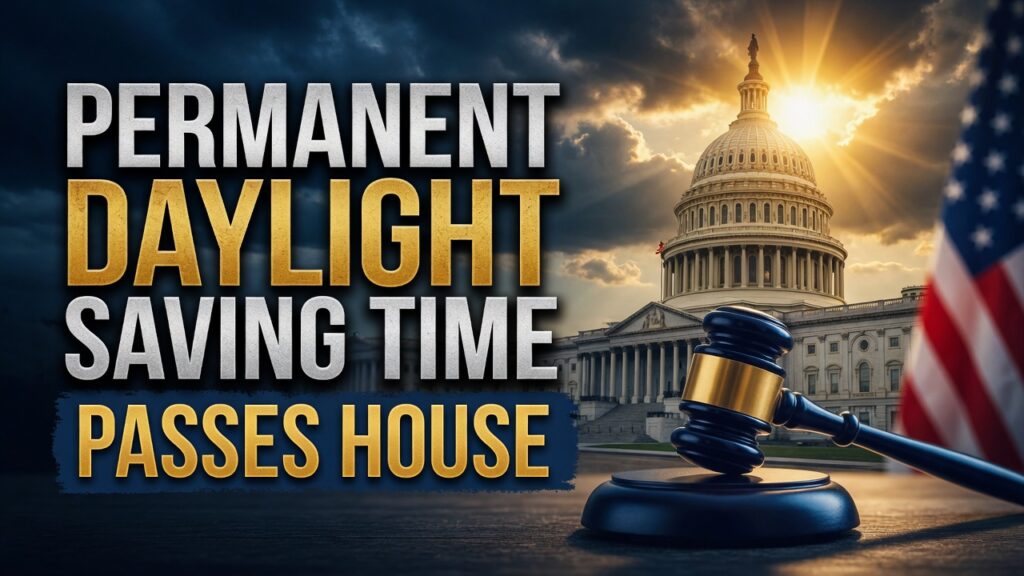
After more than a decade of false starts, Congress is one vote away from ending the clock change for good. The question millions of Americans are asking: will the Senate finish the job — or bury the bill again?
The twice-yearly clock change may finally be running out of time. On Tuesday, July 14, the House of Representatives passed the Sunshine Protection Act by a vote of 308 to 117, legislation that would make daylight saving time permanent nationwide and end the biannual ritual most Americans have observed since the 1960s.
The bill now heads to the Senate, and President Trump has said he will sign it if it reaches his desk. After decades of hearings, failed experiments, and legislative near-misses, the country is one chamber away from never changing its clocks again. The only question left is whether the Senate will finish the job — or bury the bill the way Washington has buried every previous attempt.
What Did the House Actually Vote For?
The Sunshine Protection Act, introduced by Rep. Vern Buchanan of Florida, would lock the nation onto the clock currently observed from March to November — the “spring forward” time — and eliminate the fall return to standard time. Critically, the bill does not force a one-size-fits-all mandate on every state. Any state with a standard-time exemption in effect before the law takes hold can keep it, which is how Hawaii and most of Arizona already operate today.
That opt-out provision matters. It respects the principle that states, not federal regulators, should have the final say over how their residents live. And the vote itself defied party lines: 22 Republicans and 95 Democrats opposed the measure, while large majorities of both parties supported it. Two months earlier, the House Energy and Commerce Committee advanced the bill 48 to 1. By Washington standards, that is close to consensus.
Support Independent Local Journalism
TheTownHall.News is a non-profit reader-supported journalism. Just $5 helps us hire local reporters, investigate important issues, and hold public officials accountable across Alameda County. If you believe our community deserves strong, independent journalism, please consider donating $5 today to support our work.Why Did It Take Washington More Than a Decade?
Here is where the accountability story begins. In March 2022, the Senate passed a nearly identical bill by unanimous consent — not a single senator objected. The House then let it die without a floor vote. In 2025, a bipartisan group of senators tried again to pass the measure by unanimous consent and was blocked by a single objection from Sen. Tom Cotton of Arkansas.
So the two chambers have now each passed a version of this reform, just never in the same Congress at the same time. Meanwhile, the American people kept waiting. The Senate passed this unanimously in 2022 — and the House let it die. Now the House has passed it 308-117. Will the Senate return the favor, or is four more years of clock-changing the price of congressional dysfunction?
Where Does California Stand?
California voters settled this question eight years ago. In 2018, roughly 60 percent of the state approved Proposition 7 [state election results], authorizing the Legislature to move California to year-round daylight saving time — contingent on Congress changing federal law. Congress never did, so the mandate from millions of California voters has sat in a drawer ever since.
California is not alone. Nineteen states have enacted laws or resolutions to adopt permanent daylight saving time the moment Congress allows it [National Conference of State Legislatures]. Californians voted to end clock changes in 2018. Eight years later, they are still waiting on Washington. If your state voted for something, shouldn’t Congress at least give it a vote?
What Do the Numbers Actually Tell Us?
Nineteen states. That is how many have already passed legislation to make daylight saving time permanent — and every one of them is still waiting for federal permission. What exactly are they waiting for?
President Trump has framed the issue in fiscal terms, arguing on Truth Social that hundreds of millions of dollars are spent every year by people, cities, and states forced to change their clocks — calling the twice-yearly switch a “ridiculous” production. Supporters of the bill, including Buchanan, argue that ending the change would improve sleep and public health, reduce traffic accidents, and encourage outdoor activity and commerce in the evening hours.
Public opinion is more nuanced. Polling from 2025 shows Americans broadly dislike changing their clocks but remain divided on which time should become permanent [AP-NORC poll]. In other words, the country agrees on the problem even while it argues about the fix. That is precisely the kind of question elected representatives are paid to resolve — not to dodge for another decade.
Didn’t America Already Try This — and Hate It?
Honest reporting requires acknowledging the strongest fact against the bill: the United States has tried permanent daylight saving time before, and it failed. Congress first enacted daylight saving in 1918 to conserve energy during World War I and revived it during World War II. Then, during the 1973 oil crisis, Congress made it year-round — and repealed the experiment within months after the public revolted against pitch-dark winter mornings.
That history is not a technicality; it is a warning. Dark 8 a.m. school commutes in January soured Americans on the idea once before. Any honest advocate of this bill should be prepared to answer for that record rather than pretend it does not exist. But it is also worth noting what has changed since 1974: work patterns, commuting, lighting technology, and after-school life look very different today, and 19 state legislatures have examined the trade-offs and chosen daylight time anyway.

What Do Opponents of Permanent Daylight Saving Time Actually Believe?
The opposition deserves a fair hearing, because it is not frivolous. Sen. Cotton argues that permanent daylight saving time would push winter sunrises past 9 a.m. in parts of the country, forcing children to walk to school in darkness and early-shift workers to start their days without sun. Many sleep researchers agree that if the clock change must end, permanent standard time better matches human biology. Rep. Mary Gay Scanlon of Pennsylvania made that case this week, urging colleagues to follow the science and prioritize children’s health.
These are serious arguments — and the bill answers them in a serious way. First, no state is compelled to adopt permanent daylight time; the opt-out preserves each state’s ability to choose standard time instead. Second, the House considered the alternative: lawmakers rejected a proposal Monday to make standard time permanent instead. Third, the status quo — the disruptive twice-yearly switch — is the one option almost nobody defends. Disagreement over which permanent time is best should not condemn Americans to another decade of the arrangement they like least.
Is This the Accountability Moment — or Another False Start?
The Sunshine Protection Act is, at bottom, a test of whether Congress can still deliver a simple, popular reform that voters in 19 states have already demanded. The House has done its part, decisively. The White House is on board. The remaining obstacle is a Senate that passed this exact idea unanimously four years ago.
If 308 House members, 19 state legislatures, and the President all agree, what exactly is stopping the United States Senate?
Senate Majority Leader John Thune now decides whether the bill gets a floor vote. If it does, senators will have to take a public position instead of letting the measure quietly expire — and that, win or lose, is what accountability looks like. If it does not, Americans deserve to know which senators preferred silence to a vote.
Key Questions
- Will Senate leadership schedule a floor vote, or let the bill die without one — again?
- Should one senator’s objection be enough to override 19 state legislatures and a 308-vote House majority?
- If permanent daylight saving time becomes law, will your state keep it or opt out?
The clock change survives not because Americans want it, but because Congress has never been forced to finish the argument. This week, the House forced it. What do you think — will the Senate act, or will you be setting your clocks back again this November? Share this article and let us know.
Still have questions? Subscribe to The Town Hall News for daily coverage of what Washington does — and what it avoids. Think others need to hear this? Share the article. Want your voice counted? Call or email your two U.S. senators this week and ask them one question: will you demand a floor vote on the Sunshine Protection Act?