FY2026 Spending Bill: Vote Count, Deficit, and What It Means
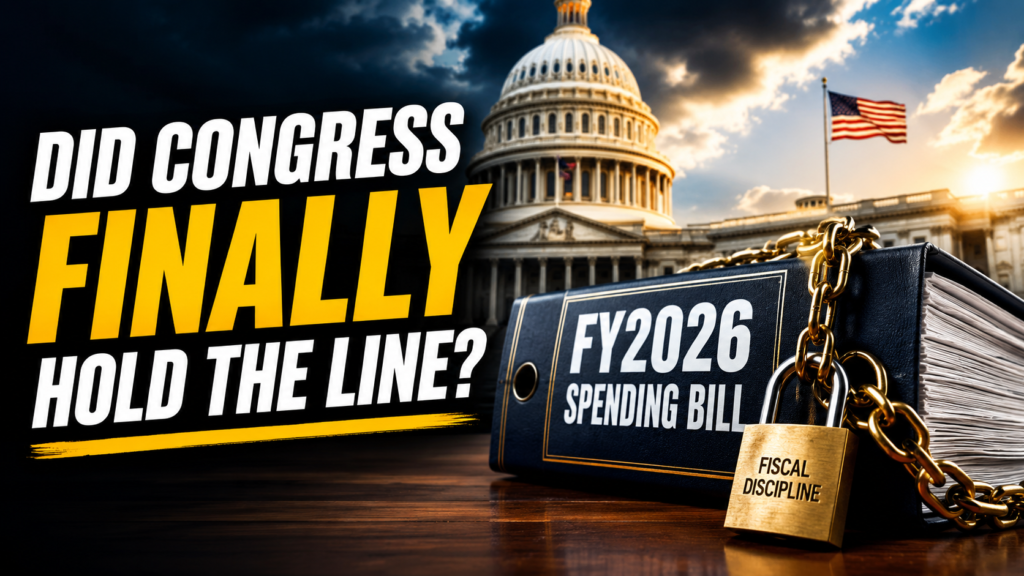
As Washington closes the books on all twelve FY2026 appropriations bills, a bigger question looms: did lawmakers actually restore fiscal discipline, or just relabel the same borrowing?
Congress just closed out a full year of spending bills. That alone is rare.
For the first time in years, the House pushed all twelve Fiscal Year 2026 appropriations measures through to completion, rather than relying on stopgap continuing resolutions. Republican leaders called it a return to “regular order.” But the path to get there included a partial government shutdown, a party-line final vote, and a federal deficit that grew regardless of which bills passed. That combination is exactly why fiscally minded Americans should look past the celebratory press releases and ask what “finishing the job” actually cost.
Support Independent Local Journalism
TheTownHall.News is a non-profit reader-supported journalism. Just $5 helps us hire local reporters, investigate important issues, and hold public officials accountable across Alameda County. If you believe our community deserves strong, independent journalism, please consider donating $5 today to support our work.What Did Congress Actually Pass?
On January 22, 2026, the House passed H.R. 7148, the Consolidated Appropriations Act, 2026, by a lopsided 341–88 vote. The same day, it passed H.R. 7147, the Department of Homeland Security Appropriations Act, 2026, by a narrower 220–207 margin. House Appropriations Chairman Tom Cole (R-OK) called the DHS bill “the final measure in our FY26 agenda,” marking the House’s completion of all twelve annual funding bills for the first time in this Congress.
That vote alone looked like a fiscal accountability win. A broad bipartisan majority backing a full-year funding package is not something Washington produces often. Compare that to the last decade, when Congress routinely relied on massive year-end omnibus packages spanning thousands of pages, voted on with only days of notice. Passing separate bills, each debated on its own merits, is the kind of process fiscal conservatives have demanded for years.
Why Did a “Finished” Budget Trigger a Shutdown?
Here is where the story gets complicated. The Senate did not simply accept the House’s work. It amended H.R. 7148, adding a provision from Senator Susan Collins providing continuing appropriations for the Department of Homeland Security, and passed that amended version 71–29 on January 30. When the bill came back to the House, the changes were significant enough to blow up the original deal.
If Congress can pass a bill on a 341–88 vote and still trigger a shutdown weeks later, was the deal ever really finished?

The result was a four-day partial government shutdown. Federal agencies faced funding lapses, and the “final” FY2026 agenda was suddenly back on the table. Regular order, it turned out, did not mean a smooth landing. To be fair, the underlying funding levels for defense, labor, health, education, and transportation had already been locked in through the earlier full-year bills. What collapsed was narrower: a fight over how to fund homeland security operations while final language was negotiated.
Did the Final Vote Show Unity or Division?
On February 3, 2026, the House voted to concur with the Senate’s amendments. The bill passed, but by a razor-thin 217–214 margin, a stark contrast to the earlier 341–88 vote on the same underlying legislation. President Trump signed it into law that same day, ending the shutdown.
That swing matters. A bill that once drew nearly 80 percent support in the House barely cleared a majority once amended. A 341-vote landslide becoming a 217-vote nail-biter is not fiscal consensus — it’s fiscal whiplash. Supporters will point to the fact that funding ultimately passed without further disruption. Skeptics will note that “finishing” FY2026 required a shutdown most of Congress claimed to want to avoid in the first place.
What Do the Numbers Actually Tell Us?
Passing bills is not the same as controlling spending. The Congressional Budget Office projected on February 11, 2026, that the FY2026 federal deficit would reach $1.853 trillion, or about 5.8 percent of gross domestic product. By the end of March, the government’s cumulative deficit for the fiscal year had already reached $1.2 trillion.
$1.853 trillion. The question no one on the House floor wanted to answer: how much of that was actually reduced by “finishing” the FY2026 process?
Support Independent Local Journalism
TheTownHall.News is a non-profit reader-supported journalism. Just $5 helps us hire local reporters, investigate important issues, and hold public officials accountable across Alameda County. If you believe our community deserves strong, independent journalism, please consider donating $5 today to support our work.Part of the answer lies in what Congress doesn’t fully control. In FY2026, roughly 75 percent of federal spending is mandatory — Social Security, Medicare, Medicaid, and interest on the debt — leaving only about a quarter of the budget subject to the annual appropriations fight lawmakers just celebrated finishing. Net interest payments alone are projected at roughly $1.039 trillion for FY2026, now one of the largest line items in the entire federal budget, larger than what the government spends on national security.
Is completing twelve spending bills really a fiscal victory if the deficit grows no matter what gets signed?
Some of the deficit picture is more complicated than a single number suggests. Individual and payroll tax collections rose roughly 9 percent through the first four months of FY2026 compared with the year before, and customs duties, boosted by expanded tariffs, jumped sharply over the same span, adding tens of billions in new revenue. Revenue is climbing. So is spending. And so is the deficit — evidence that revenue growth alone has not been enough to offset how much Washington continues to spend.
Who Is Really Paying for This Outcome?
Every taxpayer inherits the difference between what Washington spends and what it collects. When discretionary spending fights consume headlines while mandatory spending and interest costs quietly do the real damage to the balance sheet, voters can be forgiven for feeling like the fiscal debate they’re shown isn’t the one that matters most. For a household budgeting on a fixed income, spending more than you take in every single year, no matter the vote count behind it, would be considered a crisis rather than a legislative accomplishment.
That’s not a partisan claim — it’s arithmetic. Interest costs are projected to consume more than a quarter of total tax revenue within a decade, and the CBO projects the deficit-to-GDP ratio will average roughly 6.1 percent over the next ten years. No vote count, however lopsided, changes that trajectory on its own.
What Do Supporters of This Policy Actually Believe?
Supporters of how FY2026 unfolded make a reasonable case worth engaging directly: for the first time in years, Congress completed all twelve appropriations bills instead of punting to omnibus packages or endless continuing resolutions. They argue that individual bills passing through committee, debated separately, and voted on their own merits represent exactly the “regular order” process that fiscal conservatives have demanded for years. They also point out that the final DHS-related dispute was resolved in days, not weeks, limiting the shutdown’s damage compared to past standoffs, and that a functioning appropriations process is itself a form of accountability voters should welcome.
That argument has real merit. Process matters, and returning to bill-by-bill appropriations is a structural improvement over cramming everything into one take-it-or-leave-it package at the last minute. But process improvements and spending discipline are two different achievements. Completing the paperwork on time does not, by itself, shrink a $1.853 trillion deficit or slow the growth of mandatory spending and interest costs that dwarf anything decided in the discretionary fight. It also does not resolve the deeper structural issue: as long as three-quarters of the budget runs on autopilot, no amount of hard-fought discretionary votes can, by itself, bend the long-term debt curve. Both things can be true at once — and voters deserve credit for noticing that.
Is This the Accountability Moment Taxpayers Were Promised?
Congress will tell you it kept its word by finishing the FY2026 budget on a bill-by-bill basis. That claim isn’t false. But “on time” and “under control” are not synonyms, and the deficit figures make that distinction unavoidable.
The real test isn’t whether twelve bills got signed. It’s whether the spending inside them, and the mandatory obligations Congress still won’t touch, actually change the fiscal trajectory the country is on.
What do you think — did Congress hold the line, or just move the finish line? Share this and let us know.
The question isn’t whether Washington can pass a spending bill. It’s whether anyone in Washington is still willing to ask what happens when passing one isn’t enough.