California Wildfire Prevention: 400 Goats Outperform State Spending
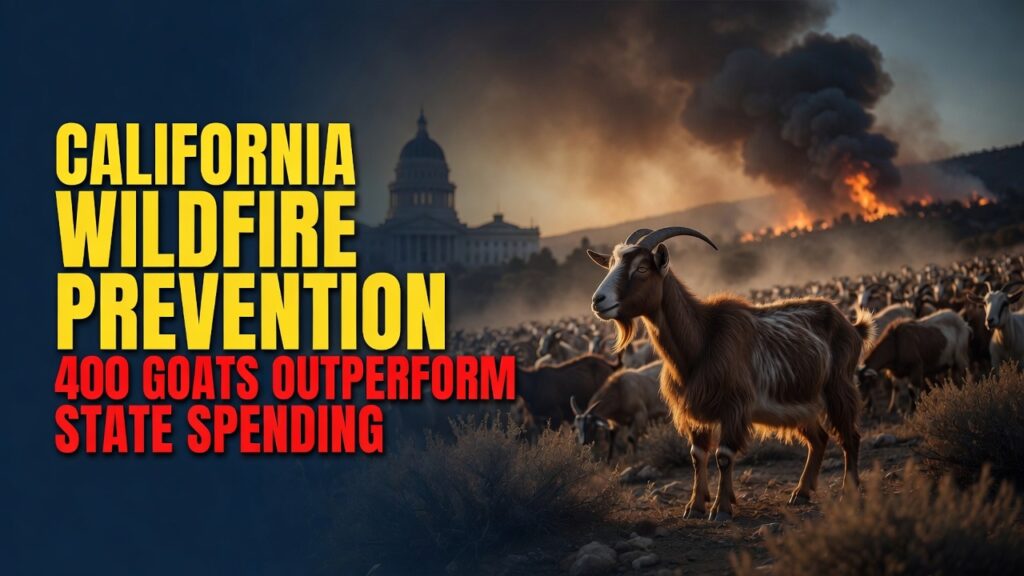
As Sacramento’s wildfire budget keeps climbing past $4 billion a year, a small herd of goats in Fresno is quietly raising a question the state hasn’t answered: why does the cheap solution keep working better than the expensive one?
Four hundred goats just did something California’s multibillion-dollar wildfire bureaucracy has struggled to do efficiently: clear dangerous brush, on time, on budget, without a single legislative hearing.
In northeast Fresno this month, the city partnered with the Sierra Resource Conservation District to turn loose a herd of more than 400 goats and sheep on roughly 180 acres near Woodward Park. Their target is yellow star thistle, a spiny invasive weed that chokes out native plants and adds dangerous fuel to California’s already explosive wildfire risk. The herd is expected to graze for eight weeks, and as they eat the plant’s seeds, those seeds pass through their digestive systems and become nonviable, stopping the weed from coming back next year.
Support Independent Local Journalism
TheTownHall.News is a non-profit reader-supported journalism. Just $5 helps us hire local reporters, investigate important issues, and hold public officials accountable across Alameda County. If you believe our community deserves strong, independent journalism, please consider donating $5 today to support our work.It is a small, practical, low-cost success story. And it is happening at the same time California taxpayers are pouring billions into a wildfire prevention system that critics say has grown bigger without necessarily growing better.
Is Simple, Local Problem-Solving Outperforming a Multibillion-Dollar Bureaucracy?
The Fresno grazing project did not require a new state agency, a task force, or a nine-figure appropriation. It required a phone call to a local grazing operator in Fowler, a fence line, and animals that already knew what to do. Rebecca Ozeran, a certified resource manager with the Sierra Resource Conservation District, told ABC30 the goats and sheep go straight for the thistle’s spiny flowers, “even when they’re pokey as heck,” eating the seeds and preventing the next generation of the plant from returning.
This is not an isolated experiment. Caltrans has used goat herds for firebreaks along Highway 101 in Sonoma County. West Sacramento has hired goats since 2014, and in 2022 a herd of 400 helped stop a fire from reaching more than 250 homes after the animals had already cleared underbrush earlier that season. Anaheim keeps roughly 400 goats working nearly year-round in Deer Canyon Park. These are not fringe pilot programs. They are a track record.
What Do the Numbers Actually Tell Us About State Wildfire Spending?
CAL FIRE’s budget was $2.5 billion in the 2018-19 fiscal year, the year before Gavin Newsom took office [state budget act data]. By 2025-26, the Legislative Analyst’s Office reports the agency’s budget had grown to $4.5 billion, with staffing rising from roughly 7,182 positions to more than 12,500 [Legislative Analyst’s Office]. That is a near doubling of both money and headcount in under a decade.

$4.5 billion. The question Sacramento rarely answers in plain terms: what is the state getting for that money that a fenced-in herd of goats could not deliver for a fraction of the cost?
None of this means CAL FIRE’s firefighting mission is unnecessary. Aircraft, engines, and trained crews matter when a fire is already burning. But vegetation management — the unglamorous work of removing fuel before a spark ever arrives — is exactly the kind of task where a $150,000 seasonal grazing contract, roughly what West Sacramento reportedly paid for its goat herd one summer, invites an obvious comparison to line items that run into the hundreds of millions.
Who Is Really Paying the Price When Prevention Gets Complicated?
Every Californian living near wildland pays for wildfire risk twice: once through taxes that fund state agencies, and again through insurance premiums, evacuation costs, and property losses when prevention falls short. The 2025 Eaton and Palisades fires alone caused an estimated $76 billion to $131 billion in damage [Resources for the Future estimate]. A 2025 analysis from Resources for the Future found California would need $225 million to $1.8 billion annually just for vegetation management to meaningfully reduce risk in high-danger zones — and current combined state and federal spending barely covers the lowest end of that range.
If a fenced herd of animals can clear 180 acres of fire fuel for the cost of a contract, why does removing brush from the rest of the state remain so expensive and so slow?
That is not a rhetorical trick. It is the question taxpayers are entitled to ask every time a new wildfire funding request lands in Sacramento.
Support Independent Local Journalism
TheTownHall.News is a non-profit reader-supported journalism. Just $5 helps us hire local reporters, investigate important issues, and hold public officials accountable across Alameda County. If you believe our community deserves strong, independent journalism, please consider donating $5 today to support our work.“It almost looks like a moonscape after they go through. They’re good for the environment, and everyone around here loves them.” — a West Sacramento city spokesman, describing a 400-goat herd credited with helping stop a fire before it reached a residential neighborhood.
Why Are More Cities Quietly Turning to Goats Instead of Government Contracts?
Anaheim, Sonoma County, West Sacramento, and now Fresno did not choose grazing because it was trendy. They chose it because it works in terrain and situations where mowers, herbicide crews, and heavy equipment struggle — steep hillsides, brush too thick for machinery, and land where chemical spraying is restricted or unwanted. Goats climb where trucks cannot go. They leave behind pellets instead of flammable clipped debris. And because they eat the seeds along with the plant, they attack the problem at its root instead of simply mowing the surface for next season’s regrowth.
This is the kind of solution that limited-government advocates have pointed to for years: local governments and private contractors solving a public problem directly, without layering in new bureaucracy and without asking Sacramento for a bigger check first.
What Do Supporters of California’s Current Wildfire Spending Actually Believe?
Supporters of the state’s expanded wildfire budget make a fair point worth engaging directly: goats cannot fly a firefighting helicopter, staff an engine company, or manage a 50,000-acre blaze once it is already burning. California’s terrain, drought conditions, and wildland-urban interface genuinely require a large, well-funded, professional firefighting force, and the doubling of CAL FIRE’s personnel has put more boots on the ground during active emergencies.
That argument holds up for suppression and emergency response. It holds up far less well for prevention. Grazing projects like Fresno’s are not a substitute for firefighters battling an active blaze; they are a substitute for expensive mechanical clearing and herbicide contracts used to prevent that blaze from starting in the first place. The honest question is not goats versus firefighters. It is whether every dollar spent on the slower, costlier side of prevention is actually buying more safety than a fraction of that dollar spent on grazing contracts already proven to work.
Is This the Accountability Moment Taxpayers Have Been Waiting For?
Fresno’s 400 goats will not fix California’s wildfire budget on their own. But they are a working, documented example that inexpensive, low-bureaucracy solutions can produce real results — results a state agency with a $4.5 billion budget should be able to explain, replicate, and scale far faster than it currently does. Every acre cleared by a grazing contract instead of a slower government process is a test of whether Sacramento’s growing wildfire spending is producing results proportional to its size.
Californians do not need to romanticize goats to ask a straightforward, fiscally responsible question: before the next multibillion-dollar wildfire request reaches the state budget, has anyone in Sacramento seriously asked what a herd of goats could have done for less?
Key Questions This Story Raises
- If low-cost grazing contracts already prevent wildfires in Fresno, Sonoma, West Sacramento, and Anaheim, why isn’t the approach scaled statewide faster?
- With CAL FIRE’s budget nearly doubling since 2018, what specific results justify that growth beyond the prevention work grazing herds already deliver cheaply?
- Should state and county wildfire budgets be required to show why cheaper, proven alternatives like targeted grazing were not used before approving costlier contracts?
The real question isn’t whether goats can help prevent wildfires — it’s whether the state will admit how much money it could save by using more of them.
Still have questions about how your tax dollars are spent on wildfire prevention? Stay informed — subscribe for daily coverage from The Town Hall News. Think your neighbors need to see this? Share the article. Want your voice to count? Contact your county board of supervisors or state assembly representative and ask whether local grazing contracts are being considered for fuel reduction in your area before the next wildfire season begins.