Section 219 NDAA Vote Explained: What Congress Blocked and Why
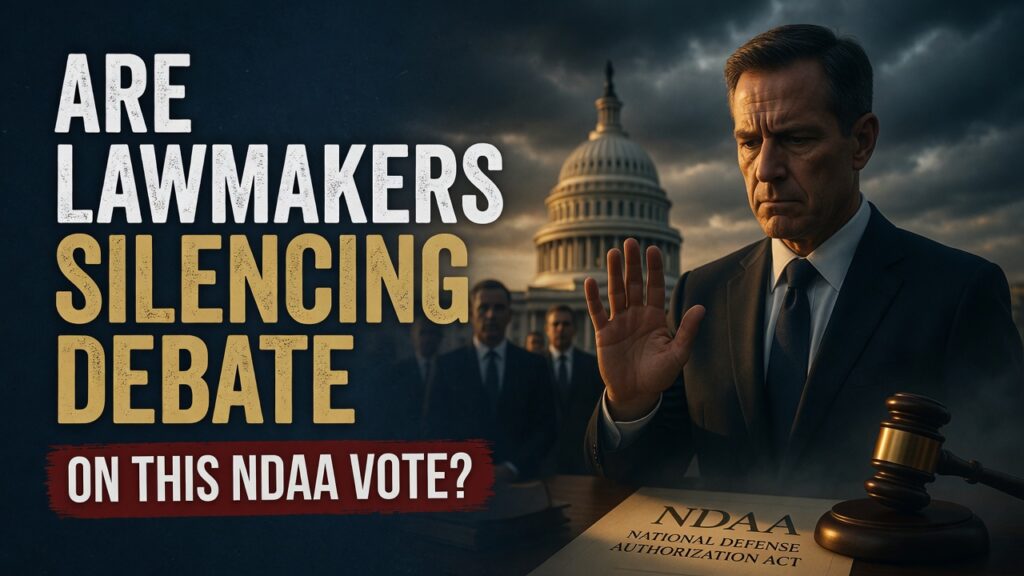
A rare bipartisan coalition tried to force a vote on removing a controversial military provision. House leadership wouldn’t let them. Now Americans are asking who this bill actually answers to.
Congress just passed a trillion-dollar defense bill — and blocked its own members from voting on one of its most disputed provisions. That’s not a footnote. That’s a process problem.
On Wednesday, the House approved the fiscal year 2027 National Defense Authorization Act, H.R. 8800, sending it to the Senate. Buried inside is Section 219, a provision creating a permanent U.S.-Israel Defense Technology Cooperation Initiative. Before members could vote on the bill itself, the House Rules Committee blocked a floor vote on a bipartisan amendment that would have stripped Section 219 out entirely.
Support Independent Local Journalism
TheTownHall.News is a non-profit reader-supported journalism. Just $5 helps us hire local reporters, investigate important issues, and hold public officials accountable across Alameda County. If you believe our community deserves strong, independent journalism, please consider donating $5 today to support our work.What Exactly Is Section 219?
Section 219, formerly numbered Section 224, would establish a formal, ongoing initiative linking U.S. and Israeli defense technology and supply chains. Under the provision, the Secretary of Defense would be required to designate a Pentagon executive agent responsible for coordinating efforts with Israeli defense officials, developing an implementation plan, and reporting back to congressional defense committees [reporting: Military.com, citing House Armed Services Committee explanation].
Supporters describe this as a technical expansion of existing bilateral cooperation — the kind of joint research-and-development work the U.S. already does with several allies. Critics describe it differently: as the beginning of a structural, statutory merger of defense supply chains that Congress will have far less ability to unwind once it’s written into law. Whichever framing you accept, one fact isn’t in dispute: lawmakers were never allowed to vote on removing it.
Why Wasn’t This Provision Allowed a Vote?
Reps. Thomas Massie (R-Ky.) and Ro Khanna (D-Calif.) co-sponsored an amendment to strike Section 219 from the bill. It never reached the floor. The House Rules Committee — which controls what amendments even get a vote — declined to make it eligible for consideration [reporting: The Intercept].
That’s the part that should concern anyone who cares about how Congress actually functions, regardless of what you think of the underlying policy. Massie called the provision “dangerous,” warning that “codifying the integration of our military technology and supply chains with those of any other country” sets a precedent Congress may not be able to walk back. A separate attempt by Rep. Anna Paulina Luna (R-Fla.) to strike the provision was also denied a vote.

Is it possible to have an honest debate about American sovereignty if the debate itself gets blocked before it starts?
Who Voted How — And Why It Matters
The final tally reported by The Intercept and Fox News was 216-212, largely along party lines — though other outlets reported different totals before the vote was formally closed, underscoring how contested and fast-moving this process was. What’s consistent across reporting: seven Republicans crossed party lines to vote no — Massie, along with Reps. Josh Brecheen (Okla.), Tim Burchett (Tenn.), Eli Crane (Ariz.), Harriet Hageman (Wyo.), Anna Paulina Luna (Fla.), and Chip Roy (Texas).
Six Democrats voted yes: Reps. Henry Cuellar (Texas), Don Davis (N.C.), Jared Golden (Maine), Vicente Gonzalez (Texas), Adam Gray (Calif.), and Marie Gluesenkamp Perez (Wash.) [reporting: The Intercept, Fox News].
Seven Republicans and six Democrats broke ranks on the same bill — for opposite reasons. That’s not a normal vote. Democratic opposition wasn’t limited to Section 219 either; much of the caucus also objected to Republican-backed amendments on transgender care for troops and firearms access on military bases, which pulled Democratic support for the bill down to a fraction of its usual bipartisan total [reporting: Fox News].
What Do Supporters of This Policy Actually Believe?
Supporters of Section 219 argue the criticism is overblown and, in some cases, dishonest. Rep. Mike Lawler (R-N.Y.) directly rejected the “merger” framing used by critics, telling Rep. Alexandria Ocasio-Cortez (D-N.Y.) on social media, “We are not merging our military with the IDF” [reporting: Fox News]. On this view, Section 219 simply formalizes and expedites defense-technology cooperation the U.S. already conducts with a close ally — creating an accountable structure, complete with a designated Pentagon official and mandatory reporting to Congress, rather than a loose or informal arrangement.
That’s a fair point on its face: formal reporting requirements are, in principle, more transparent than ad hoc cooperation. But it doesn’t answer the process objection. Whether Section 219 is modest or sweeping, members of Congress — from Massie on the right to Khanna on the left — were denied the chance to even debate it on the record. A policy can be defensible and still deserve an up-or-down vote. Congress denied itself that vote.
Support Independent Local Journalism
TheTownHall.News is a non-profit reader-supported journalism. Just $5 helps us hire local reporters, investigate important issues, and hold public officials accountable across Alameda County. If you believe our community deserves strong, independent journalism, please consider donating $5 today to support our work.What Happens Next in the Senate?
The bill now moves to the Senate, which is working from its own version of the NDAA. A conference committee will eventually negotiate a single final bill. Sen. Bernie Sanders (I-Vt.) has emerged as the most vocal Senate critic of Section 219, and Khanna has already said he intends to “fight to strip this amendment in the conference between the House and the Senate” [reporting: Common Dreams].
$1.15 trillion. That’s the size of the defense bill this provision rides inside of — the question no one asked before the vote was blocked: how many members actually understood what they were authorizing?
That funding scale is precisely why process matters here. A provision this consequential, tucked into a bill this large, is exactly the kind of thing an up-or-down floor vote exists to catch — and exactly the kind of thing that gets buried when leadership decides debate isn’t worth the time.
Why Are So Many Americans Starting to Ask Questions?
Because this isn’t really a story about Israel. It’s a story about whether the people elected to represent you get to vote on what you’re bound by. If your own representative can’t get a floor vote on stripping a provision from a trillion-dollar bill, who exactly is running Congress?
Massie put it plainly: “our founders would be appalled at what Congress is doing now” [reporting: Common Dreams]. You don’t have to agree with his politics to recognize the underlying concern — a legislature that can quietly foreclose debate on its own most controversial provisions isn’t functioning the way it’s supposed to.
Key Questions This Story Raises
- Why did the House Rules Committee block a floor vote on removing Section 219, when members on both sides of the aisle wanted one?
- If Section 219 is as narrow as supporters claim, why avoid a direct, on-record vote to prove it?
- Will the Senate allow the debate the House didn’t — and will Section 219 survive conference?
A Question Worth Sitting With
Set aside where you land on U.S.-Israel policy. The real question this vote raises is simpler and applies no matter your politics: can Congress still be trusted to debate its own bills in the open? Section 219 may or may not deserve to survive the Senate. But the way it got here — advanced without the vote its own members asked for — is the part every American should be watching.
The real question isn’t whether Section 219 gets stripped in conference. It’s whether Congress will ever let its members vote on it at all.
Still have questions about how your representative voted? Stay informed — subscribe for daily coverage.
Think others need to see how this vote actually went down? Share this article.
Want your voice to count before the Senate conference? Contact your senators’ offices directly and ask where they stand on Section 219 before the final NDAA is negotiated.