NFA Suppressor Registration Ruling: What Gun Owners Need to Know
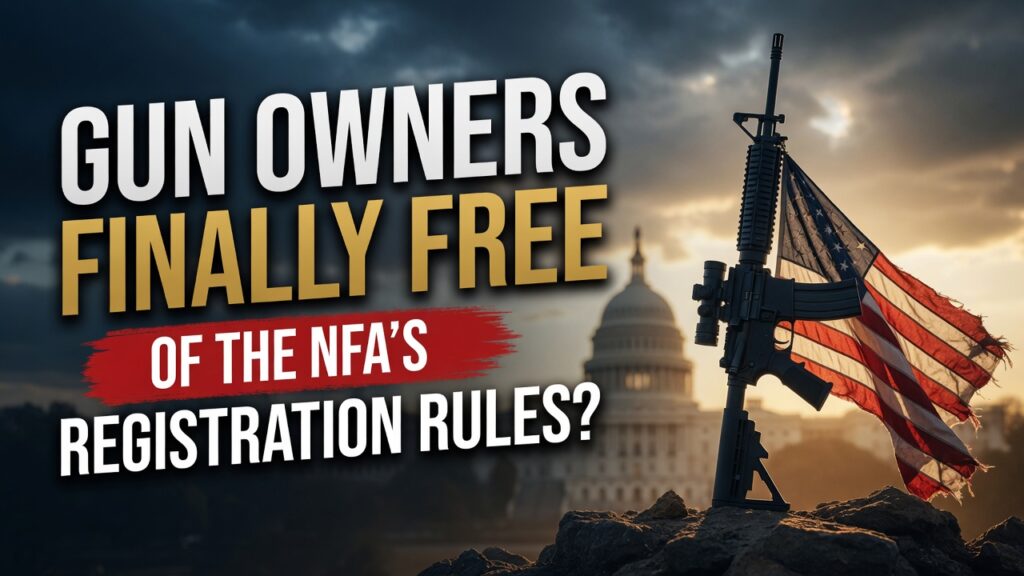
A federal judge just ruled that decades of NFA paperwork can no longer be enforced — but the government has already signaled it isn’t giving up without a fight. Here’s what actually changed, and what didn’t.
A federal judge just told the ATF it has run out of legal authority.
On August 5, 2026, U.S. District Judge James Wesley Hendrix ruled that major provisions of the National Firearms Act are unconstitutional as applied to suppressors, short-barreled rifles, short-barreled shotguns, and a category of firearms known as “any other weapons.” The registration scheme that has governed those items since 1934 — fingerprints, photographs, a months-long federal wait — no longer has a legal leg to stand on, at least for the plaintiffs who sued to strike it down.
Support Independent Local Journalism
TheTownHall.News is a non-profit reader-supported journalism. Just $5 helps us hire local reporters, investigate important issues, and hold public officials accountable across Alameda County. If you believe our community deserves strong, independent journalism, please consider donating $5 today to support our work.Why Did This Ruling Happen Now?
The answer traces back to Congress, not the courts. When lawmakers passed the 2025 reconciliation bill, they zeroed out the $200 transfer tax that had funded and justified NFA registration for suppressors and short-barreled firearms since the Roosevelt administration. The tax cut took effect at the start of this year. Gun-rights groups argued that once the tax hit zero, the registration apparatus built to collect it lost its constitutional foundation. Judge Hendrix, a Trump appointee sitting in the Northern District of Texas, agreed.
In a 66-page opinion granting summary judgment in Silencer Shop Foundation v. ATF, consolidated with a related case, Hendrix wrote that the NFA’s regulatory provisions “cannot be upheld under the taxing power” because they no longer generate any revenue. Congress, he found, never invoked any other constitutional authority when it wrote those provisions. The registration scheme, in his words, must be enjoined because it exceeds Congress’s enumerated powers.
What Exactly Did the Court Strike Down?

The ruling targets the paperwork, not the products. Form 1 applications to manufacture a covered item. Form 4 applications to transfer one. The ATF’s approval process and its lengthy processing delays. The federal registry entry created every time someone lawfully acquired a suppressor or short-barreled firearm. All of it, the court held, can no longer be enforced against the plaintiffs in this case.
A federal judge just erased 90 years of paperwork gun owners had no choice but to accept. That is the plain text of a 66-page federal court opinion. The ruling does not touch machine guns, which remain regulated under separate law, and it stopped short of ruling on Second Amendment claims at all. Hendrix decided the case on limited-government grounds: Congress cannot maintain a regulatory regime built on a tax that no longer exists.
Who Actually Benefits From This Decision?
For now, the ruling covers named plaintiffs and their members and customers — not every American who wants to buy a suppressor. Court filings identify the Silencer Shop Foundation, Gun Owners of America, the Firearms Regulatory Accountability Coalition, several firearms manufacturers including B&T USA, Palmetto State Armory, and SilencerCo, and fifteen states as parties to the case. Silencer Shop has told its customers the order covers anyone who buys through the company, current and future.
That distinction matters. This is not yet a blanket national policy change. It is a court order binding on specific parties — a narrow, fact-specific ruling rather than a sweeping mandate. Whether the logic eventually applies more broadly depends on further litigation and, quite possibly, the Fifth Circuit.
Support Independent Local Journalism
TheTownHall.News is a non-profit reader-supported journalism. Just $5 helps us hire local reporters, investigate important issues, and hold public officials accountable across Alameda County. If you believe our community deserves strong, independent journalism, please consider donating $5 today to support our work.6.4 million. That’s how many suppressors were already sitting in the federal registry as of June, according to ATF data [government data]. What happens to that registry now that the law behind it has been struck down?
Is the Government Already Trying to Undo This?
Judge Hendrix stayed his own ruling for seven days, giving the Department of Justice a window to appeal before the order takes effect. That stay is set to expire around August 12, though it can be extended while an appeal proceeds. The Justice Department has not indicated whether it will seek emergency relief, but few expect the administration to let a ruling this significant go unchallenged.
An appeal would likely land at the Fifth Circuit, which has not been uniformly receptive to challenges against the NFA. Months before this ruling, a Fifth Circuit panel upheld an NFA suppressor conviction on separate Second Amendment grounds, reasoning that registration functions like the “shall-issue” licensing regimes the Supreme Court has already approved. That precedent used a different legal theory than Hendrix relied on, but it signals the appellate court won’t rubber-stamp this ruling.
What Do Supporters of Stricter Gun Regulation Actually Believe?
Groups that favor tighter firearms restrictions raise a specific, legitimate concern worth engaging honestly: the NFA registration process included a background-check-style review, and gun-control advocates argue that losing it removes a meaningful safety layer. The Giffords Law Center has said the process functioned as a heightened background check because it required notifying local law enforcement and allowed applications to be denied for cause.
That argument deserves a direct answer, not a dismissal. Standard federal background checks through the National Instant Criminal Background Check System still apply — that requirement comes from separate law untouched by this ruling. What disappears is a second, NFA-specific layer of paperwork, not the background check every gun buyer already completes. The real question is whether a months-long federal approval process was ever a safety necessity, or whether it was a tax-enforcement mechanism that outlived the tax it was built to collect. Hendrix’s opinion says it was the latter.
Why Does This Matter Beyond Gun Owners?
This case is bigger than suppressors. It tests whether federal agencies can keep enforcing a regulatory structure after Congress removes its legal basis — a principle that reaches far beyond firearms, into whether agencies answer to the law as written or to the law as they wish it still existed.
“No longer can the challenged NFA provisions be justified — as they have been for nearly 90 years — under Congress’s taxing power.”
That single line from Hendrix’s opinion captures the entire case. For nearly a century, Americans accepted fingerprinting, photographing, and months of federal waiting as the price of owning a legal, common firearm accessory. The court just said the price was never actually about safety — it was about a tax that no longer exists.
Key Questions This Ruling Raises
Will this ruling survive an appeal to the Fifth Circuit, or will the stay simply be extended indefinitely while the case drags on? Does the logic extend beyond the named plaintiffs to every American who wants to buy a suppressor without federal registration? And if a 90-year-old regulatory scheme can be struck down this quickly once its funding disappears, what does that say about how many other federal rules are standing on similarly hollow legal ground?
Where Does This Leave Gun Owners Right Now?
Nothing changes immediately for most buyers. State law still applies regardless of federal action — several states restrict or ban suppressors outright, and this ruling does not touch those laws. For buyers elsewhere, the practical effect depends entirely on whether the stay expires, gets extended, or gets overturned on appeal.
If a federal agency can no longer point to a valid law to justify its own paperwork, why should anyone still have to fill it out? That is the question this case ultimately forces Washington to answer, and it is not going away regardless of what happens on appeal.
Has the ATF Finally Run Out of Road?
For ninety years, the National Firearms Act operated on the assumption that its registration requirements were permanent fixtures of federal law. This ruling challenges that assumption directly, and it does so using the same limited-government, rule-of-law reasoning that conservatives have applied to agency overreach for decades: an agency’s power to regulate cannot outlive the constitutional authority Congress actually gave it.
The fight is not over. An appeal is likely. The stay could be extended past August 12. And the NFA itself remains on the books, even if this particular enforcement mechanism does not survive. But for the first time in nearly a century, a federal court has said out loud what gun-rights advocates have argued for years: the paperwork outlived its purpose.
The real question isn’t whether the government will fight to keep this rule alive — it’s whether the law is still on its side.
What do you think — should Congress simply repeal NFA registration outright rather than leave it to the courts? Share this article and let us know. Still have questions about what this means for your state? Subscribe for daily coverage as this case moves through appeal. Want your voice heard on this? Contact your congressional representative and ask where they stand on NFA reform.