Roblox Stock Decline 2026: $70 Billion Lost, Why Investors Are Worried
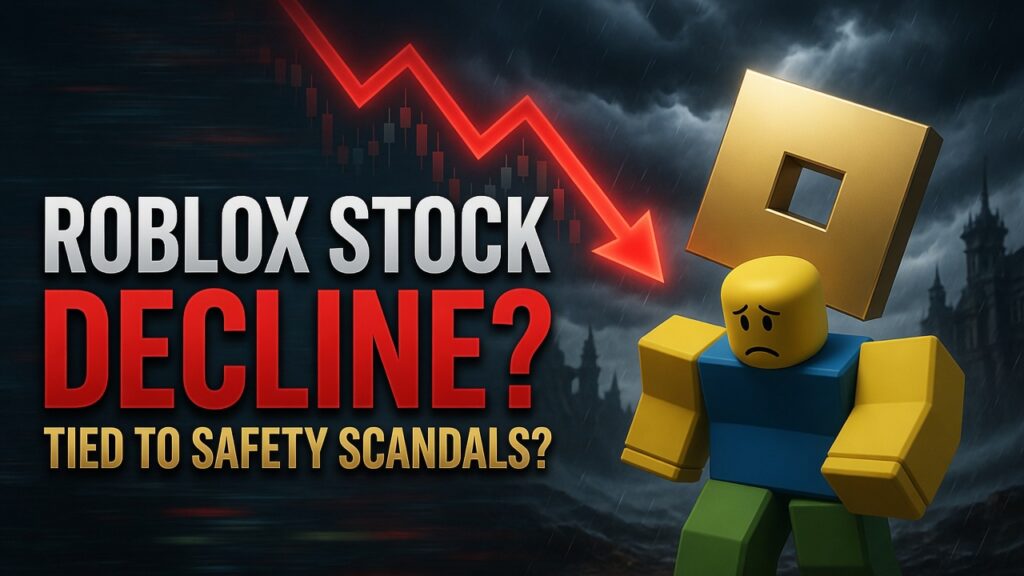
As Roblox tells investors its slump comes down to a lack of hit games, state attorneys general across the country are building a very different case — and millions of parents are watching closely.
Roblox just lost $70 billion in market value. That is not a rounding error.
The company’s own Q2 2026 earnings report, released July 31, offers one explanation: a shortage of viral games. But that explanation arrives during the same stretch in which at least a half-dozen state attorneys general have sued or settled with Roblox over child safety failures, and a federal securities fraud case now questions whether the company was straight with investors in the first place. Shareholders and parents are left asking the same basic question: is Roblox telling the whole story?
Support Independent Local Journalism
TheTownHall.News is a non-profit reader-supported journalism. Just $5 helps us hire local reporters, investigate important issues, and hold public officials accountable across Alameda County. If you believe our community deserves strong, independent journalism, please consider donating $5 today to support our work.What Do Roblox’s Own Numbers Actually Show?
Roblox’s daily active users fell to 123 million in the second quarter of 2026, down from a peak of 152 million just a year earlier, according to the company’s own quarterly disclosures. Bookings, the company’s core measure of player spending, grew only 8 percent year over year — a fraction of the growth rates that once justified Roblox’s soaring valuation. Shares are down roughly 70 percent over the past twelve months.
Perhaps most telling: Roblox declined to provide full-year financial guidance. For a publicly traded company, withholding guidance is rarely a sign of confidence. It signals that management itself cannot say with certainty where the business is headed. Chief Financial Officer Naveen Chopra attributed the shortfall to engagement shifting away from high-monetizing “2025 vintage” viral games toward newer, lower-revenue experiences, a shift he said was compounded by changes to the platform’s recommendation algorithm.
That is a plausible business explanation. It is also an incomplete one.

Why Does the Timing Matter Right Now?
Roblox’s stock did not decline in a vacuum. Over the same period, Texas Attorney General Ken Paxton sued the company, accusing it of prioritizing profit over child safety. Nebraska Attorney General Mike Hilgers filed suit in March alleging Roblox knowingly maintained an environment that exposed children to predators while misrepresenting its safety record to parents. Oklahoma and Arkansas followed with their own lawsuits, the latter describing Roblox and Discord together as functioning like a coordinated predatory pipeline.
A company doesn’t lose $70 billion in value overnight without investors asking hard questions about what leadership isn’t saying.
Roblox has already paid a price beyond its stock chart. Alabama secured a $12.2 million settlement in April, funding school resource officers statewide. South Dakota followed in July with a nearly $10 million settlement that requires Roblox to roll out facial age-estimation and government-ID-based age verification. More than 160 individual family lawsuits have been consolidated into a federal multidistrict litigation in the Northern District of California. None of this appeared in Roblox’s earnings call.
Who Is Really Being Asked to Pay the Price Here?
Support Independent Local Journalism
TheTownHall.News is a non-profit reader-supported journalism. Just $5 helps us hire local reporters, investigate important issues, and hold public officials accountable across Alameda County. If you believe our community deserves strong, independent journalism, please consider donating $5 today to support our work.Parents who trusted Roblox’s marketing as a safe, child-friendly platform are now confronting lawsuits that allege the opposite was true for years. Investors who bought shares based on growth projections are now facing a securities fraud class action alleging management overstated the success of its age-verification rollout before the stock fell sharply after April’s earnings disclosure. Taxpayers in states like Alabama and South Dakota are only now seeing settlement dollars flow toward school safety programs that critics say should never have been necessary in the first place.
If a public company can lose three-quarters of its value while facing lawsuits in half a dozen states, shouldn’t shareholders have been told sooner?
This is where personal responsibility and corporate accountability intersect. Roblox built a platform that, by its own account, reaches two-thirds of American children ages 9 to 12. With that scale comes an obligation — not just to shareholders chasing growth, but to the families who trusted the platform with their kids. When a company’s public explanation for a financial collapse omits a wave of state-level legal action over child safety, that is not simply an incomplete earnings call. It is a credibility problem.
What Do the Numbers Actually Tell Us?
$70 billion. That is how much Roblox has lost in market value over the past year. The question no shareholder should let go unanswered: how much of that decline traces back to a company culture that consistently prioritized growth metrics over the safeguards regulators say were long overdue?
Roblox’s algorithm change, which the company says now favors long-term user retention over near-term monetization, is a legitimate business strategy. But retention only matters if parents keep letting their kids on the platform in the first place — and multiple attorneys general allege that trust has been eroding for reasons that have nothing to do with which games go viral.
Growth and safety cannot be treated as separate line items when the same audience — children — drives both.
Is this the accountability moment investors and parents have been waiting for — or just the beginning of a much longer reckoning?
Is This the Accountability Moment Investors and Parents Have Been Waiting For?
For years, critics of Big Tech have argued that platforms built around children’s attention operate with too little oversight and too much benefit of the doubt. The current wave of state action against Roblox — spanning Texas, Nebraska, Oklahoma, Arkansas, Alabama, and South Dakota, with additional state investigations reportedly underway — suggests that benefit of the doubt is running out. Multiple state settlements now require concrete safety changes, including age verification measures Roblox had previously resisted implementing at scale.
What Happens If Investors and Regulators Stop Looking the Other Way?
If the pattern holds, Roblox faces a two-front challenge: rebuilding user growth without the reliable viral hits that once drove its valuation, while simultaneously satisfying a growing list of state-mandated safety reforms that will likely cost money and slow platform growth further in the short term. Wall Street rewards growth. Child-safety compliance, by its nature, adds friction. Roblox’s next several quarters will show whether the company can do both — or whether it continues treating one as a financial talking point and the other as a legal inconvenience to be settled quietly, state by state.
What Do Supporters of Roblox’s Position Actually Believe?
Roblox’s defenders make a fair point worth engaging directly: viral hit games are genuinely unpredictable, and no platform can manufacture the next breakout sensation on command. Every major gaming company, from established console makers to mobile app studios, faces cycles where user engagement dips between hits. By this view, Roblox’s slowdown is simply a normal, if painful, business cycle — and conflating it with unrelated safety litigation unfairly stacks the deck against the company.
There is real merit to that argument on its own terms. Viral content is unpredictable everywhere in the entertainment industry, and Roblox is not wrong that its recommendation algorithm changes are a legitimate strategic pivot. But the argument only accounts for half the picture. It does not explain why Roblox omitted any mention of active lawsuits in six-plus states, a securities fraud class action, and a federal multidistrict litigation from its public accounting of a $70 billion decline. Investors deserve a complete picture, not a partial one, and a legitimate business explanation for slowing growth does not excuse silence about ongoing legal exposure that reasonable shareholders would consider material.
Key Questions This Story Raises
- Should Roblox have been required to disclose ongoing state child-safety litigation as a material risk to shareholders before the stock collapsed?
- How much of Roblox’s user decline reflects parents actively pulling their kids off the platform, versus a simple shortage of hit games?
- Will state-mandated safety reforms like age verification become an industry standard other child-focused platforms are forced to adopt?
So Where Does This Leave Roblox — and the Families Who Trusted It?
Roblox’s stock decline may well be driven in large part by a genuine shortage of viral hits, exactly as the company says. But that explanation, standing alone, leaves out a legal and reputational reckoning playing out state by state, courtroom by courtroom. The real question isn’t whether Roblox’s algorithm needs fixing — it’s whether the company can be trusted to tell its shareholders and the parents of its youngest users the full truth about why growth has stalled.
What do you think — should Roblox be required to disclose ongoing state child-safety litigation as a material risk to investors? Share this article and let us know where you stand.
Still have questions about how this affects your family or your portfolio? Stay informed — subscribe for daily coverage from The Town Hall News.
Think other parents or investors need to see this? Share the article.
Want your voice to count? Contact your state attorney general’s consumer protection division to ask whether an investigation into Roblox is already underway in your state.