AI Data Center on Public Land Approved: What Boulder City Found
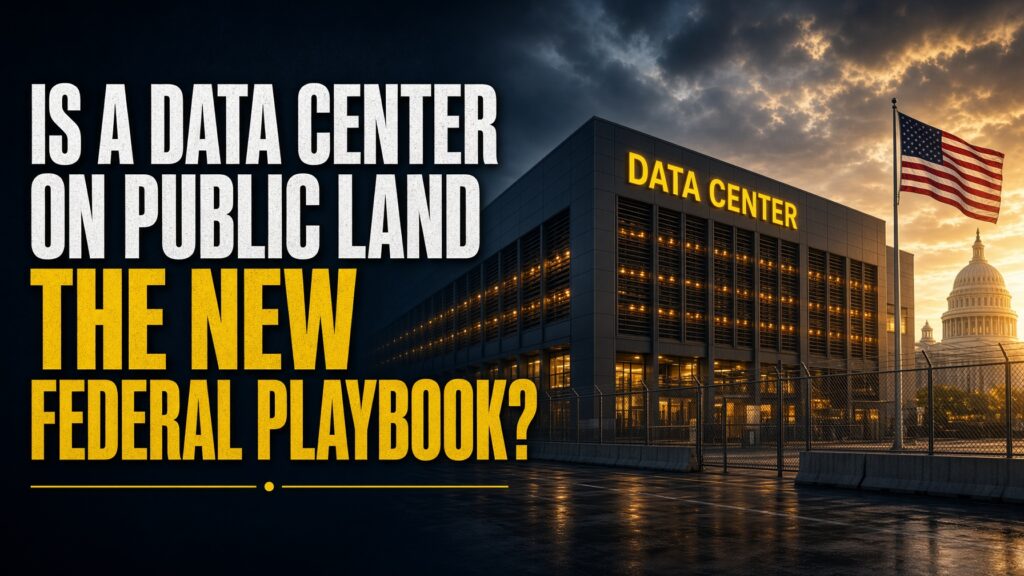
For the first time in U.S. history, federal officials approved an AI data center on land owned by every American — without a new environmental review or a single public hearing. A small Nevada city says it may be the test case for the entire West.
Who gave a Texas developer the right to build a 167-megawatt AI facility on your land? In Boulder City, Nevada, the answer was not the voters, not the planning commission, and not the city council. It was a single federal field office manager, acting alone.
On June 26, 2026, the Bureau of Land Management approved the Townsite Data Center on roughly 85 acres of federally managed desert near the “gateway to Hoover Dam.” [wire-confirmed via multiple regional outlets]. The project skipped a new environmental study, borrowing one written in 2023 for an entirely different project — and that decision is now the center of a fight over who really controls America’s public land.
Support Independent Local Journalism
TheTownHall.News is a non-profit reader-supported journalism. Just $5 helps us hire local reporters, investigate important issues, and hold public officials accountable across Alameda County. If you believe our community deserves strong, independent journalism, please consider donating $5 today to support our work.Why Did the BLM Skip a New Environmental Review?
The land in question was never meant for a data center. In 2023, the BLM approved a right-of-way for Townsite Solar 2, LLC to build a 19-megawatt solar farm with 35 megawatts of battery storage on the site. That review examined the impacts of a facility that produces power. A federal agency reused a three-year-old environmental study written for a solar farm to approve an industrial facility eight times its size — without asking the public a single question.
In late 2025, the developer changed course. It asked BLM to swap the solar project for a 300,000-square-foot data center capable of drawing up to 167 megawatts, according to Boulder City’s own appeal filing. That is roughly triple the electrical load of Boulder City itself. Rather than order a fresh environmental assessment, the BLM field office determined the new use was similar enough to the old one to skip it entirely.
Is Skipping a New Review Even Legal?
Boulder City doesn’t think so. In its July 23 appeal, the city argues the BLM violated both the National Environmental Policy Act and the Federal Land Policy and Management Act by treating a power generator and a power consumer as functionally identical.
A facility that adds power to the grid is not the same as one that pulls three times a city’s electrical load off it — yet federal officials called that a technicality. Attorneys for the city put it more bluntly, writing that the BLM’s reasoning tried to “drive a square peg through a round hole.” The city also says it was never consulted, despite the fact that the data center would still depend on Boulder City’s roads, water, police, and fire services.

Who Is Really Paying for This Decision?
Boulder City did not sit on the sidelines when a similar data center was proposed on city-owned land nearby. Its Planning Commission held hearings, took public comment, and voted 6 to 1 against the project. The developer then withdrew that application entirely.
Days later, the developer secured approval for a nearly identical facility a half-mile away, on land the city doesn’t control. Local officials say that sequence looks less like coincidence and more like a workaround. If a city rejects a project through the process it’s supposed to follow, should a federal agency approve the same project anyway, just a few hundred yards over the line?
What Do the Numbers Actually Tell Us?
167 megawatts. That is the standalone figure at the center of this fight — enough electricity for roughly 75,000 homes, and more than Boulder City itself consumes [per city appeal filing]. Where is that power supposed to come from, in a region already straining under declining Colorado River flows and a shrinking Hoover Dam hydropower supply?
Boulder City’s own appeal warns that Hoover Dam’s hydropower output is expected to drop sharply as Lake Mead levels fall, even as the new facility competes for electricity on the same regional grid. That is a math problem local ratepayers may end up solving.
Is This the Blueprint for Public Land Nationwide?
Federal officials have not been shy about their intentions. The BLM’s own approval documentation states the decision “supports federal efforts to accelerate permitting for data center infrastructure,” and the action was carried out under Executive Order 14318, which explicitly positions the Boulder City approval as a replicable model.
Support Independent Local Journalism
TheTownHall.News is a non-profit reader-supported journalism. Just $5 helps us hire local reporters, investigate important issues, and hold public officials accountable across Alameda County. If you believe our community deserves strong, independent journalism, please consider donating $5 today to support our work.That framing is exactly what worries Boulder City and conservation groups alike. If a 2023 solar review can be repurposed to approve a 2026 data center without new public input, what stops the same maneuver from being used in Arizona, Utah, or anywhere else the federal government owns land near a power grid? Sierra Club Toiyabe Chapter director Olivia Tanager, whose organization appealed alongside the Center for Biological Diversity on July 27, argued the decision could become a nationwide template if left unchallenged. [advocacy-group statement, not independently verified]
What Happens If No One Speaks Up?
Two separate appeals now sit before the Interior Board of Land Appeals: one from Boulder City, one from the Center for Biological Diversity and Sierra Club. Both request a stay to pause construction while the case is reviewed. As of early August, no ruling had been issued, and officials say they have no timeline.
Meanwhile, Congress has taken notice. Rep. Rashida Tlaib introduced H.R. 9939, the No AI Data Centers on Federal Lands Act, and Nevada Rep. Dina Titus has publicly pressed both the BLM and Nevada’s governor for answers. If federal agencies can bypass local zoning and environmental law once, what guarantees it won’t happen again in your town?
What Do Supporters of This Policy Actually Believe?
Supporters of accelerated permitting make a real argument worth engaging. The United States is in an AI infrastructure race, they say, and the facilities that win it will be built somewhere — better on underused federal desert than on farmland or in residential neighborhoods. Faster permitting, in this view, simply matches government process to the speed of private investment, and the developer notes it is proposing waterless cooling and its own renewable power sourcing to limit strain on local resources.
That argument has merit when projects go through real review. It weakens when an agency reuses a three-year-old study written for a fundamentally different facility, and skips the public comment period Congress built into federal law for exactly this kind of change. Speed is not the enemy of good governance. Sidestepping the law to get there is.
Is This the Accountability Moment We’ve Been Waiting For?
Key Questions This Story Raises:
- Should a single federal field office be able to convert public land from clean-energy use to industrial-scale AI infrastructure without a new environmental review?
- If a city’s own planning commission rejects a project, should a federal agency be allowed to approve the same project on adjoining land anyway?
- As Hoover Dam’s hydropower output declines with Lake Mead, who gets priority on the region’s strained electrical grid — residents or data centers?
Boulder City is a town of about 15,000 people that has spent decades saying no to things bigger cities wave through — it is one of only two Nevada municipalities that still bans gambling. Its instinct to slow down before allowing a 167-megawatt industrial facility next door isn’t radical. It’s exactly what local government is supposed to do.
“This is a departure from previous precedent and procedure as the BLM essentially sweepingly approved a new land use without following processes in federal law.”
That line, from the city’s own attorney, is the heart of the matter. Federal agencies do not get to rewrite the rules of environmental review and local consultation simply because the technology involved is new and politically popular in Washington.
The Interior Board of Land Appeals will eventually decide whether the BLM’s shortcut was lawful. But the larger question won’t be settled in that ruling alone: should any federal agency convert public land to industrial use without asking the people who live next to it? Boulder City is fighting to make sure the answer is no — and the outcome will likely shape how, and where, AI infrastructure gets built across the American West.
The real question isn’t whether this will happen in another town next — it’s whether anyone will be listening when it does.
Still have questions about how this could affect public land near you? Stay informed — subscribe for daily accountability coverage. Think your neighbors need to see this? Share the article. Want your voice to count? Contact your congressional representative and ask where they stand on H.R. 9939, the No AI Data Centers on Federal Lands Act, before the next vote.