California High-Speed Rail Cost Overrun Hits $231 Billion — Even Bill Maher Tells Newsom to Walk Away
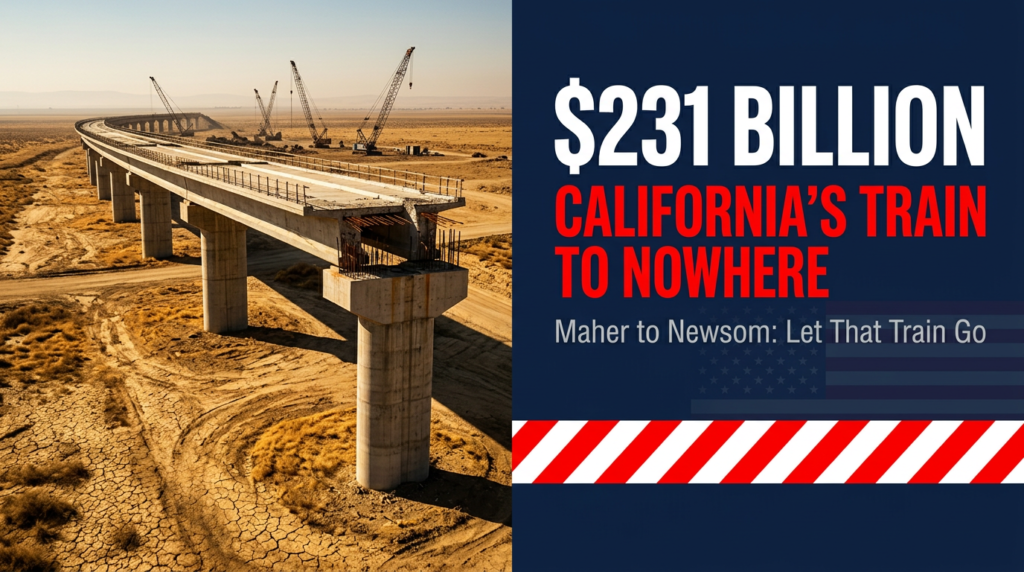
Even one of Hollywood’s most outspoken liberal voices has run out of patience with California’s catastrophic high-speed rail failure. When Bill Maher can’t defend you, you’re in serious trouble.
There are moments in politics when the spin machine finally breaks down — when no amount of smooth talking, carefully rehearsed deflection, or optimistic projections can obscure a disaster hiding in plain sight. California Governor Gavin Newsom hit one of those moments live on national television.
On a recent episode of Real Time with Bill Maher, the comedian and liberal commentator — a man who has repeatedly championed Newsom as a future presidential candidate — turned on his own party’s golden boy. The target: California’s infamous high-speed rail project, a government undertaking so staggeringly over budget and behind schedule that even its most loyal defenders are struggling to keep a straight face. “You’ve gotta get rid of the train,” Maher told the governor bluntly. “Let that train go.” Newsom smiled, pivoted, and said almost nothing of substance. The audience wasn’t buying it. Neither was the host.
Support Independent Local Journalism
TheTownHall.News is a non-profit reader-supported journalism. Just $5 helps us hire local reporters, investigate important issues, and hold public officials accountable across Alameda County. If you believe our community deserves strong, independent journalism, please consider donating $5 today to support our work.From $33 Billion Promise to a $231 Billion Nightmare
To understand why Maher’s frustration resonates far beyond late-night television, you have to look at the numbers — and they are brutal.
When California voters approved Proposition 1A in 2008, they were sold a vision: a sleek, modern high-speed rail network connecting San Francisco to Los Angeles for an estimated $33 billion, with service projected to begin by 2020. That promise has been shredded beyond recognition.
As of April 2026, the project’s estimated total cost has ballooned to $231 billion — a sevenfold increase from the original estimate. Approximately $14 billion has already been spent, mostly on land acquisition and construction in California’s Central Valley. What has that bought taxpayers? Roughly 119 miles of track under active construction between Merced and Bakersfield — two cities that, combined, represent a fraction of California’s population and economic activity.
The original completion date was 2020. The current target for even this scaled-back Central Valley segment is 2032. Federal funding for the project has been cut off entirely. The state is now relying on a reportedly “risky” $1 billion per year from California’s Greenhouse Gas Reduction Fund just to keep the lights on.

This is not mismanagement. This is institutional failure on a historic scale.
“The Worst Public Infrastructure Failure in U.S. History”
The criticism isn’t coming only from conservatives or late-night comedians. California’s own Legislative Analyst’s Office recently flagged eight distinct structural problems with the project’s 2026 business plan, citing a lack of transparency, uncertain funding assumptions, and shifting project scopes that may actually violate state law.
State Senator Tony Strickland didn’t mince words, calling it “the most wasteful government project in probably world history.” Congressman Kevin Kiley went further, labeling it “the worst public infrastructure failure in U.S. history.”
These aren’t partisan talking points. They are conclusions drawn from a paper trail of cost overruns, missed deadlines, and governance failures that span multiple administrations and reveal a systemic problem at the heart of California’s big-government model: when accountability disappears, taxpayer money follows.
When a government project burns through $14 billion and delivers zero completed miles of usable rail, something has gone catastrophically wrong — and someone needs to answer for it.
Support Independent Local Journalism
TheTownHall.News is a non-profit reader-supported journalism. Just $5 helps us hire local reporters, investigate important issues, and hold public officials accountable across Alameda County. If you believe our community deserves strong, independent journalism, please consider donating $5 today to support our work.Newsom’s Defense: Spin Over Substance

To his credit, Governor Newsom showed up. He sat in the chair, faced the questions, and made his case. But what he offered was textbook political deflection rather than genuine accountability.
“We’re doing $119 million in construction… we put it back on track,” Newsom told Maher, pivoting to claims that environmental hurdles and legal litigation are now behind the project. “We’re making this project work.”
Maher wasn’t satisfied — and he was right not to be. The governor’s response didn’t address the core indictment: that the project has no viable path to connecting the state’s two major population centers, that its costs have multiplied beyond any reasonable justification, and that the “Merced to Bakersfield” segment being defended so vigorously serves a tiny fraction of the state’s commuters.
Newsom himself acknowledged as far back as 2019 that there was no clear path to completing the full San Francisco–Los Angeles corridor. He redirected the project’s scope to the Central Valley segment — a decision that critics argue transformed an ambitious statewide infrastructure project into an expensive local rail line serving an agricultural corridor.
When Maher called out Newsom’s evasive answer in real time, the governor smiled and continued talking. The host’s response was telling: “It’s why you’d be a good candidate. You play this game well.” It was a compliment wrapped in an indictment.
What Defenders of the Project Get Wrong
Supporters of California’s high-speed rail are not without arguments. A 2025 poll found that 62% of California voters still approve of the project, suggesting that public appetite for the vision — cleaner transportation, reduced highway congestion, a modern rail network — remains alive even as the execution has faltered.
Advocates also point to the complexity of large-scale infrastructure, noting that major rail projects in other countries have faced similar early-stage cost pressures before ultimately delivering results. They argue that abandoning the project now would waste the billions already spent and forfeit long-term environmental and economic benefits.
These points deserve acknowledgment. But they do not hold up under scrutiny.
Public support for a vision is not the same as public support for unlimited spending with no accountability. The voters who approved $33 billion in 2008 did not sign a blank check for $231 billion in 2026. And the argument that “sunk costs” justify continued spending is precisely the kind of reasoning that has driven the project to this point in the first place. At some stage, fiscal responsibility requires the courage to stop digging.
The real question is not whether Californians want modern infrastructure. Of course they do. The question is whether this specific project — plagued by structural mismanagement, skyrocketing costs, and a governance model the state’s own analysts describe as opaque and legally questionable — is the vehicle to deliver it. The evidence overwhelmingly says no.
The Broader Lesson California Can’t Keep Ignoring
The high-speed rail disaster doesn’t exist in isolation. Maher made that clear during the interview when he rattled off a litany of California’s failures: gas prices among the highest in the nation, rents that have made the state unaffordable for working families, and a regulatory environment so cumbersome that even Democrats are calling for reform.
Newsom himself admitted on Maher’s show that needless regulation represents “an indictment of liberal governance and leadership.” That is a remarkable concession — and a rare moment of candor. But candor without action is just another form of spin.
California’s problems are not the result of bad luck or external forces alone. They are the predictable consequence of decades of government expansion, unchecked spending, regulatory overreach, and a political culture that has consistently prioritized grand visions over basic competency and fiscal discipline.
When the government promises a $33 billion train and delivers a $231 billion construction zone connecting two Central Valley cities, it isn’t just a transportation failure. It’s a governance failure — and ordinary Californians are paying the price every single day.
Conclusion: The Train Has Left the Station — and Taken the Money With It
Bill Maher’s willingness to confront Gavin Newsom on his own turf is significant not because Maher has changed his politics, but because it reflects a growing bipartisan exhaustion with excuses. Americans across the political spectrum understand what fiscal accountability means — even if the politicians responsible for spending their money have forgotten.
California’s high-speed rail project represents everything that goes wrong when government is given unlimited resources, minimal oversight, and no serious consequences for failure. Costs that were once dismissed as overblown estimates are now so enormous they defy comprehension. Timelines that were once called optimistic are now simply embarrassing. And the political figures who championed the project year after year are still, remarkably, asking for more time and more money.
At some point, leadership means making hard calls. “Let that train go” isn’t just a late-night punchline. It’s sound fiscal advice — and the kind of straight talk that California’s taxpayers have been owed for a very long time.
Key Takeaway
California’s high-speed rail project has ballooned from a $33 billion voter-approved plan to a $231 billion fiscal catastrophe with no completed route, no federal funding, and a completion date now set for 2032 — for a 171-mile stretch between Merced and Bakersfield. Even Bill Maher, one of Governor Newsom’s most prominent media allies, has called for the project to be scrapped. The numbers don’t lie, and the politics can’t hide them anymore.
If this story matters to you, share it with someone who needs to see the facts. Independent journalism depends on readers like you — stay informed, stay engaged, and hold your elected officials accountable.