Spirit Airlines Shutdown: What the Collapse of America’s Cheapest Carrier Reveals About Markets and Government
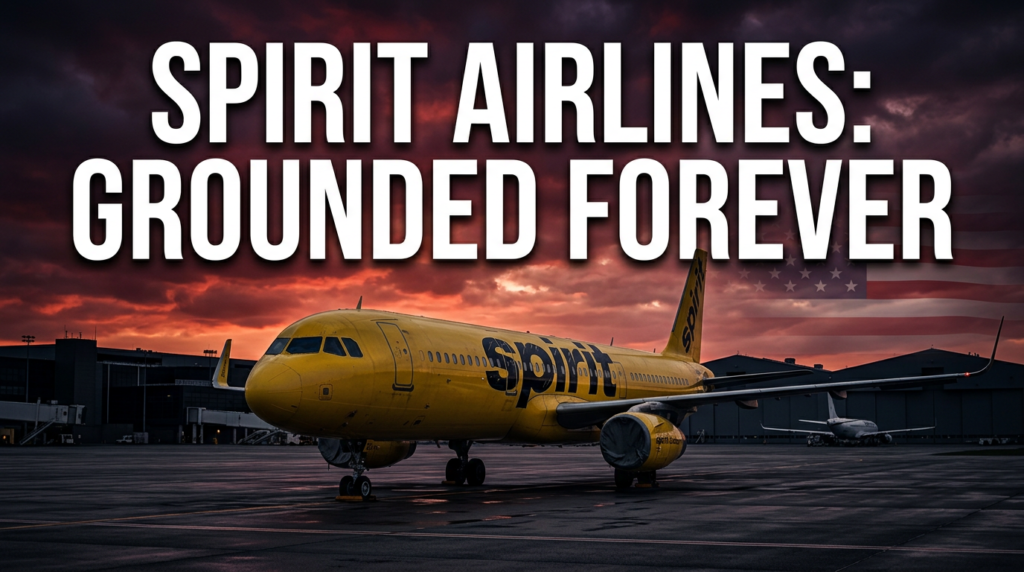
The death of Spirit Airlines didn’t happen overnight — it was the predictable result of years of bad decisions, bloated debt, and a last-ditch bet on a government bailout that American taxpayers should be glad never arrived.
The lights went out at Spirit Airlines at 3:00 AM Eastern on Saturday, May 2, 2026. No farewell flight. No graceful exit. Just a terse statement on the airline’s website — “all flights have been canceled, and customer service is no longer available” — leaving roughly 60,000 passengers stranded mid-trip and 17,000 employees suddenly out of work.
After 34 years of rock-bottom fares, unbundled fees, and a business model that tested the patience of even its most loyal customers, Spirit Airlines is gone. And while the human cost is real and serious, the story of how it ended carries lessons that go far beyond the aviation industry — lessons about debt, accountability, the limits of government intervention, and what happens when a company spends years betting someone else will pay for its mistakes.
Support Independent Local Journalism
TheTownHall.News is a non-profit reader-supported journalism. Just $5 helps us hire local reporters, investigate important issues, and hold public officials accountable across Alameda County. If you believe our community deserves strong, independent journalism, please consider donating $5 today to support our work.A Business Model Built on Borrowed Time
Spirit’s collapse didn’t come out of nowhere. The ultra-low-cost carrier had been bleeding for years, surviving on high passenger volume while piling up debt that would eventually crush it. The airline filed for its second bankruptcy in August 2025, a clear signal that its underlying economics were broken.
The business model itself was aggressive by design: strip out every amenity, charge separately for carry-on bags, seat selection, and snacks, and flood routes with cheap base fares to drive volume. For a certain type of traveler, it worked. For the company’s long-term financial health, it was a ticking clock.
When jet fuel prices surged sharply following the outbreak of the U.S.-Israel war on Iran, Spirit had no cushion. Airlines with stronger balance sheets could absorb the shock. Spirit could not. Its margins, already razor-thin, evaporated entirely.
The free market, over time, tends to deliver its verdict accurately. Spirit’s verdict came due on Saturday morning.

The Bailout That Never Should Have Happened
Here is where the story gets politically instructive. As Spirit careened toward collapse, the Trump administration entered bailout discussions — floating a proposal that would have provided the airline with a $500 million government loan in exchange for a 90% ownership stake in the company.
Read that again. A government takeover of a private airline. In exchange for half a billion dollars in taxpayer-backed funds.
To their credit, Spirit’s bondholders rejected it. The creditors who had the most to lose refused to hand majority control of a private company to the federal government, and the deal collapsed. Whatever one thinks of Wall Street bondholders, in this case, their self-interest aligned with the public interest: government has no business owning airlines.
The episode is a reminder that the instinct to use public funds to rescue failed private enterprises — regardless of which administration pursues it — carries real risks. It distorts markets, rewards mismanagement, and shifts the cost of corporate failure onto taxpayers who had no say in the decisions that caused it. Fiscal accountability means letting markets clear, even when the outcome is painful.
17,000 Jobs, Real People, and the Limits of Outrage
None of this is abstract for the 17,000 Spirit employees who woke up Saturday without a job. The roughly 2,000 pilots, 5,000 cabin crew members, and thousands of support staff who built careers at this airline are facing a genuinely difficult moment — and that deserves acknowledgment without pretense.
Support Independent Local Journalism
TheTownHall.News is a non-profit reader-supported journalism. Just $5 helps us hire local reporters, investigate important issues, and hold public officials accountable across Alameda County. If you believe our community deserves strong, independent journalism, please consider donating $5 today to support our work.But the response to that reality matters. Rather than calling for further government intervention, Transportation Secretary Sean Duffy moved swiftly to coordinate private-sector relief. United, Delta, JetBlue, and Southwest agreed to implement fare caps for displaced Spirit passengers rebooking flights. American Airlines and Delta announced reduced fares on high-volume Spirit routes. Allegiant froze prices across overlapping routes. Frontier is offering a 50% base-fare discount to affected travelers.
Simultaneously, American and United announced they are launching dedicated hiring portals specifically for former Spirit employees — pilots and crew included. Major carriers are extending travel passes to Spirit staff who need to get home.
This is what a functional private sector response looks like. Not a government check — coordinated, voluntary industry action that addresses real human need without compelling taxpayers to fund it.
Personal responsibility and private-sector solidarity are not opposites. Saturday proved they can work together.
What the Critics Get Wrong About Airline Deregulation
Some commentators will use Spirit’s collapse to argue that the airline industry needs heavier regulation, government price controls, or federally subsidized competition to protect consumers. This argument misreads the situation entirely.
Spirit’s failure is not evidence that the market failed consumers. It is evidence that a particular business model, executed poorly, with unsustainable debt, failed its investors and employees. Those are different things.
The aviation market remains robustly competitive. Delta, United, American, Southwest, Frontier, Allegiant, and several regional carriers continue to operate. Fares on Spirit’s former routes will likely rise in the short term — that is the honest, predictable consequence of reduced supply. But those routes will not remain vacant. Other carriers will fill the gap, and competition will reassert itself.
What would genuinely harm consumers is the precedent of government bailouts keeping zombie airlines on life support — distorting pricing, discouraging investment in well-run competitors, and socializing losses while profits remain private. That is not consumer protection. That is corporate welfare with a populist veneer.
The Blocked Merger That Made This Worse
One piece of this story deserves more attention. In 2024, federal regulators blocked a proposed $3.8 billion merger between JetBlue and Spirit on antitrust grounds. The argument was that the merger would reduce competition and harm consumers.
The irony is difficult to ignore. Regulators intervened to protect competition — and the result is that Spirit, denied a potential lifeline, has now exited the market entirely. The consumers those regulators sought to protect are now scrambling to rebook flights at higher prices with fewer options.
This is not an argument against all antitrust enforcement. It is an argument for regulatory humility — an acknowledgment that government interventions in markets carry consequences that are not always visible at the moment of decision, and that the cure is sometimes worse than the disease.
What Stranded Passengers Need to Know Right Now
If you or someone you know held a Spirit ticket, the path forward is clear but requires action:
Passengers who booked directly with Spirit using a credit or debit card will receive automatic refunds. Those who booked through travel agents must contact the agent directly. Vouchers, Free Spirit loyalty points, and travel credits will be resolved through Spirit’s bankruptcy court process — and history suggests modest recovery at best.
Spirit has explicitly instructed passengers not to go to the airport. If you have travel insurance, file a claim immediately. And if you need to rebook, contact the carriers listed above — most have dedicated processes for Spirit customers in place as of this morning.
The lesson here, bluntly stated: travel insurance is not an optional luxury. It is part of traveling responsibly. When airlines collapse — as they occasionally do — insurance is the safety net, not the federal government.
The Takeaway: Markets Work, and That’s a Good Thing
Spirit Airlines is gone. That is a loss — for its employees, for its customers, for the communities that depended on its low-cost routes. But it is not a crisis of capitalism. It is capitalism functioning as designed.
A company that could not sustain its financial model, that accumulated debt it could not service, that failed to adapt when external costs rose, exited the market. Its assets, routes, and talent will be absorbed by better-run competitors. The market will adjust. Fares will normalize. And the aviation industry will continue to serve hundreds of millions of Americans every year.
What would be genuinely alarming is a future in which failed airlines are routinely nationalized, propped up with taxpayer loans, and insulated from the consequences of their own mismanagement. That path leads not to cheaper flights, but to less innovation, less accountability, and more expensive government.
The free market delivered its verdict on Spirit Airlines. The right response is to respect it — and learn from it.
Stay Informed. Stay Engaged.
Stories like Spirit’s collapse touch real lives — stranded passengers, displaced workers, communities losing affordable air service. Independent journalism that covers these issues honestly, without partisan spin or corporate influence, depends on readers like you.
Share this article. Discuss it with your community. And if you value accountability journalism that follows the facts wherever they lead, consider supporting independent news outlets that keep doing the work.