Magnetic Refrigeration Technology: The Cooling Breakthrough That Could Change Everything
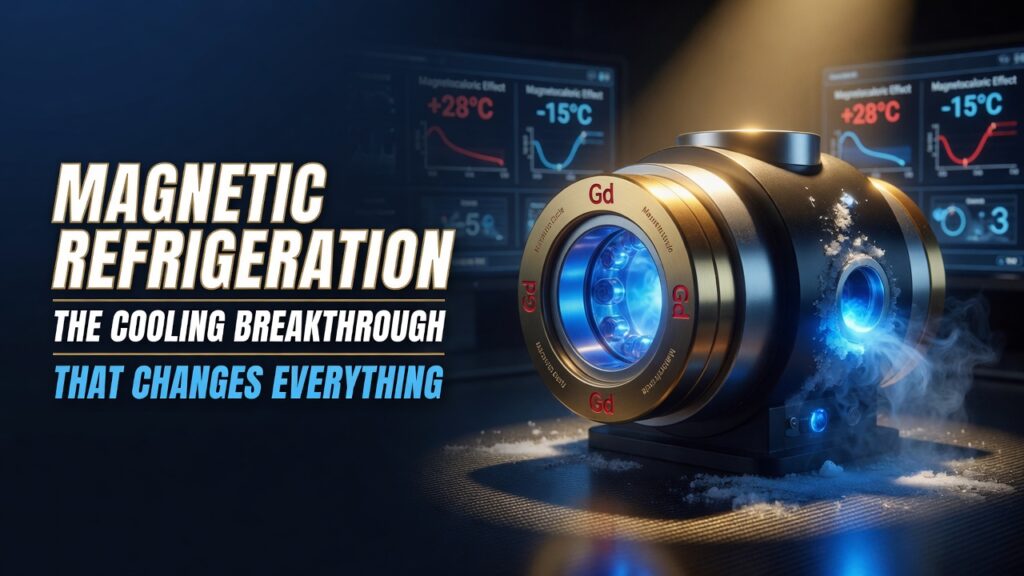
Scientists have built a compressor-free refrigerator powered entirely by magnets. As governments rush to ban traditional refrigerants, the question millions of consumers and small business owners should be asking is: who is steering this transition — and at what cost to your wallet and your freedom of choice?
The future of your refrigerator may already exist in a German laboratory. While Washington debates energy mandates and Brussels layers on refrigerant bans, a quiet revolution in cooling technology has crossed a decisive threshold — and almost nobody in government is talking about it.
Magnetocaloric refrigeration — a process that uses alternating magnetic fields to heat and cool specially engineered materials — has moved out of the theoretical realm and into the commercial market. In 2025 and early 2026, a series of peer-reviewed breakthroughs confirmed what researchers at institutions from Tokyo to Seoul to Darmstadt have long argued: magnetic cooling is real, it is scalable, and it is arriving faster than policymakers anticipated. The question is whether governments will enable its rise — or regulate it into oblivion before it gets the chance.
Support Independent Local Journalism
TheTownHall.News is a non-profit reader-supported journalism. Just $5 helps us hire local reporters, investigate important issues, and hold public officials accountable across Alameda County. If you believe our community deserves strong, independent journalism, please consider donating $5 today to support our work.What Is Magnetic Refrigeration, and Why Does It Matter Right Now?
The science is elegant. Certain materials — most notably gadolinium and lanthanum-based alloys — change temperature when exposed to a magnetic field. Apply the field, and the material warms. Remove it, and the material cools. Cycle that process rapidly through a heat exchanger, and you have a working refrigerator with no compressor, no refrigerant gas, and no moving parts beyond the magnets themselves.
In December 2025, a multinational team led by Japan’s National Institute for Materials Science (NIMS) published findings in the journal Advanced Materials confirming a landmark achievement: by precisely tuning the covalent bonds in a gadolinium-germanium compound, researchers doubled the material’s reversible cooling power — from 3.8 Kelvin to 8 Kelvin — while simultaneously improving its durability across thousands of cycles. That solves what had been the field’s defining dilemma: giant cooling effect and long-term reliability, achieved together for the first time.
That same month, South Korea’s Institute of Materials Science (KIMS) announced the country’s first full-cycle magnetic cooling system, engineering large-area lanthanum sheets and gadolinium wires at world-competitive tolerances, published in the journal Rare Metals.
Magnetic refrigeration has crossed its first major commercial threshold — and almost no one in government is talking about what that means for consumers.

The First Commercial Product Is Already on Shelves — Without Government Help
German startup MagnoTherm Solutions didn’t wait for a subsidy program. Their POLARIS beverage cooler — described by the company and independently noted in Applied Thermal Engineering as the world’s first CE-certified commercial magnetic cooler — is already available for purchase and rental. It cools up to 150 beverages to 5°C, uses zero refrigerant gas, produces no direct greenhouse emissions, and is PFAS-free.
MagnoTherm claims the system runs 15% more efficiently than comparable propane refrigeration and up to 30% more efficiently than conventional systems. Those numbers have not yet been independently verified at industrial scale, but the device has been deployed in real retail environments, including German supermarkets, demonstrating that this is no longer a prototype.
This is the market working. No mandate. No billion-dollar federal grant program. No regulatory taskforce. A private company, backed by private capital, delivered a refrigerant-free cooler to market through engineering discipline and competitive incentive.
“The market didn’t need a mandate to build the world’s first magnetic cooler. It needed engineers, investors, and the freedom to compete. That’s a lesson regulators should write down.”
What Do the Numbers Actually Tell Us?
USD 28 billion. That is the projected size of the global magnetic refrigeration market by 2035, growing from approximately $750 million in 2025 at a compound annual growth rate of roughly 43.7% [SNS Insider market analysis, 2025]. Is that growth being driven by government policy — or by the market recognizing an inevitable technological shift?
The honest answer is both — but the market is ahead of the policy. Industry analysts note that tightening international regulations, particularly the Kigali Amendment to the Montreal Protocol, which mandates an 85% phasedown of hydrofluorocarbons (HFCs) in developed nations by 2036, are creating urgency. But the engineering breakthroughs arrived independently of those mandates, driven by scientific competition between Japan, South Korea, Germany, and the United States.
Support Independent Local Journalism
TheTownHall.News is a non-profit reader-supported journalism. Just $5 helps us hire local reporters, investigate important issues, and hold public officials accountable across Alameda County. If you believe our community deserves strong, independent journalism, please consider donating $5 today to support our work.If private innovation is already solving the refrigerant problem, what exactly is the regulatory apparatus adding — besides compliance costs?
The Hidden Cost Nobody Is Discussing: Rare Earth Dependency
Here is what the breathless green-energy press releases tend to leave out. Magnetocaloric refrigeration, in its current most effective form, depends on gadolinium and lanthanum — rare earth elements that are expensive, difficult to mine sustainably, and overwhelmingly controlled by China’s supply chain.
Furthermore, even if the refrigerant material evolves toward non-rare-earth manganese alloys — which KIMS and others are developing — every magnetic cooling system still requires powerful neodymium-iron-boron (NdFeB) permanent magnets. Those, too, are rare-earth-dependent.
Fiscal conservatives and national security hawks should be asking a pointed question: are we solving a refrigerant dependency only to create a rare earth dependency that is strategically more dangerous and economically more fragile?
Are we trading one supply chain vulnerability for a worse one — and calling it progress?
What Do Supporters of This Technology Actually Believe?
Proponents — and they include serious scientists, not just clean-energy advocates — make a compelling case. Magnetic cooling eliminates refrigerants that carry genuine greenhouse warming potential. It operates more quietly than compressor-based systems, has fewer mechanical failure points, and, as the NIMS research confirmed, can now achieve both high performance and long-term durability simultaneously.
Supporters also argue that rare earth dependency is a transitional problem, not a permanent one. Non-rare-earth manganese-based alloys are improving. Recycling infrastructure for NdFeB magnets is expanding. And the energy efficiency gains — if the commercial numbers hold at scale — could meaningfully reduce electricity consumption in a sector that accounts for a significant portion of global energy use.
These are fair points. The science is real. The direction is right. The debate is not about whether magnetic refrigeration works — it demonstrably does.
The debate is about who controls the transition, at what speed, at whose expense, and whether government mandates will crowd out the very private innovation that got us here.
Is the Government About to Take Credit for What the Market Already Built?
History offers a pattern worth noting. A technology gestates in universities and private labs for decades, funded by a combination of academic grants and venture capital. It crosses a commercial threshold through private risk-taking. Then regulators arrive — with mandates, certification requirements, preferred-vendor lists, and subsidy structures that inevitably advantage large incumbents over the startups that did the actual work.
MagnoTherm is a small German company. KIMS is a Korean national research institute racing to lock up patents before larger powers do. The window in which small innovators can shape this market is narrow. Once Washington and Brussels fully engage — and they will, especially as Kigali Amendment deadlines approach — the regulatory architecture will be built around the interests of whoever is at the table.
The entrepreneurs who built this technology deserve a seat at that table. The question is whether they’ll be invited — or regulated around.
Key Questions This Story Raises
- Who controls the rare earth supply chain that magnetic refrigeration depends on — and is the U.S. government taking that dependency seriously enough before mandating a technology transition?
- Will small innovators like MagnoTherm be protected from regulatory capture as governments move to standardize and subsidize magnetic cooling, or will compliance costs hand the market to larger incumbents?
- Are consumers being given an honest accounting of both the benefits and the supply chain risks of the coming refrigerant transition — or only the version that justifies the policy already decided?
The Question That Lingers After Every Breakthrough
Magnetic refrigeration is not a fantasy. It is not a green-energy talking point. It is a peer-reviewed, commercially demonstrated technology that reached the retail shelf without a single federal mandate ordering it to exist.
That is a story worth celebrating — and worth protecting. Because the same regulatory momentum that is phasing out old refrigerants could, if handled carelessly, hand control of the next generation of cooling technology to governments and large corporations rather than the engineers and investors who earned it.
The real question is not whether magnetic refrigeration will change how we cool our homes and businesses. It will. The question is whether the transition will be driven by free markets and scientific merit — or by bureaucrats who arrived after the breakthrough and are now writing the rules.
What do you think — is government overreach the biggest risk to this technology’s promise? Share this article and tell us where you stand.
Still have questions about the energy and technology policies shaping your daily life? Subscribe for daily coverage that cuts through the noise.
Think others need to hear this? Share the article — the conversation starts with you.
Want to make your voice count? Contact your congressional representative and ask what the U.S. is doing to secure domestic rare earth supply chains for next-generation cooling technology. The House Energy and Commerce Committee accepts constituent input at energycommerce.house.gov.