Albania Kushner Resort Protests: Government Accountability, Environmental Law, and What Comes Next
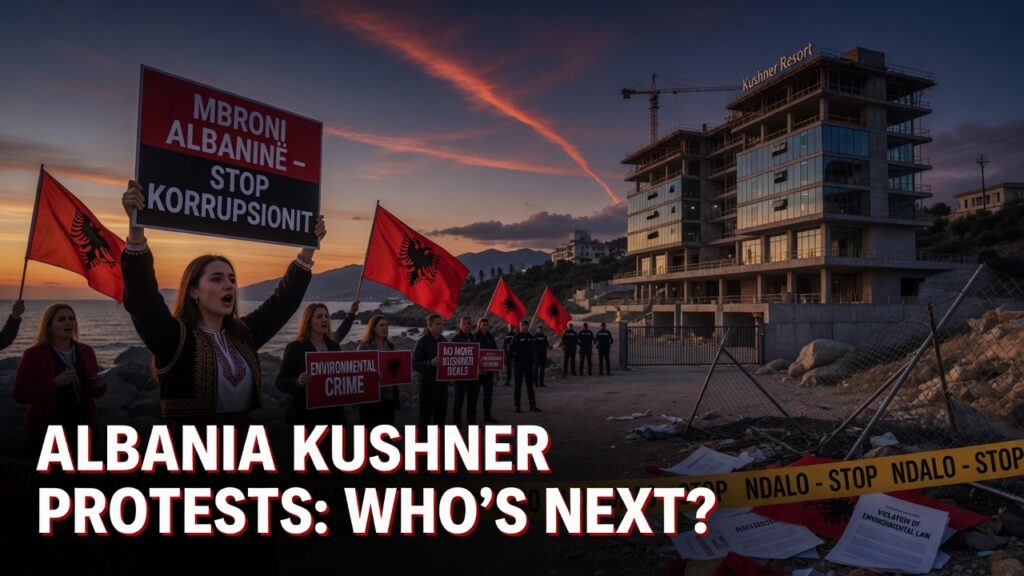
As protests enter their second consecutive day in Tirana, Albanians are demanding answers their government has so far refused to give — and the world is finally paying attention.
The fences went up in early May. No announcement. No public consultation. Just barbed wire, cutting off Albanians from beaches their families had walked for generations.
That single act — the physical seizure of a protected coastline to make way for a $4 billion luxury resort linked to Jared Kushner, son-in-law of U.S. President Donald Trump — has now ignited the most internationally visible flashpoint in an already-turbulent Albanian political crisis. As of June 2, 2026, thousands are back in the streets of Tirana for the second straight day. They are not chanting about politics in the abstract. They are chanting, “Albania belongs to Albanians.”
Support Independent Local Journalism
TheTownHall.News is a non-profit reader-supported journalism. Just $5 helps us hire local reporters, investigate important issues, and hold public officials accountable across Alameda County. If you believe our community deserves strong, independent journalism, please consider donating $5 today to support our work.What Exactly Is Being Built — and Where?
The project, backed by Kushner’s investment firm Affinity Partners, is planned across two ecologically protected zones: the Vjosa-Narta coastal landscape near the Zvernec peninsula and the island of Sazan, a formerly restricted military island on Albania’s Adriatic coast. The development is projected to include approximately 10,000 hotel rooms and villas, sprawling across roughly 2.5 square kilometres of coastline that sits inside a formally designated protected area.
This is not an undeveloped industrial zone. Vjosa-Narta is home to flamingos, Mediterranean monk seals, and sea turtle nesting sites. Environmental scientists have warned that construction threatens critical bird migration corridors and irreplaceable Adriatic biodiversity. In January 2026, 41 environmental organizations from 28 countries formally demanded the project be suspended.
The Albanian government said no and handed over the permits anyway.
Did Albania Rewrite Its Own Laws to Make This Happen?
Yes — and that is precisely what prosecutors are now investigating.

In 2024, the Albanian legislature passed a law creating a specific legal exception allowing five-star hotel construction within protected natural zones. The timing was noted by critics: the exception came shortly after Kushner’s interest in developing the area became public knowledge. Environmental advocates and opposition figures argued at the time that the law was not crafted in the public interest — it was crafted for a deal.
Albania’s Special Anti-Corruption Prosecution Office (SPAK) has now opened a formal criminal investigation into changes made to the protected status of Vjosa-Narta. That investigation examines whether those regulatory changes constitute corruption. The government has not been charged — but the probe’s very existence signals that Albania’s independent judiciary is asking the same questions its citizens are shouting in the streets.
When a government rewrites environmental law weeks before issuing a permit to a foreign billionaire — and does so without public announcement — that is not investment policy. That is a question of accountability.
What Do Supporters of This Deal Actually Believe?
This is a fair question, and Prime Minister Edi Rama has answered it directly. His position is that Albania needs high-end foreign investment to compete regionally, that the project complies with all legal and environmental requirements as currently written, and that luxury tourism development is a legitimate pillar of national economic strategy.
He is not entirely wrong on the economics. Albania’s tourism sector has grown rapidly, and foreign direct investment in hospitality infrastructure can generate jobs, tax revenue, and long-term development. Rama has framed critics as opponents of progress, arguing the project will elevate Albania’s global profile.
Support Independent Local Journalism
TheTownHall.News is a non-profit reader-supported journalism. Just $5 helps us hire local reporters, investigate important issues, and hold public officials accountable across Alameda County. If you believe our community deserves strong, independent journalism, please consider donating $5 today to support our work.But here is the problem with that argument: legitimate investment does not require a country to change its laws in secret, fence off public beaches, and deploy private security guards to drag protesters across clifftops. The rule of law exists precisely to prevent government officials from bending legal frameworks to accommodate powerful private interests — domestic or foreign. If the deal was genuinely clean, a transparent public process would have proved it. The absence of that transparency is not a procedural footnote. It is the story.
“If a government rewrites its own environmental protections to accommodate a foreign billionaire connected to the world’s most powerful family — and does it without a single public announcement — the question isn’t whether something went wrong. The question is how deep it goes.”
Is Anyone Actually Being Held Responsible?
This is where the story becomes complicated — and important.
On the protest side: approximately 15 demonstrators have been criminally charged following recent clashes. Two private security company licenses were revoked after footage emerged of guards assaulting protesters. A local police chief was stripped of his duties. These are real consequences — but they fall almost entirely on citizens, not on those who made the decisions that triggered the unrest.
On the institutional side: SPAK — the same anti-corruption body that has previously investigated Albania’s own Deputy Prime Minister Belinda Balluku for procurement fraud — is now probing the legal changes that enabled the Kushner development. The investigation carries real weight. SPAK has demonstrated a willingness to pursue powerful figures regardless of political pressure.
$4 billion. That is the projected cost of a resort being built on protected land — land whose legal protections were quietly removed before a single brick was laid. Who authorized that, and why?
What Does This Mean for the Rule of Law?
The protests in Albania are not simply about one resort. They are erupting inside a broader, months-long political crisis that began in late 2025 after the indictment of Deputy Prime Minister Balluku on corruption charges, and after a disputed parliamentary election in which Rama’s Socialist Party claimed 83 seats. Opposition parties allege electoral fraud. Citizens allege institutional capture.
The Kushner resort controversy has merged with this existing anger, giving it a sharper international dimension. When a government’s response to peaceful protest is to charge the protesters — while the officials who altered environmental law face no consequences — it sends a message about whose interests the state actually serves.
Could this be the moment Albanian civil society forces a real reckoning with government accountability — or will the money win, as it so often does?
That is the question Albanian citizens are answering with their feet, right now, in the streets of Tirana.
What Happens If No One Speaks Up Beyond Albania’s Borders?
The involvement of a figure with direct ties to the American presidency raises legitimate questions that extend beyond Albanian domestic politics. Kushner’s firm, Affinity Partners, has faced scrutiny from U.S. lawmakers — including a Senate Finance Committee inquiry — over its fundraising from foreign governments while Kushner was involved in U.S. foreign policy during the first Trump administration.
Whether or not those concerns prove legally actionable, they underscore a broader principle: when private financial interests intersect with political power at the highest levels, transparency is not optional — it is the minimum standard a democratic society should demand.
Forty-one environmental groups said stop. The Greek minority in southern Albania raised concerns about land rights. Local residents said their homes and livelihoods were threatened. The government moved forward regardless.
KEY QUESTIONS THIS STORY RAISES:
- Did Albanian officials receive any personal benefit from the 2024 legislative changes that enabled construction in a protected zone — and will SPAK’s investigation produce public answers?
- What due diligence, if any, did Affinity Partners conduct regarding the legality and public consultation requirements before committing to this development?
- If Albania’s EU accession process is ongoing, how do European institutions plan to respond to a member-candidate government that is criminalizing environmental protesters while shielding developers?
The Question That Doesn’t Go Away
Governments that rewrite laws without public notice, issue permits without public announcements, and then send security personnel to remove protesters from public land are not managing investment policy. They are demonstrating who they answer to.
Prime Minister Rama calls it development. Thousands of Albanians, backed by environmental scientists and anti-corruption prosecutors, call it something else entirely. SPAK is now formally asking which version is true.
The pattern here — legislative exception, quiet permit, foreign capital, criminalized dissent — is one that citizens in any country with functioning democratic instincts should recognize and resist. Institutional accountability does not preserve itself. It requires people willing to ask inconvenient questions, in print and in the streets, long enough for the answers to matter.
The real question isn’t whether the Albanian coastline can be saved. It’s whether the institutions meant to protect it — and the people who built them — still have the will to try.
What do you think — when governments rewrite environmental law to benefit foreign investors without public input, is that still legitimate policy? Share this article and tell us where you stand.
Still have questions about what’s happening in Albania? Stay informed — subscribe for daily international coverage and analysis. Think others need to hear this? Share the article across your networks. Want to make your voice count? Contact your own elected representatives and ask what position your government takes on foreign investment in protected ecological zones.