Albania Sazan Island Deal: The Truth About Rama, Kushner, and the €1.4 Billion Resort Controversy
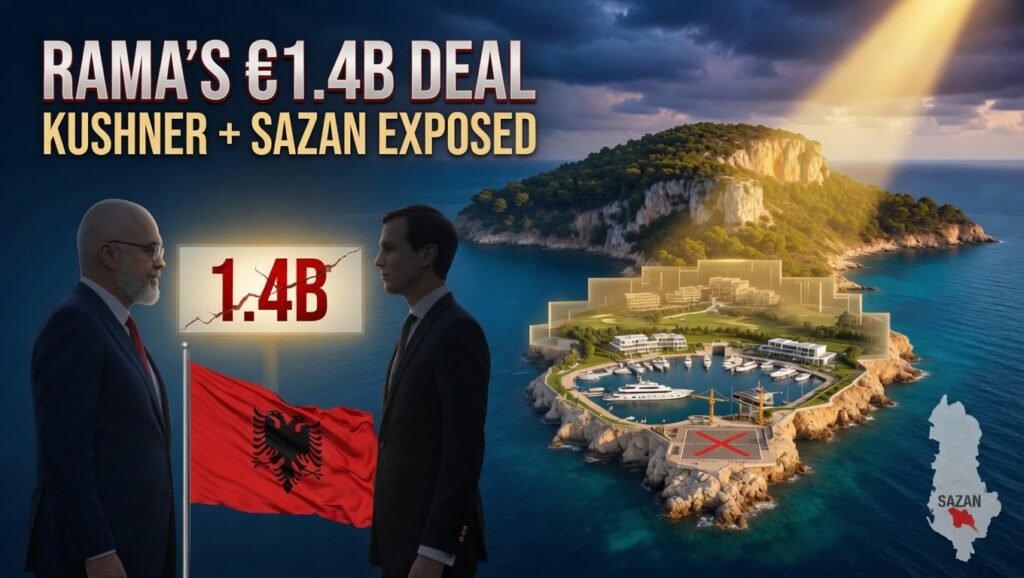
As Albania’s anti-corruption prosecutors open a criminal investigation and thousands pour into the streets, one urgent question demands an answer: who gave away the Albanian people’s land — and why?
Watch the video:
https://www.instagram.com/p/DZGS81oj4fp
Support Independent Local Journalism
TheTownHall.News is a non-profit reader-supported journalism. Just $5 helps us hire local reporters, investigate important issues, and hold public officials accountable across Alameda County. If you believe our community deserves strong, independent journalism, please consider donating $5 today to support our work.A Nation’s Crown Jewel, Quietly Handed Over
Sazan Island doesn’t belong to a politician. It belongs to the Albanian people.
Yet as of June 2026, that pristine Adriatic island — nestled inside a nationally protected marine park, home to endangered monk seals and rare migratory birds — is at the center of a €1.4 billion luxury resort deal that critics say was engineered in the shadows, stripped of its environmental protections by bureaucratic sleight of hand, and fast-tracked for a politically connected American billionaire without meaningful public debate.
The developer is Jared Kushner, son-in-law of U.S. President Donald Trump, operating through his private equity vehicle Atlantic Incubation Partners LLC, affiliated with Affinity Partners. The Albanian government, under Prime Minister Edi Rama, granted the project “Strategic Investor” status — a designation that bypasses normal permitting requirements and accelerates approvals. In December 2024, the government quietly declassified Sazan Island from military use. Shortly after, changes were made to the protected status of surrounding coastal areas, including the ecologically sensitive Vjosa-Narta landscape and the Zvërnec peninsula.
None of this happened in open parliamentary debate. And that, say protesters, is the point.

What Did Albanians Actually Agree To?
The honest answer is: very little.
No public referendum. No transparent tender process. No independent environmental impact assessment — Rama himself admitted to lawmakers that the final proposal hasn’t been submitted and the environmental study hasn’t been completed. Yet physical construction activity has already begun. Barbed-wire fences have gone up along what were once public beaches in Zvërnec, blocking access for ordinary Albanians and tourists who have used that coastline freely for generations.
€1.4 billion. That’s the price tag on a deal the Albanian public was never formally asked to approve — and may never fully understand until it’s too late.
When protesters tried to remove those fences, private security guards allegedly assaulted them — with footage circulating on social media showing guards dragging demonstrators near a cliff edge. That footage didn’t just spark outrage. It ignited a movement.
Is This the Accountability Moment Albania Has Been Waiting For?
On June 2, 2026, Albania’s Special Anti-Corruption Prosecution Office (SPAK) — the country’s most powerful independent anti-corruption body, established with EU and U.S. backing — confirmed it has opened a formal criminal investigation into the 2024 changes to Sazan’s protected status and land ownership. Investigators are probing whether those legal maneuvers were made improperly to benefit a foreign private investor.
Support Independent Local Journalism
TheTownHall.News is a non-profit reader-supported journalism. Just $5 helps us hire local reporters, investigate important issues, and hold public officials accountable across Alameda County. If you believe our community deserves strong, independent journalism, please consider donating $5 today to support our work.This is not a minor regulatory query. SPAK was built specifically to target high-level corruption that Albania’s ordinary courts couldn’t touch. Its involvement signals that what many Albanians long suspected — that something deeply irregular happened behind closed doors — now has institutional weight behind it.
“For two days, thousands have taken to the streets, and demonstrations are set to continue throughout the entire week. Mainstream media is not covering the protests, but people are organizing through social media.” — Gresa Hasa, doctoral researcher, University of Graz Faculty of Law
Rama, for his part, is not backing down. He told Albanian lawmakers the project is central to his vision of transforming Albania into a premier Mediterranean tourism destination. He denies the resort threatens the marine park. But when a government strips a national park of its protected status to accommodate a billionaire’s investment — and calls that “economic development” — citizens have every right to ask hard questions about who, exactly, is being developed.
Who Is Really Paying for This — and Who Profits?
Personal responsibility and fiscal accountability demand that citizens follow the money. So let’s follow it.
Kushner’s Affinity Partners has received sovereign wealth fund backing from Gulf states, reportedly including Saudi Arabia’s Public Investment Fund — a connection that has drawn scrutiny from U.S. senators including Ron Wyden, who raised concerns about foreign financial entanglements involving the Trump family. In Albania, the deal is structured as a public-private partnership, with the Albanian Investment Corporation and the state-owned Seaports Development Company holding joint oversight of the state’s stake.
What does “state’s stake” mean in practice for ordinary Albanians? That remains, deliberately, opaque. The government has not published the full terms of the Strategic Investor agreement. No independent audit of the public’s share of projected revenues has been released.
If Albanian public land is the asset, Albanian citizens deserve to know exactly what return they are receiving — and what they are permanently surrendering.
What Do Supporters of This Policy Actually Believe?
To be fair: the pro-development argument is not without substance.
Supporters, including Rama and some Albanian economists, argue that Albania needs bold foreign direct investment to escape endemic poverty and youth emigration. They point out that Sazan Island was a decommissioned Soviet and Albanian military base — not pristine wilderness — and that without investment, it could remain a deteriorating, inaccessible liability for decades. They argue that €1.4 billion and an estimated 1,000 construction and operational jobs represent generational economic opportunity for Vlorë, one of Albania’s most underserved regions.
These are legitimate points worth engaging. Infrastructure decay is real. Youth brain drain is real. The economic appeal of Mediterranean luxury tourism is real.
But here is where the argument breaks down on the grounds of law and civic values: economic benefit does not justify procedural corruption. A government that bypasses environmental review, strips national park protections without parliamentary debate, and awards “strategic” status to a foreign billionaire with direct family ties to a sitting U.S. president — all without transparent public accounting — is not pursuing development. It is pursuing something else entirely. The ends do not legitimize the means when the means involve dismantling the rule of law.
A Warning From Belgrade: Will Albania Listen?
There is a direct and instructive precedent.
Kushner’s company pursued a near-identical strategy in Belgrade, Serbia — proposing an urban redevelopment project that required the removal of cultural heritage protections from a historic site. Serbian citizens protested. Legal proceedings were launched. And in December 2025, Kushner’s company withdrew from the Belgrade project entirely.
If Albanian citizens stay in the streets, Serbia’s example proves something powerful: organized civic pressure works.
The protest movement’s slogan — “Albania Is Not For Sale” — is not merely emotional. It is a statement of constitutional principle. Public land held in trust for citizens cannot be transferred to private foreign interests through opaque agreements that bypass environmental law, public consultation, and legislative scrutiny. That is not development. That is divestiture of sovereignty.
Key Questions This Story Raises
- Was the 2024 removal of Sazan Island’s protected status a legitimate policy decision — or a corrupt act designed to benefit a specific foreign investor?
- What are the full financial terms of the Strategic Investor agreement, and what share of revenues — if any — will benefit ordinary Albanian citizens?
- If SPAK’s investigation finds criminal conduct, will Prime Minister Edi Rama face personal legal accountability — or will the investigation be quietly buried?
Has Albania Reached Its Tipping Point?
The question Albanians are now asking is not simply about one island. It is about what kind of country Albania intends to be.
A nation governed by law, where public assets are stewardship responsibilities, where environmental protections mean something, where foreign investment is welcomed transparently and on equal terms — or a country where politically connected insiders broker deals in back rooms, where protected coastlines become private luxury enclaves, and where citizens who dare to object are met with barbed wire and security guards.
The real question isn’t whether Sazan Island can be saved. It’s whether the Albanian state still belongs to the Albanian people — or whether it was quietly sold, along with everything else.
What do you think — is it too late to reverse course? Share this article and let us know in the comments.
Still have questions? Subscribe for daily coverage of the Balkans’ most consequential political stories. Think others need to hear this? Share this article across your networks — and tag your representative. Want to make your voice count? Contact the Albanian Embassy in your country and demand transparency on the Sazan Island agreement terms.