Kellogg’s Omaha Plant Closure 2026: 450 Jobs Lost and a Community Left Behind
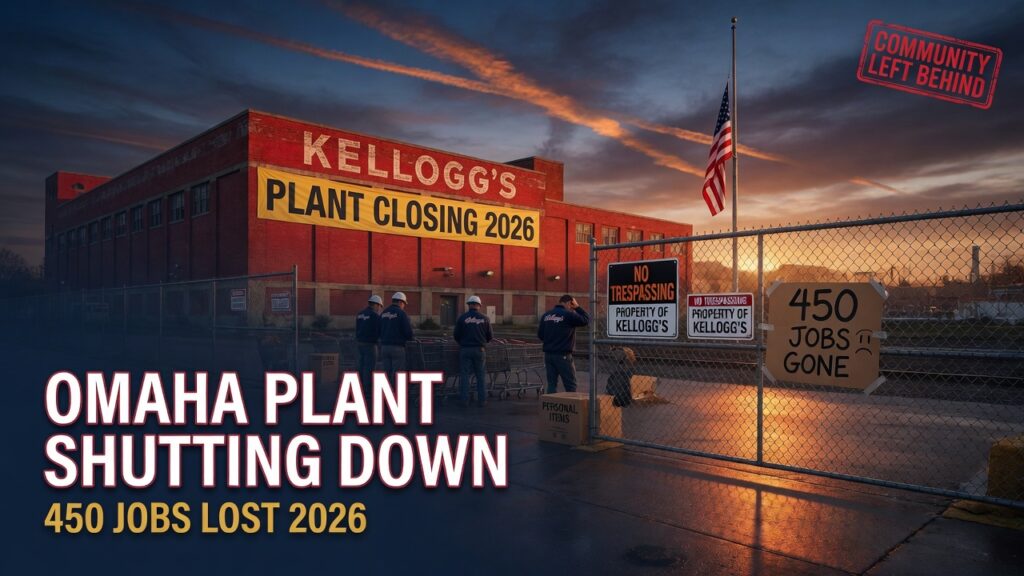
Kellogg's Omaha plant closure
As a cereal giant abandons 85 years of history and 450 livelihoods, Omaha’s families are left holding the bill — and America’s manufacturing decline is impossible to ignore any longer.
Four hundred and fifty families. One corporate memo. And a city left wondering what comes next.
By mid-August 2026, the last workers at WK Kellogg Co.’s Omaha, Nebraska plant will clock out for the final time — not because they failed, but because a boardroom decided consolidation mattered more than community. The plant at 96th and F Streets opened in 1942, survived wars, recessions, and strikes. It could not survive a restructuring strategy that prioritizes facilities in Michigan, Ontario, and Pennsylvania over the heartland workforce that built the brand.
A Decision Two Years in the Making — and Still Devastating
Kellogg’s didn’t spring this on anyone. In August 2024, WK Kellogg Co. formally announced the plant’s closure, promising a phased wind-down beginning in late 2025 and a full shutdown in 2026. The company framed it as strategic consolidation — a move toward a “streamlined” manufacturing footprint with investments in upgraded facilities elsewhere.
Support Independent Local Journalism
TheTownHall.News is a non-profit reader-supported journalism. Just $5 helps us hire local reporters, investigate important issues, and hold public officials accountable across Alameda County. If you believe our community deserves strong, independent journalism, please consider donating $5 today to support our work.But advance notice doesn’t soften the blow of permanent job loss. According to a letter filed with the Nebraska Department of Labor, approximately 100 workers will be laid off between July 6 and July 20, with the remaining ~350 employees losing their jobs between August 4 and August 18. The company confirmed that severance payments will be provided, and that both union and non-union workers are affected.
The timeline is orderly. The human cost is not.
What Do the Numbers Actually Tell Us?
5,000+. That’s how many manufacturing jobs Nebraska has lost compared to just one year ago, according to the Nebraska Department of Labor. The question no state official seems eager to answer: when does a trend become a crisis?
The WK Kellogg closure ranks as the second-largest single-site layoff in Nebraska in at least three years [Nebraska Department of Labor data]. Only the Tyson Foods shutdown in Lexington — which eliminated more than 3,000 jobs earlier in 2026 — exceeds it in scale. Two massive food-sector closures. One state. One year.

The Kellogg plant spans nearly 900,000 square feet across three buildings and carries a property valuation of approximately $24 million. That industrial campus, once a pillar of Omaha’s working-class economy, will now be listed for sale — its future purpose entirely unknown.
“When a factory that has fed American families for 85 years disappears, we are not just losing jobs — we are losing the connective tissue of a community. The question is whether anyone in power is paying attention.”
Is This the End of the American Manufacturing Town?
The Kellogg story is not unique to Omaha. It is a chapter in a longer, grimmer national narrative. American manufacturing employment has been under sustained pressure for decades, but something sharper appears to be happening now at the regional level. States like Nebraska — historically insulated from coastal economic volatility by strong agricultural and food-processing sectors — are no longer immune.
The closure of Kellogg’s Omaha plant is not just a local story. It is a warning flare for every mid-sized American city that assumed its industrial base was stable.
Economists and workforce development officials point to a convergence of pressures: automation, supply chain restructuring post-pandemic, and shifting corporate cost-benefit calculations that increasingly favor centralized mega-facilities over distributed regional plants. For the workers left behind, explanations don’t pay mortgages.
Who Is Really Paying for This — Workers or Shareholders?
Personal responsibility is a value most working Americans hold deeply. These Kellogg employees showed up. They worked the line, honored their contracts — some through an 11-week strike that they ultimately won — and kept production running. Their reward? A WARN Act notice and a severance package.
Support Independent Local Journalism
TheTownHall.News is a non-profit reader-supported journalism. Just $5 helps us hire local reporters, investigate important issues, and hold public officials accountable across Alameda County. If you believe our community deserves strong, independent journalism, please consider donating $5 today to support our work.Meanwhile, WK Kellogg Co. continues to operate profitable facilities in other states and Canada. The company’s strategic pivot doesn’t represent failure — it represents a deliberate corporate choice with real human consequences.
If 450 workers losing their livelihoods doesn’t prompt a serious conversation about what corporations owe the communities that sustain them, what will?
Fiscal accountability is not only a government issue. When a company benefits from local tax incentives, a trained regional workforce, and decades of community goodwill — and then exits without obligation — the ledger deserves scrutiny.
What Do Supporters of This Corporate Strategy Actually Believe?
This is a fair question, and it deserves a fair answer. Defenders of WK Kellogg’s decision argue that businesses must adapt to survive — that consolidating production into fewer, more modern facilities is economically rational, ultimately protects shareholder value, and may even preserve the company as a whole. They note that Kellogg’s provided nearly two years’ advance notice, offered severance to all affected employees, and followed legal obligations under the federal WARN Act. In a free-market economy, companies are not obligated to operate unprofitable facilities indefinitely.
These are legitimate points. No serious observer advocates for government mandates that force corporations to maintain uneconomical plants.
But there is a meaningful difference between accepting market realities and ignoring the systemic conditions that produce them. When tax policy, trade agreements, and regulatory frameworks consistently advantage consolidation and offshoring over regional investment, the “free market” is not operating in a vacuum — it is operating inside a policy environment that someone designed. That design deserves democratic scrutiny, and the communities bearing its costs deserve a voice in reshaping it.
Are Nebraska’s Leaders Finally Ready to Act?
State officials have acknowledged the scale of Nebraska’s manufacturing losses, but acknowledgment is not a policy. The convergence of the Tyson Foods and Kellogg closures — eliminating, combined, more than 3,500 jobs in a single year — should be prompting urgent legislative and economic development responses [Nebraska Department of Labor].
What specific workforce retraining programs are being funded? What tax incentive structures are being reviewed? What are Nebraska’s congressional representatives doing at the federal level to address the conditions driving food-sector consolidation?
If this happened in your hometown, would anyone in the statehouse be held accountable — or would the cameras simply move on?
These are not rhetorical luxuries. They are the questions that determine whether the next closure catches another community completely off guard.
🔲 KEY QUESTIONS This Story Raises
- Who bears long-term responsibility for 450 displaced workers in a state that has now lost 5,000+ manufacturing jobs in a single year — the corporation, state government, or federal policy?
- What will happen to the 900,000-square-foot Kellogg facility — and will its next use create comparable employment, or simply convert a working-class anchor into a warehouse or speculative investment?
- Is Nebraska’s manufacturing decline a temporary correction or a structural collapse — and what does the answer mean for every other mid-sized industrial community watching from the sidelines?
The Question That Should Follow Every Closing Ceremony
There will be no closing ceremony at 96th and F Streets. There will be final paychecks, exit interviews, and emptied lockers. There will be people quietly recalculating their futures — figuring out whether to retrain, relocate, or hold on.
Omaha’s Kellogg plant didn’t just produce Frosted Flakes and Froot Loops. It produced paychecks, careers, health insurance, retirement savings, and small-business revenue for every diner, hardware store, and school district that depended on its workers’ spending power. That economic ecosystem doesn’t disappear cleanly. It frays — and the fraying spreads.
The real question isn’t whether corporate restructuring is sometimes necessary. It is. The real question is who gets to decide what counts as necessary — and whether the people most affected ever get a seat at the table when those decisions are made.
The answer, in Omaha, arrived on a Tuesday morning when some workers were told to leave immediately.
What do you think — is it too late to change the conditions that make closures like this inevitable? Share this article and tell us where you stand.
Get Involved — Your Voice Matters
- Still have questions? Stay informed — subscribe for daily coverage of the stories that affect working Americans.
- Think others need to hear this? Share the article and start the conversation in your community.
- Want to make your voice count? Contact your Nebraska state legislators or your U.S. congressional representative and ask directly: what is the plan for workers displaced by manufacturing consolidation? You can find your representative at congress.gov/members.