American Tomato Farmers Are Winning Under Trump’s Mexico Tariffs — Here’s the Proof
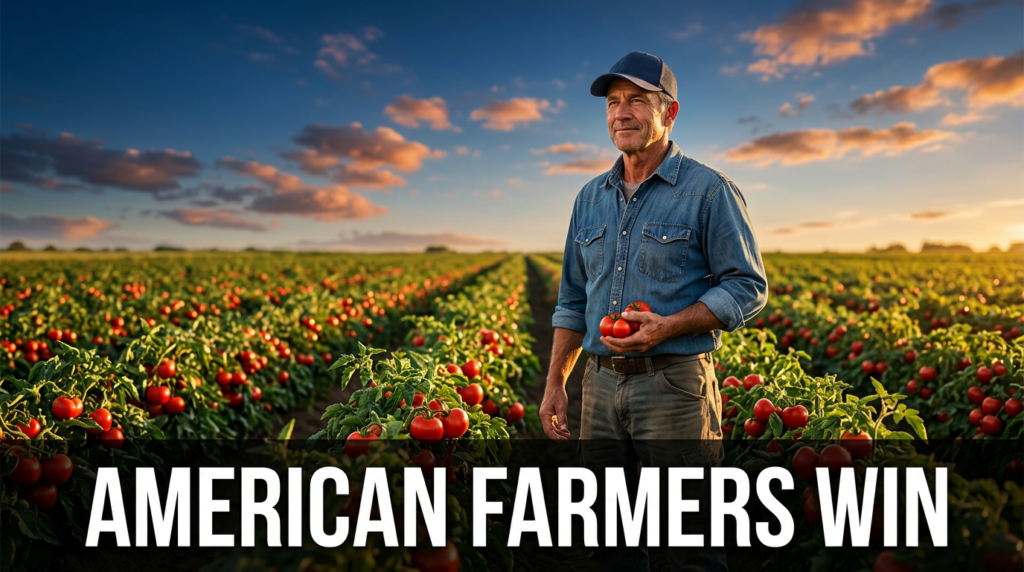
The same economists and media voices who predicted doom and gloom are being proven wrong by American farmers — one phone call at a time.
When the Trump administration announced it was withdrawing from a decades-old trade agreement and imposing a 17.09% anti-dumping tariff on fresh Mexican tomatoes, the chorus of criticism was immediate and loud. Prices would skyrocket, they said. Consumers would suffer. The policy was reckless. Within 48 hours of the tariff taking effect, American tomato farmers were already getting more calls than they could handle.
That’s not spin. That’s what happened. And it matters — because it’s one more data point in a growing body of evidence that the experts dismissing America’s trade policies as economic self-destruction may have fundamentally misunderstood what fair competition actually looks like for the people who grow our food.
Support Independent Local Journalism
TheTownHall.News is a non-profit reader-supported journalism. Just $5 helps us hire local reporters, investigate important issues, and hold public officials accountable across Alameda County. If you believe our community deserves strong, independent journalism, please consider donating $5 today to support our work.The Policy the Establishment Called a Mistake
On July 14, 2025, the U.S. Department of Commerce officially withdrew from the 2019 Suspension Agreement governing fresh tomato imports from Mexico, triggering a 17.09% anti-dumping duty on most Mexican tomato shipments entering the United States. The department cited years of evidence that Mexican producers had been pricing their tomatoes below fair market value — a practice known as “dumping” — making it structurally impossible for American growers to compete on price alone.
Mexico supplies approximately 70% of all fresh tomatoes consumed in the United States, according to the Florida Tomato Exchange. That market dominance wasn’t built on superior soil or better farming. It was built, at least in part, on artificially suppressed prices that undercut American producers who play by different rules — paying U.S. wages, complying with U.S. environmental regulations, and contributing to U.S. communities.
The question was never whether tariffs carry short-term costs. The real question was whether American food production is worth protecting — and who gets to answer it.
“It’s Only Been Two Days” — And the Phones Are Already Ringing
Chad Smith of Smith Tomato Farm in Steele, Alabama, put it simply: “It’s only been two days now, and we’ve actually had a lot more calls of people having interest in doing business — and the price hasn’t even changed.”

That single quote encapsulates something the models and the op-eds consistently miss: markets respond to signals, not just prices. The moment American buyers understood that Mexican tomatoes would now carry an additional cost, they started looking for domestic alternatives. Before a single price tag changed at the grocery store, American farmers were already fielding new business inquiries.
Smith’s fellow growers echoed the sentiment across the country. Matt Rudd of Rudd Family Farm in Browns Summit, North Carolina, said the tariff means store shelves should “be more local and United States-grown — where we can compete with those prices.” Sam Newell of Fruit Fair in Chicopee, Massachusetts, called it “a win-win for the community and us,” adding that the tariff finally gives domestic producers “a more level playing field.”
This is what fair competition looks like when the government steps in to enforce it — not to pick winners, but to stop a system that was structurally penalizing American producers for following American rules.
Food Security Is National Security
There’s a deeper argument here that cuts beyond economics: a nation that cannot feed itself is a nation that has surrendered a critical dimension of its sovereignty.
Logan Duvall of Me and McGee Market in Little Rock, Arkansas, put the broader stakes plainly: “We see the impact when that money goes directly to our farmers in our community versus a multinational conglomerate — it’s a big difference.”
Support Independent Local Journalism
TheTownHall.News is a non-profit reader-supported journalism. Just $5 helps us hire local reporters, investigate important issues, and hold public officials accountable across Alameda County. If you believe our community deserves strong, independent journalism, please consider donating $5 today to support our work.Steve Longmire of Tennessee Homegrown Tomatoes in Rutledge, Tennessee, looked further down the calendar: “In the fall and wintertime… that’s where it’s going to be a good thing for the farmer. Hopefully more of their tomatoes are going to sell at a little bit better price because of the tariff on the imports.”
The argument for domestic food production isn’t protectionism for its own sake. It’s the recognition that an agricultural sector hollowed out by decades of unfair competition leaves America dependent on foreign supply chains for something as fundamental as fresh produce. We learned painful lessons about supply chain vulnerability in recent years. Food is not an area where that vulnerability should be acceptable.
What the Critics Get Wrong
The standard counterargument runs like this: tariffs raise prices for consumers, hurt low-income households disproportionately, and invite retaliatory measures from trading partners. These are legitimate concerns that deserve honest engagement.
The price data bears watching. By late November 2025, tracking by Investopedia found that grape tomato prices had risen modestly at major retailers — approximately 4% at Walmart, 8% at Target, and 18% on Amazon — compared to pre-tariff baselines. These are real increases, and no serious advocate for this policy should pretend otherwise.
But context matters. First, these are early-stage price effects in a market that is still adjusting. Domestic supply does not scale overnight. Growers need seasons, not days, to expand capacity and meet new demand signals. The short-term price bump is the market in transition — not the market at equilibrium.
Second, the alternative — a permanent status quo where 70% of America’s tomato supply comes from a country whose producers were formally found to be dumping below market value — carries its own enormous long-term cost. That cost is measured in shuttered family farms, rural economic decline, and increasing dependence on foreign agricultural supply chains.
Third, the tariff applies specifically to anti-dumping enforcement, not a general trade wall. It is a narrowly targeted correction of a documented market distortion. Framing it as “protectionism” mischaracterizes both the mechanism and the intent.
The Farmers Who Were Told to Accept the Inevitable
There is a human story here that the macro-economic debate tends to erase. American tomato farmers have spent years being told, implicitly and sometimes explicitly, that they should adapt or exit. That the global market had spoken. That competing with cheaper Mexican imports was simply not viable in the long run.
Rich Troccio, owner of Bloomfield Groceria in Pittsburgh, Pennsylvania, said it directly: “It will not bother me if he put a 50% tariff on Mexico… as long as it’s something grown here, this is where I want to buy my product.”
That’s not a fringe view. It’s the view of someone who understands that local supply chains, local producers, and local dollars kept in local economies are not just sentimental preferences — they are genuine sources of community resilience.
Mark Reuben of Gilcrease Orchard in Las Vegas, Nevada, noted that his farm wouldn’t even raise prices in response to the tariff — keeping tomatoes at $1.50 per pound. American producers are not automatically passing costs to consumers. Many are seizing the competitive opening to grow their customer base.
Key Takeaway
When the rules of trade are fair, American farmers can compete. The tomato tariff isn’t an attack on the free market — it’s a correction that makes the free market actually function.
The Bigger Picture: Who Decides What America Produces?
Underlying this entire debate is a question about values as much as economics: Do we believe it matters where our food comes from? Do we believe the capacity to produce our own agricultural goods has strategic and civic value beyond its price tag?
For decades, the answer from Washington’s consensus class was essentially “no.” Global supply chains were efficient. Comparative advantage would sort everything out. The farmer in Alabama or Tennessee would find something else to do.
The results of that philosophy are visible in hollowed-out agricultural communities across the American South and Midwest. The tariff on Mexican tomatoes is, in part, a rejection of that logic — a signal that food production is a national interest, not just a line item on a global supply chain spreadsheet.
Conclusion: Don’t Apologize for Expecting Fair Competition
American tomato farmers didn’t ask for handouts. They asked for a level playing field. The Trump administration’s anti-dumping tariff on Mexican tomatoes is delivering exactly that — and the early signs are encouraging. Farmers are receiving new business inquiries. Domestic demand for American-grown produce is responding to the new pricing environment. The policy is working.
Yes, there are real costs in the transition. Prices have nudged upward at retail. Supply capacity will take time to scale. These challenges deserve honest monitoring and transparent reporting.
But the story being written in Alabama, North Carolina, Tennessee, and farms across the country is not the story of a failed policy. It’s the story of American producers discovering, perhaps for the first time in a long time, that the rules of the game are finally tilted in their favor.
The experts said it couldn’t work. The farmers are already proving otherwise.
Stay Informed. Stay Engaged. Stay American.
This is the kind of story that doesn’t always make the front page of legacy media — but it should. If you believe in fair trade, food security, and the survival of American family farms, share this article and help make sure the real story gets told. Subscribe to independent journalism that covers the issues that matter to your community, and make your voice heard at every level of civic life.