A Korean Startup Says Sunlight Can Clean Your Drinking Water in 30 Minutes. The Science Is Real — But the Hard Truth Is More Complicated
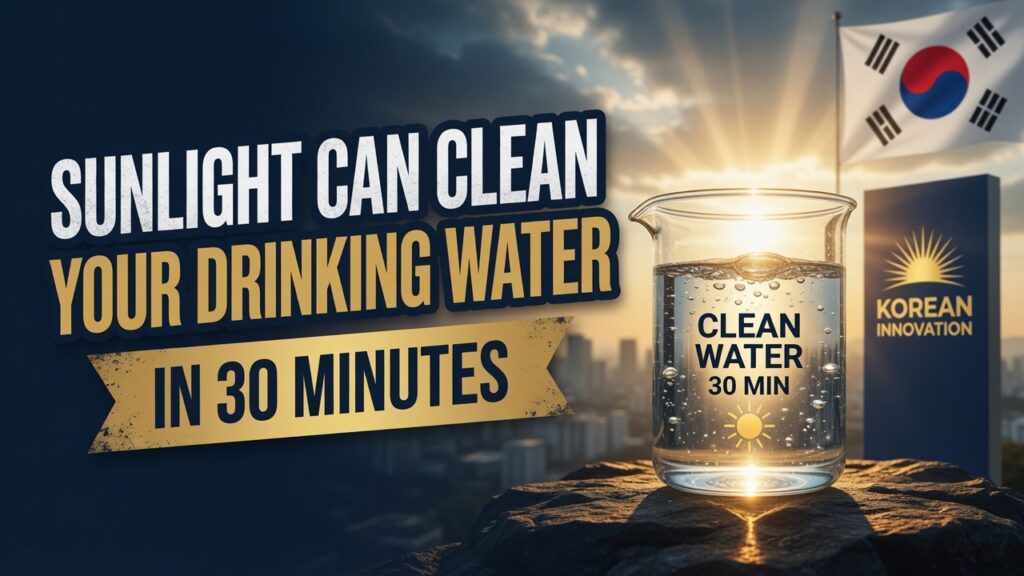
A viral green tech demo from Seoul is making waves. Here’s what the research says, what it doesn’t, and what 2.1 billion people actually need.
A video from a green tech expo in Seoul is circulating online, and the hook is irresistible: a startup showing off strange green balls that can purify contaminated water using nothing but sunlight. No machines. No chemicals. No electricity bill.
It’s the kind of breakthrough that sounds too clean to be true — and in important ways, it still is.
Support Independent Local Journalism
TheTownHall.News is a non-profit reader-supported journalism. Just $5 helps us hire local reporters, investigate important issues, and hold public officials accountable across Alameda County. If you believe our community deserves strong, independent journalism, please consider donating $5 today to support our work.But here’s what’s striking: the science behind it isn’t fringe. It isn’t pseudoscience. It’s been sitting in peer-reviewed journals since 1972, it’s attracted billions in market investment, and it has quietly become one of the most studied technologies in environmental engineering. The question hanging over it isn’t whether it works in a lab. It’s whether it will ever work where it’s actually needed.
What Exactly Did That Startup Show?
The demo took place at ENVEX — the International Exhibition on Environmental Technology & Green Energy — organized by Korea’s Ministry of Environment and the Korea Environmental Conservation Institute (KECI). The expo, which has run annually since 1979, is no fringe event. ENVEX 2025 drew 262 companies from 13 countries, with an estimated 45,000 visitors, and is specifically designed to help small and medium-sized green tech enterprises scale globally through buyer meetings and export programs.
The “green balls” the startup displayed are a form of floating photocatalyst — a physical structure coated in titanium dioxide (TiO₂) nanoparticles designed to sit on the surface of water and be activated by sunlight. The concept has direct antecedents in Korean patent literature: at least one documented invention describes a floating body made of expanded polystyrene with TiO₂ nanoparticles fixed to its surface, engineered to photodegrade pollutants while floating.
The form factor — cheap, passive, deployable without infrastructure — is the entire pitch.

The Chemistry Is Legitimate
Photocatalysis using titanium dioxide is not a startup gimmick. It was first identified as a promising water treatment method in 1972 by Fujishima and Honda, who demonstrated that UV light could trigger electrochemical reactions on TiO₂ surfaces. The mechanism is well understood: when UV photons from sunlight are absorbed by TiO₂, they excite electrons and create electron-hole pairs. Those pairs migrate to the surface where, in contact with water and oxygen, they generate reactive oxygen species (ROS). Those ROS then attack and destroy bacteria, algae, viruses, and a range of organic contaminants.
Studies have demonstrated removal of up to 99% of certain harmful contaminants under controlled lab conditions in as little as 10–30 minutes. One published study using TiO₂ nanowire filters paired with carbon nanotubes showed the material could trap pathogens mechanically while the UV-triggered ROS attacked them simultaneously — a double kill mechanism with no chemicals required.
TiO₂ is also non-toxic, chemically stable, inexpensive, and already used in everything from sunscreen to food packaging. From a materials standpoint, it is almost ideal.
The global photocatalytic water treatment market reflects this optimism: valued at $1.2 billion in 2024, it is projected to reach $2.8 billion by 2033 at a compound annual growth rate of 10.5%.
So Why Isn’t Everyone Using It?
“Although heterogeneous photocatalysis has been recognized as a promising technology for decontaminating and disinfecting municipal and industrial wastewater over the last few decades, it has not yet successfully transitioned from laboratory-scale research to real-world applications.” — Journal of Environmental Chemical Engineering, 2024
That sentence is worth sitting with. Decades of research. Over 8,000 scientific papers published since 2000 on photocatalytic water treatment alone. And still no large-scale commercial deployment.
Support Independent Local Journalism
TheTownHall.News is a non-profit reader-supported journalism. Just $5 helps us hire local reporters, investigate important issues, and hold public officials accountable across Alameda County. If you believe our community deserves strong, independent journalism, please consider donating $5 today to support our work.The core problem is physics. Standard TiO₂ has a large bandgap that restricts its light absorption almost entirely to the ultraviolet range — which makes up only about 5% of the solar spectrum. On a clear day in a sun-drenched region, it works. On a cloudy day, in a monsoon, at night, in a turbid river carrying heavy sediment — the efficiency drops sharply. Researchers are actively working to extend TiO₂’s absorption range into visible light through metal doping, heterostructures, and composite materials, but these enhancements remain largely in the laboratory.
There is also the recoverability problem. When TiO₂ is used as a loose powder in water — the most efficient configuration because it maximizes surface area — it becomes nearly impossible to remove completely from the treated water. And ingesting nanoparticles is not considered safe. The “ball” or structural form addresses this by fixing the TiO₂ to a surface, but that trade-off reduces the reactive surface area and, with it, the speed and effectiveness of decontamination.
Then there’s the scale problem. A backyard pond test and a river serving 50,000 people are categorically different engineering challenges. Flow rates, turbidity, contaminant concentrations, temperature variation, and maintenance requirements all compound in ways that lab studies don’t model.
Why This Still Matters Enormously
Set aside the caveats for a moment and look at the demand side of this equation.
According to WHO and UNICEF data released in August 2025, 2.1 billion people — one in four globally — still lack access to safely managed drinking water. 106 million of them drink directly from untreated surface sources. A World Bank report published in November 2025 found the world is losing 324 billion cubic meters of freshwater every year through droughts and mismanagement — enough to supply 280 million people annually. The FAO reported in December 2025 that renewable water availability per person has declined 7% over the past decade.
The communities at greatest risk are precisely those least able to build conventional water treatment infrastructure: rural villages, post-conflict zones, islands, flood-prone areas of Sub-Saharan Africa and South Asia. These are also, in many cases, the places with the most abundant sunlight year-round.
That alignment — abundant sun, absent infrastructure, desperate need — is exactly why solar photocatalysis has attracted so much research attention. The technology doesn’t need to be perfect to be transformative. It needs to be good enough, cheap enough, and durable enough.
The ENVEX startup’s green balls are a bet on that premise. So is a growing body of engineering work combining TiO₂ with carbon nanotubes, graphene composites, and MXene materials to build hybrid filters that can purify water as it passes through them — no slurry, no recovery problem, and enough solar-driven reactivity to kill a broad spectrum of pathogens.
KEY QUESTIONS
Does sunlight photocatalysis actually kill pathogens? Yes, under the right conditions. Bacteria, algae, and certain viruses are verifiably destroyed by TiO₂-triggered reactive oxygen species. The 99% removal figures are real — in lab conditions with clean, thin-layer water and adequate UV exposure.
Why hasn’t it scaled? Standard TiO₂ only absorbs UV light, which is a tiny fraction of sunlight. It doesn’t work at night or in turbid water. Loose nanoparticle forms are hard to recover. Fixed-form catalysts trade off surface area for safety.
Is the ENVEX startup credible? The technology basis is credible. The event is credible. The specific company’s claims about deployment scale, durability, and real-world pathogen clearance warrant independent verification before anyone treats this as a solved problem.
What would success actually look like? A photocatalytic system that works on cloudy days, handles turbid water, requires no maintenance, costs under $5 per household per year, and clears regulatory approval for drinking water use. None of those bars have been cleared at scale yet.
Who would benefit most? The 106 million people drinking directly from untreated surface water — rivers, streams, ponds — primarily in low-income countries in Sub-Saharan Africa, South Asia, and parts of Southeast Asia.