Del Monte Bankruptcy Leaves California Peach Growers with $550 Million in Broken Contracts
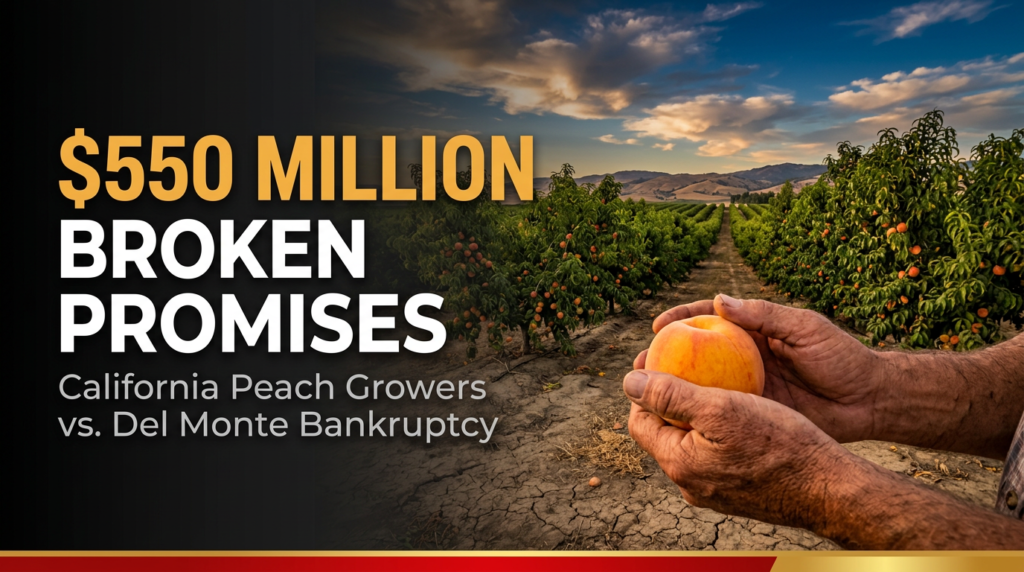
Seventy California farming families who honored their contracts are now watching their orchards face the bulldozer. The question isn’t just who failed them — it’s whether Washington will make it worse.
Sarb Johl didn’t plant his peach trees in Yuba County on a whim. He planted them under a 20-year contract with Del Monte Foods — the kind of long-term agreement that a farmer bets his livelihood on, that banks lend against, and that families build generational plans around. This spring, those trees are heavy with fruit. And there is nowhere to sell it.
Del Monte Foods filed for Chapter 11 bankruptcy on July 1, 2025. By August, it had voided its contracts with roughly 70 California cling peach growers. Its iconic Modesto and Hughson canneries — once the engine of California’s processed fruit industry — closed permanently on April 7, 2026. What’s left behind is a $550 million crater in the heart of the Central Valley and a hard question about who is responsible for picking up the pieces.
Support Independent Local Journalism
TheTownHall.News is a non-profit reader-supported journalism. Just $5 helps us hire local reporters, investigate important issues, and hold public officials accountable across Alameda County. If you believe our community deserves strong, independent journalism, please consider donating $5 today to support our work.A Crisis Built on Broken Contracts, Not Bad Farming
Let’s be clear about what happened here: these growers did everything right.
They signed long-term agreements. They planted specific cling peach varieties suited exclusively to canning — not the fresh market. They invested in orchards, equipment, irrigation, and labor, all structured around a stable, contracted buyer. Del Monte’s collapse wasn’t caused by their mismanagement. It was a corporate failure, accelerated by shifting consumer habits, pandemic-era financial miscalculations, and decades of accumulated debt.
The California Canning Peach Association has filed a bankruptcy claim for more than $550 million — the collective value of the voided contracts. But a claim filed in bankruptcy court is far from a guaranteed payment. Unsecured creditors in Chapter 11 cases routinely recover cents on the dollar, if anything at all.
For farmers like Johl, who grew thousands of pounds of peaches solely for Del Monte, there is no pivot table or restructuring plan. There is just an orchard — and the looming cost of tearing it out.

The Last Cannery Standing — and Its Limits
When Del Monte exited the market, it left Pacific Coast Producers (PCP) — a cooperative of about 160 Northern California family farmers — as the only remaining cling peach canner in the state. PCP moved quickly, acquiring Del Monte’s canned fruit assets and brand rights, including the Del Monte and S&W labels, completing the transaction in late March 2026. CEO Matt Strong called it “a significant event for our grower owners.”
But the math is brutal. Del Monte’s contracts last year covered approximately 74,000 tons of cling peaches. PCP offered one-year contracts for only about 24,000 tons. That leaves more than 50,000 tons — spread across an estimated 3,000 acres — without a buyer, a processor, or a future.
When bankruptcy proceedings failed to produce a buyer for the Modesto cannery, whatever hope remained for salvaging the industry’s processing capacity evaporated. Fresh Del Monte Produce — a separate company that purchased the Del Monte brand for $285 million in the court sale — confirmed it has no plans to reopen the shuttered plants.
The math is simple: you cannot can peaches without a cannery.
Why This Matters Beyond the Farm Gate
The ripple effects extend far beyond individual orchards. The Modesto cannery closure eliminated approximately 1,800 jobs. The Yuba-Sutter regional economy — already a working-class corridor with tight margins — is absorbing a significant blow. The Sutter County agricultural commissioner has already warned in writing that the crisis risks producing abandoned orchards, which carry regulatory fines for their operators and can trigger pest infestations that spread to neighboring farmland.
Support Independent Local Journalism
TheTownHall.News is a non-profit reader-supported journalism. Just $5 helps us hire local reporters, investigate important issues, and hold public officials accountable across Alameda County. If you believe our community deserves strong, independent journalism, please consider donating $5 today to support our work.This isn’t an abstract policy dispute. It’s a concrete collapse of a supply chain that sustained families, communities, and regional tax bases for generations.
The loss of domestic canning capacity also raises longer-term questions about food supply resilience. The United States is steadily ceding processed fruit production to foreign competitors. Once that infrastructure is gone — the canneries, the workforce, the grower expertise — it does not come back quickly or cheaply.
Washington Enters the Picture — With Mixed Signals
In March 2026, a bipartisan group of California lawmakers — including Reps. Mike Thompson (D), David Valadao (R), and Sen. Adam Schiff (D) — sent a letter to USDA Secretary Brooke Rollins requesting $9 million in targeted relief for affected growers. The request aligns with a broader $12 million tree-pull program proposed by the California Canning Peach Association, which includes a $3 million industry match.
The proposal is modeled on a similar federal program that supported the cling peach industry in 2005. The funds would help growers remove peach orchards and transition to another permanent crop, with additional requests for access to disaster programs, technical assistance, and economic development support.
“Many impacted growers are multi-generational family farmers who have invested decades in orchards built around stable processor relationships,” the lawmakers wrote. “Without a proper response, there is a risk of long-term structural damage to our nation’s agricultural base.”
What Critics Get Wrong
Some observers will reflexively reach for the “no-bailout” argument: let the market sort it out; don’t use taxpayer money to prop up industries that can’t sustain themselves. It is a view rooted in genuine principle, and it deserves a serious response.
The peach growers of the Central Valley are not asking to be insulated from competition or protected from their own poor decisions. They are asking for transitional assistance — partially funded by their own industry — to help them move to crops the market actually wants. The $12 million figure is modest by federal standards. And the cost of not acting — abandoned orchards, pest spread, rural economic decline, lost agricultural infrastructure — may ultimately be far higher.
Moreover, decades of trade policy, import competition, and regulatory burdens have steadily compressed margins for domestic processors. These growers didn’t fail in a neutral market — they operated in one shaped by government decisions. That context doesn’t eliminate personal responsibility, but it does complicate the “pure market” narrative.
The Orchard Decision No Farmer Wants to Make
For Sarb Johl and growers like him, the calculation is excruciating. Keep the trees and grow a crop with no confirmed buyer? Or tear out orchards that took decades to mature, absorb the short-term loss, and bet on a new crop cycle with an uncertain return timeline?
Some are considering almonds, pistachios, or walnuts — crops with stronger market demand. But tree nut orchards take years to produce commercially viable yields. Farmers carry costs in the meantime: land, water, taxes, labor, equipment. For growers already absorbing the loss of voided contracts, those carrying costs are not theoretical.
When a 20-year contract gets torn up overnight, the damage doesn’t heal in a single growing season.
Key Takeaway
The Del Monte collapse is a case study in what happens when corporate failure is absorbed entirely by the people least able to absorb it: small family farmers who honored their agreements in good faith. Targeted federal assistance — structured, time-limited, and partially industry-funded — is not a contradiction of free-market values. It is a recognition that markets don’t always fail cleanly, and that communities built on generations of agricultural investment deserve more than an invoice and a bankruptcy notice.
Stay Informed. Get Involved.
This story is still developing. The USDA has not yet responded publicly to the congressional letter. The 2026 peach harvest is approaching. And for families like Sarb Johl’s, the decisions being made right now will shape what their farms look like — or whether they exist at all — five years from now.
If you believe in supporting American farmers, holding corporations accountable, and ensuring Washington responds when communities need it most, share this article. Subscribe to independent local journalism. And contact your representatives — because the people deciding on this relief package need to hear from engaged citizens.
Sources: Sacramento Bee, Fresh Fruit Portal, Territorial Dispatch, California Canning Peach Association, U.S. Congressional letter to USDA Secretary Brooke Rollins (March 13, 2026).