ICE Makes Nearly 20,000 Immigration Arrests in Washington, D.C. Region — What the Data Really Reveals
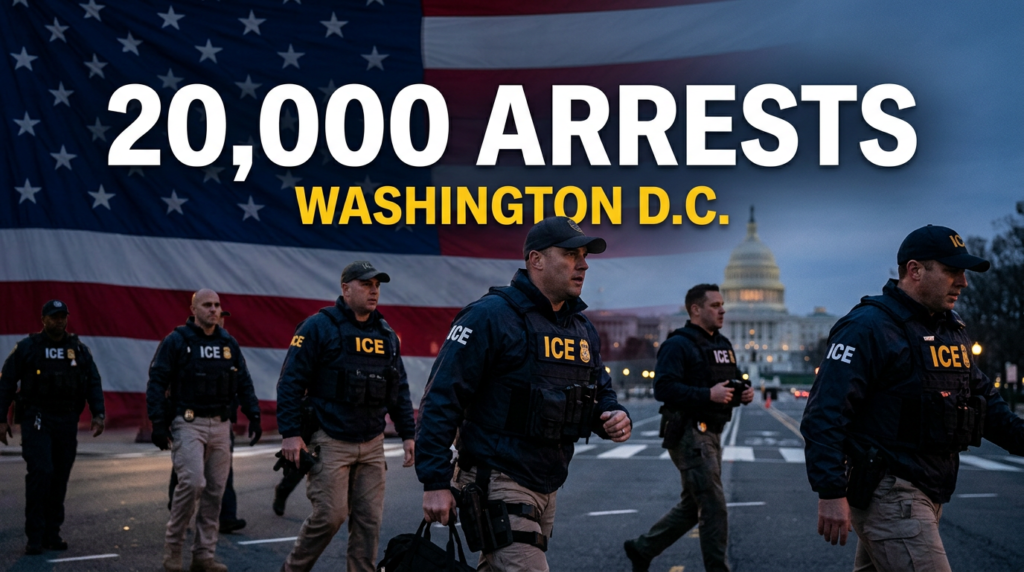
The numbers are in, the courts have weighed in, and the debate is sharper than ever. The Trump administration’s immigration crackdown in the nation’s capital is rewriting the rules of enforcement — and forcing a long-overdue national conversation about law, order, and the limits of government power.
For years, Washington, D.C. was something of an enforcement-free sanctuary — a city where federal immigration law existed on paper but was selectively ignored in practice. That era is over.
According to a Washington Post analysis of federal data published April 6, 2026, Immigration and Customs Enforcement agents made nearly 20,000 arrests across D.C., Maryland, and Virginia between January 20, 2025 — the first day of President Trump’s second term — and March 10, 2026. To put that in perspective: in the last full year of the Biden administration, ICE recorded fewer than 3,800 arrests in the same region. That is a more than fivefold increase in enforcement activity in just over a year.
Support Independent Local Journalism
TheTownHall.News is a non-profit reader-supported journalism. Just $5 helps us hire local reporters, investigate important issues, and hold public officials accountable across Alameda County. If you believe our community deserves strong, independent journalism, please consider donating $5 today to support our work.The message is unmistakable. The federal government is once again treating immigration law as law.
A Mandate From the Ballot Box
Trump made illegal immigration the defining issue of his 2024 campaign, and voters responded. The enforcement surge in the D.C. region is not a rogue operation — it is the direct execution of a democratic mandate. When a candidate wins an election on a platform of border security and interior enforcement, the administration that follows has both the authority and the obligation to act.
Nationally, ICE quadrupled its total arrest numbers in 2025 compared to the final months of the Biden era. Street arrests increased elevenfold. Daily arrest rates reached approximately 1,000 per day. Detention capacity expanded from roughly 40,000 beds in January 2025 to over 60,000 by October — with a record 73,000 detainees held by mid-January 2026, according to data from the TRAC Immigration project at Syracuse University.
These are not abstractions. They represent real enforcement of laws that were passed by Congress, signed by presidents of both parties, and long left to gather dust.

What the Numbers Actually Tell Us
Critics have been quick to seize on one specific data point: that approximately 60 percent of those arrested in the D.C., Maryland, and Virginia region had no prior criminal record. In Maryland alone, from August 2025 onward, that figure climbed to 70 percent — and peaked near 80 percent in February 2026, according to federal data analyzed by the Deportation Data Project at the University of California at Berkeley.
This is a legitimate policy debate. Prioritizing violent offenders is sound strategy, and enforcement agencies should be held accountable for how they allocate resources. The data deserves scrutiny.
But here is the critical distinction that critics consistently blur: lacking a U.S. criminal record is not the same as being in the country legally. Every individual arrested by ICE was present in the United States without legal authorization — a civil violation of federal immigration law, regardless of any additional criminal history. The law does not require a violent rap sheet as a precondition for enforcement. Choosing to enforce the law as written is not extremism. It is governance.
The Courts Weigh In — And The Boundaries Are Being Drawn
The enforcement surge has not gone unchallenged. In December 2025, U.S. District Judge Beryl A. Howell issued a preliminary injunction finding that the administration’s practice of making warrantless immigration arrests in Washington, D.C., likely violated federal law. Howell criticized what she called a “systemic failure” to follow proper legal procedure, specifically citing instances where immigration officials misstated the legal standards for warrantless arrests in public statements.
ICE arrests in the District subsequently dropped sharply — from over 1,400 between August and November 2025 to just over 100 arrests between December 2025 and early March 2026.
Support Independent Local Journalism
TheTownHall.News is a non-profit reader-supported journalism. Just $5 helps us hire local reporters, investigate important issues, and hold public officials accountable across Alameda County. If you believe our community deserves strong, independent journalism, please consider donating $5 today to support our work.Separately, federal courts have ruled more than 4,400 times since October 2025 that ICE improperly detained specific individuals, according to a Reuters investigation published in February 2026. Those rulings came from more than 400 different federal judges.
This is the system working as designed. The executive branch enforces; the judiciary checks abuses. The answer to procedural overreach is not to abandon immigration enforcement — it is to conduct that enforcement lawfully. Constitutional constraints apply to method, not mission.
What Critics Get Wrong
Opponents of enforcement often frame this debate as a humanitarian crisis caused by overzealous government — and some of the individual stories are genuinely difficult. Advocates have documented cases of immigrants arrested at scheduled check-in appointments with federal immigration offices, people who were actively complying with the process when they were detained.
Those cases warrant serious scrutiny. Due process is not optional, and the government must follow the law in how it enforces the law.
But the larger critique — that immigration enforcement itself is inherently unjust — rests on a foundation that most Americans do not accept. A nation that cannot or will not enforce its own laws does not have a border; it has a suggestion. The same civic framework that protects individual rights also depends on a functioning, enforceable rule of law. You cannot selectively honor one without undermining the other.
Furthermore, the Biden administration’s own record is instructive. Under that administration, interior enforcement collapsed — a deliberate policy choice that effectively rewarded those who had entered or remained illegally with de facto immunity. The current enforcement surge is, in large part, a correction to that collapse.
The Real Stakes for Communities
The human dimension of this story cuts in multiple directions. Advocates for immigrant communities in the D.C. region have documented real disruption — families pulling children from after-school programs, residents avoiding public spaces, civic trust eroding in communities like Brentwood, Maryland, where local officials say they know of “countless” individuals detained over the past year.
These are real consequences and they should be acknowledged honestly.
But communities also have a legitimate interest in knowing that those living and working alongside them are doing so within the law. Law-abiding immigrants who have followed the process — waited in line, filed the paperwork, built lives within the system — deserve a government that enforces the rules they followed. Selective enforcement is not compassion. It is a two-tiered system that punishes those who play by the rules and rewards those who do not.
Maryland and Virginia continued to see over 800 ICE arrests per month on average between September 2025 and early March 2026, even as D.C. enforcement slowed following the court ruling. Enforcement has not stopped — it has shifted and adapted.
Key Takeaway
The data is clear, the legal framework is being tested, and the policy debate is live. ICE has made nearly 20,000 arrests in the D.C. region in just over a year — a fivefold increase over the Biden era. Courts have pushed back on specific methods, not the mission itself. The administration is enforcing the law; the judiciary is refereeing the boundaries. That is not a constitutional crisis — that is the constitutional system functioning exactly as it was designed.
The question for Americans is not whether immigration law should exist. It is whether their government has the will to enforce it. For the first time in years, the answer appears to be yes.
Where This Goes From Here
With a new DHS Secretary — Oklahoma Senator Markwayne Mullin, confirmed in late March 2026 after Kristi Noem’s dismissal — the department is expected to continue aggressive enforcement while working to shore up procedural vulnerabilities exposed by the court rulings. Congress, meanwhile, has yet to pass comprehensive immigration reform, leaving the executive branch to operate under a legal framework written decades ago, never designed for today’s scale of enforcement.
The courts will continue to define the boundaries. The administration will continue to push them. And the American public — which has consistently ranked illegal immigration as a top-tier concern in national polling — will render its own verdict at the midterms.
Immigration law is federal law. Enforcing it is not optional — it is constitutional obligation. The debate now is over how, not whether.
Stay informed on issues that matter. Share this article with your network, subscribe to independent journalism, and make your voice heard through civic engagement — at the ballot box, at town halls, and in your community.