NYC Knicks Celebration Turns Violent: 63 Arrested, Teen Shot, Buses Burned
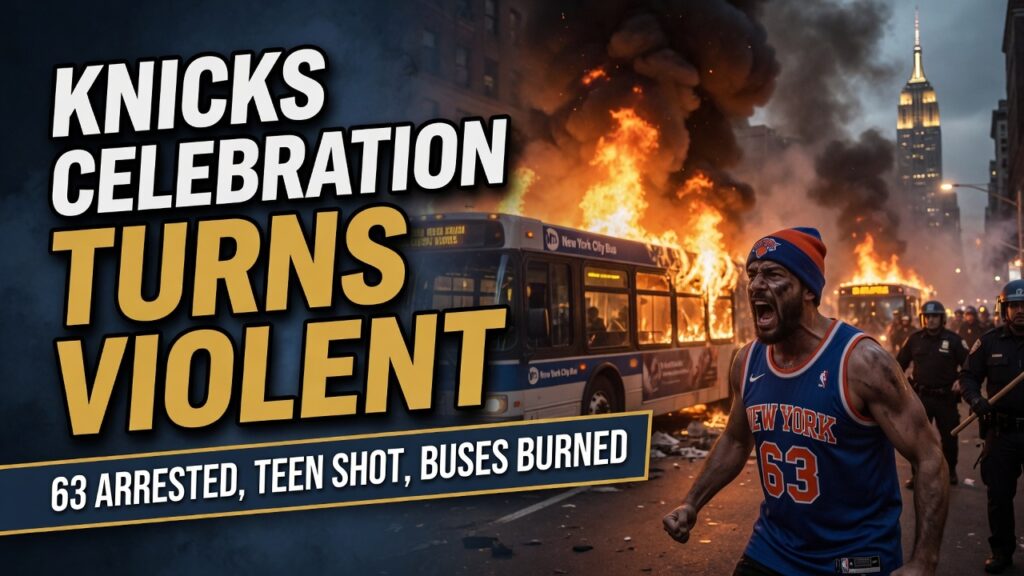
A teenager was shot in Times Square, five buses were set on fire, and ten police officers were injured — all while New York City celebrated a basketball championship. The question that deserves a real answer: how did it get this bad, and who is responsible for letting it happen?
New York City had fifty-three years to plan for this moment.
When the Knicks secured their first NBA championship since 1973 on the night of June 13, 2026, city officials knew tens of thousands of people would flood the streets around Madison Square Garden. The NYPD prepared. The mayor posted on social media. And by 2 a.m., a 17-year-old boy had been shot in the foot on Broadway, ambulances could not reach the scene because crowds had physically taken over the street, and five school buses — vehicles being used to shuttle soccer fans to World Cup matches at MetLife Stadium — were engulfed in flames.
Support Independent Local Journalism
TheTownHall.News is a non-profit reader-supported journalism. Just $5 helps us hire local reporters, investigate important issues, and hold public officials accountable across Alameda County. If you believe our community deserves strong, independent journalism, please consider donating $5 today to support our work.What Actually Happened on the Streets of Manhattan?
The facts, as confirmed by the NYPD and multiple news organizations, are not in dispute. Sixty-three people were arrested on charges including assault on a police officer, criminal possession of a weapon, criminal mischief, disorderly conduct, and resisting arrest. Ten NYPD officers were injured — one punched in the face, another struck with a glass bottle. Five police vehicles were damaged when rioters smashed windshields and jumped on hoods. At least four additional victims were slashed or stabbed. Fireworks were launched into crowds. People scaled traffic lights, scaffolding, and statues.
Around 2 a.m., bystander video captured the sound of at least seven gunshots near 42nd Street and Broadway, with people crouching and running for cover. The 17-year-old victim was shot once in the left foot and transported to Bellevue Hospital — not by ambulance, but by police officers in a patrol car, because the crowd had made the street impassable to emergency vehicles. Three people of interest were taken into custody and a firearm recovered.
63 arrests. 10 injured officers. 1 teenager shot. The question New York’s leaders have not answered: was any of this preventable?
Is This What “Celebration” Looks Like in a Well-Governed City?
The violence did not appear from nowhere. It followed a pattern that had been building for weeks. Earlier in the playoffs, a 39-year-old man wearing a San Antonio Spurs jersey was stomped and punched on West 47th Street while people tried to rip the jersey off his body. His cell phone was stolen. He was hospitalized. A separate incident during the playoffs left a teen in a coma. Dozens of arrests had already been made throughout the Finals series, including significant disorder after Games 3 and 4.

City officials were not blindsided. They were warned by the events themselves.
If a city government cannot protect an ambulance’s access to a shooting victim because crowds have taken over a street, it is not a crowd control problem — it is a governance failure.
Knicks owner James Dolan, speaking from San Antonio after the game, personally interrupted a player’s press conference to urge fans to stay calm. “Please be safe. Don’t get hurt, don’t hurt anybody,” he said. That a team owner felt compelled to issue a public safety plea from another state speaks to how predictable the chaos had become.
Who Is Really Paying the Price for This Failure?
The most immediate victim is a 17-year-old boy who will carry a bullet wound from a celebration he did not start. He is, by all accounts, in stable condition — and that is something to be grateful for. But the story does not end with him.
The five school buses destroyed were not Knicks-owned property. They were municipal transport vehicles being used to carry World Cup visitors from Manhattan to MetLife Stadium for FIFA matches — an international event New York had committed to hosting. The destruction sent a message to the world about what kind of city New York is right now.
Five police vehicles were also damaged. Ten officers were injured in the line of duty, not in a crisis no one saw coming, but at a predictable public event in one of the most heavily policed cities on earth. Every hospitalization, every repaired windshield, every torched bus represents a cost borne by taxpayers and a burden placed on civil servants who showed up to protect a celebration.
Support Independent Local Journalism
TheTownHall.News is a non-profit reader-supported journalism. Just $5 helps us hire local reporters, investigate important issues, and hold public officials accountable across Alameda County. If you believe our community deserves strong, independent journalism, please consider donating $5 today to support our work.If rioters face no real consequence, the message to the city is clear: mob behavior works.
What Do Supporters of Current Crowd Policy Actually Believe?
To be fair to those defending the city’s response, managing a spontaneous crowd of tens of thousands of euphoric people in one of the world’s most densely populated urban environments is genuinely difficult. Law enforcement officials did make arrests. The NYPD deployed significant resources and set up crowd management protocols. Mayor Zohran Mamdani praised the police response publicly, thanking officers for “keeping New Yorkers safe over the course of this Finals run.”
Supporters of the city’s approach would also argue that the overwhelming majority of fans who celebrated that night did so peacefully. That is true, and it deserves acknowledgment. Mass events of this scale will always involve some disorder, and the presence of violence does not erase the legitimate joy of an entire city.
The counterargument, however, is not abstract. If arrests during Games 3 and 4 did not deter escalating violence into Game 5, the deterrence model failed. A 17-year-old was shot after a pattern of violence that spanned multiple weeks. The question is not whether most fans behaved — it is whether the consequences for those who did not were sufficient to prevent the next incident.
Are the People Arrested Actually Being Held Responsible?
This is the question that matters most in the weeks ahead, and the one least likely to receive sustained media attention.
Charges like “disorderly conduct” and “criminal mischief” routinely result in desk appearances, adjournments in contemplation of dismissal, or outright dropped cases in New York’s court system. Without meaningful follow-through in prosecution, the arrest numbers are a press release, not a deterrent.
The three individuals taken into custody in connection with the shooting face the most serious potential consequences. But the dozens arrested for assaulting officers, destroying vehicles, and lighting buses on fire deserve accountability that matches the severity of what they did — not charges that will quietly disappear from a docket six months from now.
What happens to the 63 people arrested will tell you everything about whether New York City is serious.
What Do the Numbers Actually Tell Us?
63 arrested. That is the figure the NYPD released. But consider the context: tens of thousands of people were on those streets, video evidence of crimes was captured from dozens of angles, and the events unfolded over several hours in one of the most surveilled corridors in the country. Sixty-three arrests in that environment is not necessarily a sign of effective enforcement — it may reflect the limits of what officers could physically accomplish in a crowd that had overwhelmed public infrastructure.
That a 17-year-old shooting victim could not receive an ambulance because a street in the heart of Manhattan was impassable is not a crowd curiosity. It is a public health and safety indictment.
What Happens If No One Speaks Up?
The city will hold a victory parade Thursday with a City Hall ceremony. The cameras will show confetti and championship banners, and the chaos of Sunday morning will be treated as a footnote to a triumphant story. That is, politically, the easier narrative.
But cities that treat predictable violence as an acceptable price of celebration invite more of it. The next championship — the World Cup final is happening blocks away — will draw even larger crowds. The question of whether New York has learned anything from this night will answer itself.
The real accountability moment is not the arrest count released Sunday morning. It is what city leaders, prosecutors, and the public demand in the weeks that follow.
Key Questions
- Will the 63 people arrested face meaningful prosecution, or will charges quietly disappear?
- Why did crowd management fail to prevent escalating violence across multiple playoff games?
- What obligation does the city have to the World Cup visitors whose buses were destroyed — and to a 17-year-old who couldn’t get an ambulance?
Think this story deserves more attention? Share it and tell us: should New York face harder questions about public order after this week?
Still following the story? Subscribe for daily coverage of civic accountability.
Want to make your voice count? Contact your City Council representative and ask what steps are being taken before Thursday’s parade.