Selective Service Draft Simulation: What the New Rules Really Mean
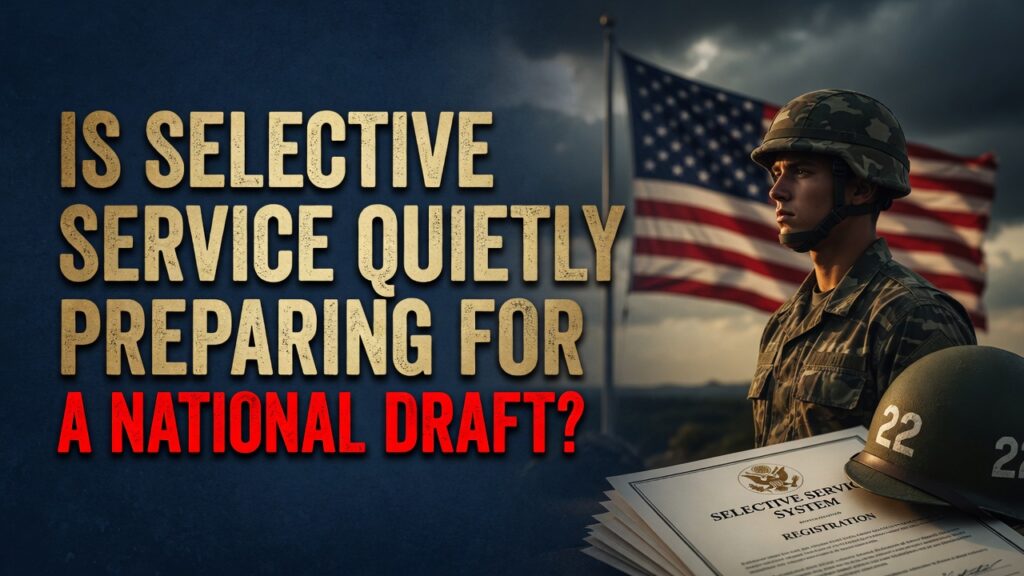
As automatic registration nears and the military widens its age limits, Americans are asking a question Washington has not answered: are we being prepped for a draft nobody voted on?
A federal agency just asked private contractors to help it war-game a national draft. That should stop you mid-scroll.
The Selective Service System published a Request for Quote last week seeking a “Readiness Simulation” — a government-owned computer model built to test how the country would process, notify, and mobilize draftees in a real emergency. Vendors have until August 14, 2026 to respond. The timing matters: it comes just months before automatic registration begins, while the Army has widened its enlistment pool and the White House has not ruled out ground operations in an active, undeclared war with Iran.
What Is the Selective Service Actually Asking For?
The RFQ is blunt about the agency’s current limitations. Selective Service told contractors it currently relies on manual analysis, legacy modeling approaches, outdated assumptions, and historical datasets that do not reflect modern demographics, communications channels, or operational readiness conditions [Military Times, citing agency RFQ]. In plain terms: the system built to run a 20th-century draft admits it cannot model a 21st-century one.
The simulation is meant to evaluate staffing and resource requirements, compare mobilization scenarios, assess surge conditions, and identify bottlenecks before a real emergency forces the question. It is contingency planning, not a declaration. No draft has been ordered, and none can begin without authorization from both Congress and the president. But contingency planning at this scale, on this timeline, is not nothing.
Support Independent Local Journalism
TheTownHall.News is a non-profit reader-supported journalism. Just $5 helps us hire local reporters, investigate important issues, and hold public officials accountable across Alameda County. If you believe our community deserves strong, independent journalism, please consider donating $5 today to support our work.Why Is Automatic Registration Different From What Came Before?
Registration for men 18 to 25 has been federal law for decades. What changes on December 19, 2026 is the mechanism. A law signed in 2025 shifts responsibility for registration away from the individual and onto the government itself, pulling names from Social Security, DMV, and other federal databases instead of waiting for young men to sign up.
Supporters call this administrative modernization — a fix for chronically low self-registration rates. But when the government registers you for a potential war without you lifting a finger, is that efficiency, or is it something else? That single sentence captures why this story is resonating: convenience is doing the work that congressional debate used to do.
Did the Draft Age Really Get Raised to 42?
No — and this is where a lot of viral claims have gotten it wrong. The U.S. Army raised its maximum voluntary enlistment age from 35 to 42 in a policy change that took effect in April 2026 [Army personnel policy], part of an effort to widen the recruiting pool amid persistent concerns about meeting personnel goals through volunteers alone. That is a recruitment policy for people choosing to enlist.
Selective Service registration and draft eligibility remain 18 to 25, expanding to 26 under the new automatic system. No law has raised the conscription age to 42. Conflating a voluntary enlistment cap with the draft pool is inaccurate, and outlets that do so are spreading a distortion — not exposing a hidden truth. Getting this distinction right is exactly the kind of accountability journalism should provide, even when the corrected version is less dramatic than the rumor.
Who Is Actually Watching How This Plays Out?
Congress passed the automatic registration provision as part of a defense authorization bill — the kind of measure that moves through committee with little public attention despite touching every young man in America. That is the real accountability gap here, and it has nothing to do with invented statistics.
If the system meant to run a draft admits it can’t model modern America, what happens the day it actually has to? Oversight hearings on this specific readiness question have been minimal relative to its stakes. Congressional offices control whether the underlying law is revisited, and constituent pressure is one of the few levers available before December’s deadline arrives.
What Do the Numbers Actually Tell Us?
0. That is how many times a peacetime draft has been ordered in the United States since 1973 [Selective Service System historical data]. The question worth asking: why build a “Readiness Simulation” now, for a contingency that has not been triggered in over fifty years?
The honest answer is that preparedness and imminence are different things. Building a model does not mean a draft is coming. But it does mean the government is investing real resources in the machinery of conscription at the same moment it is quietly automating who lands in that system — and most Americans have no idea either is happening.

Is a Ground War With Iran Raising the Stakes?
The backdrop here is not hypothetical. U.S. and Iranian forces have been in active conflict for months, and reporting indicates the White House has weighed limited ground options, including seizing Iranian territory near the Strait of Hormuz [Wall Street Journal, Axios reporting], though former military officials say a full-scale ground invasion would require far more troops than the roughly 50,000 currently deployed in the region [Foreign Policy].
No ground invasion has been ordered, and no draft has been triggered by the Iran conflict. But an unresolved war, an under-tested draft system, and a newly automated registration pool arriving within months of each other is not a coincidence readers should ignore. Is it unreasonable to ask whether the pieces are being arranged before the moment they’d be needed?
Should the government be allowed to build the infrastructure for conscription quietly, years before it ever tells the public why?
What Do Supporters of This Policy Actually Believe?
Supporters of automatic registration and readiness planning make a coherent case: an all-volunteer military still depends on Selective Service as a legal backstop, and a backstop nobody can operate in a real crisis is worse than none at all. They argue that fixing broken registration rates and stress-testing mobilization now, while there is no active draft, is exactly the kind of prudent, low-drama governance citizens should want from their institutions.
That argument has merit, and it deserves to be engaged rather than dismissed. The reasonable rebuttal is not that planning is wrong — it is that planning of this scope, tied to legislation most Americans never debated, deserves public hearings and transparency proportional to its reach. Prudence and secrecy are not the same thing, and citizens can support preparedness while still demanding the government explain itself before, not after, the system goes live.
Key Questions This Story Raises
- Why is a “Readiness Simulation” being built now, for a peacetime draft that hasn’t been ordered in over fifty years?
- Should Americans have had a public debate before registration was automated through federal databases?
- If ground options in Iran remain on the table, how does that change the urgency of a fully tested draft system?
So Where Does This Leave the Average American?
It leaves most people registered for a potential draft through no action of their own, governed by a system its own operators admit cannot model modern America, arriving at the exact moment Washington is debating ground troops in the Middle East. None of that is illegal. Very little of it has been explained.
The real question isn’t whether a draft is imminent — it’s whether the public will get a say in how ready the government becomes before it needs to be. That is a fair question to ask of any administration, regardless of party, and it is one Washington has not answered.
Still have questions about how this affects you or someone you know? Stay informed — subscribe for daily coverage. Think others need to see the distinction between fact and rumor here? Share this article. Want your voice heard before the December deadline? Contact your member of Congress and ask whether oversight hearings on Selective Service readiness are scheduled — a two-minute call that puts a real question on the record.