Iran Ceasefire 2026: How Trump’s B-52 Ultimatum Forced Tehran to Blink
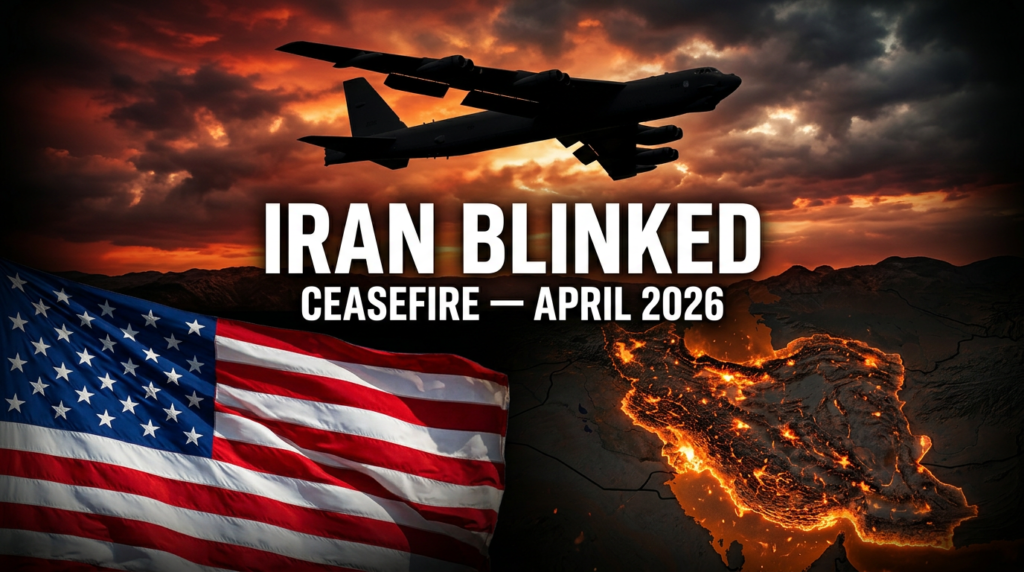
With B-52s in the air and a deadline ticking down, Iran agreed to a two-week ceasefire just minutes before the clock ran out — a moment that may reshape the Middle East, American deterrence, and the global energy order.
On the night of April 7, 2026, armed B-52 Stratofortress bombers lifted off from RAF Fairford in Gloucestershire, England — cruise missiles visible under their wings. Kuwait ordered its citizens indoors. Gulf states activated air defenses. President Donald Trump had issued the starkest ultimatum of his presidency: reopen the Strait of Hormuz or face the obliteration of Iran’s civilian infrastructure.
Then, with less than an hour to spare, Iran blinked.
Support Independent Local Journalism
TheTownHall.News is a non-profit reader-supported journalism. Just $5 helps us hire local reporters, investigate important issues, and hold public officials accountable across Alameda County. If you believe our community deserves strong, independent journalism, please consider donating $5 today to support our work.The two-week ceasefire — brokered by Pakistani Prime Minister Shehbaz Sharif and formalized as the Islamabad Accord — was the direct result of American resolve and a willingness to impose consequences that U.S. foreign policy had avoided for decades. Whether you call it brinkmanship or bold leadership, the outcome is the same: the Strait of Hormuz is reopening, and Iran is at the negotiating table.
How We Got Here: 40 Days That Changed the Middle East
The conflict began on February 28, 2026, when the United States and Israel launched coordinated strikes against Iranian military and nuclear infrastructure — a campaign American officials dubbed Operation Epic Fury. The first casualty of consequence came almost immediately: Supreme Leader Ali Khamenei was killed in an airstrike, sending the Iranian regime into leadership crisis.
Iran’s response was swift and punishing. Within 24 hours, Iranian forces struck American bases across the Gulf — including Al Udeid in Qatar, Ali Al Salem in Kuwait, and the U.S. Fifth Fleet headquarters. Six American soldiers were killed in Kuwait. The Strait of Hormuz, through which roughly 20 percent of the world’s oil supply passes, was blockaded. Iran began demanding payment for passage — in Chinese yuan. Oil prices surged past $114 per barrel.
Over the following five weeks, the U.S. and Israel methodically dismantled Iran’s military capacity. Kharg Island — Iran’s primary oil export hub — was struck. The Natanz nuclear facility was hit with bunker-buster bombs. Senior Iranian commanders and officials were eliminated in targeted strikes. By early April, Iran had lost over 150 naval vessels, more than 190 missile launchers, and thousands of military personnel.

The price was real on America’s side too. Fifteen U.S. servicemembers were killed. More than 500 were wounded. At least 13 American bases sustained damage totaling an estimated $800 million. A KC-135 refueling aircraft crashed in Iraq, killing six. An F-15E Strike Eagle was shot down over Iran — its crew recovered in a Special Forces rescue operation.
This was not a video-game war. America absorbed real costs — and continued pressing forward.
The Ultimatum That Changed Everything
By early April, Trump’s posture had hardened into something unprecedented in modern American diplomacy: a concrete deadline with concrete consequences. Reopen the Strait of Hormuz by 8 p.m. Eastern Time on April 7, or the United States would destroy every bridge, every power plant, and every piece of critical infrastructure Iran still possessed.
“The whole civilization will die tonight,” Trump warned — language critics called reckless and supporters called long overdue.
The B-52s weren’t theater. They were loaded and airborne.
Support Independent Local Journalism
TheTownHall.News is a non-profit reader-supported journalism. Just $5 helps us hire local reporters, investigate important issues, and hold public officials accountable across Alameda County. If you believe our community deserves strong, independent journalism, please consider donating $5 today to support our work.When a nation’s word carries no weight, its enemies fill the vacuum. Trump made sure every actor in the region understood the stakes.
Kuwait, reading the moment clearly, issued a shelter-in-place order. Bahrain took similar measures. The Gulf held its breath. Within the hour, Iran’s Supreme National Security Council announced it had accepted the ceasefire — with Strait of Hormuz passage to resume under Iranian military management while negotiations proceeded.
Trump declared it a “total and complete victory.” Iran’s new leadership called it a diplomatic win. Both cannot be right. But the Strait is opening — and that is not in dispute.
What Critics Get Wrong About “Reckless” Escalation
The criticism from foreign policy circles in Washington and European capitals was predictable: Trump was reckless, the ultimatum irresponsible, the threat to civilian infrastructure a violation of international norms.
What those critics consistently fail to account for is the alternative.
For decades, American deterrence in the Middle East meant calibrated, proportional responses — stern warnings, targeted strikes, and a return to the status quo. Iran tested that model repeatedly and found it hollow. Tehran armed militias that killed U.S. troops, funded Hezbollah and the Houthis, accelerated its nuclear program, and suffered no existential consequence.
The result: Iran closed the world’s most critical oil chokepoint and demanded passage fees in Chinese yuan.
The question critics owe the American public is not whether Trump’s approach was uncomfortable — it’s whether the previous approach worked. It didn’t.
The Real Stakes: American Strength and Global Energy Security
The Strait of Hormuz is not an abstraction. It is the pipeline through which approximately 20 million barrels of oil pass daily. Its closure hits American families at the gas pump, in heating bills, and in the cost of everything shipped across an ocean.
When adversaries believe the United States will not follow through, allies hedge and enemies advance. The fifteen Americans killed and 538 wounded in this conflict deserve to have their sacrifice mean something. Taxpayers funding a war already costing an estimated $18 billion — with a Pentagon request for $200 billion more — deserve a lasting strategic outcome, not a temporary pause that returns the world to February 27.
The ceasefire is a pause, not a peace. What happens in Islamabad on April 10 will determine whether those costs amounted to a turning point — or a delay.
The Road to Islamabad: What Comes Next
Formal negotiations begin April 10 in Islamabad. Iran has submitted a ten-point framework demanding full U.S. military withdrawal from the region, the lifting of all sanctions, financial compensation, and American acceptance of Iranian uranium enrichment.
Trump has said the uranium program “will be taken care of.” That language must harden into specifics, fast.
The window is two weeks. Iran’s regime is weakened but not gone. New Supreme Leader Mojtaba Khamenei — installed in March after his father’s death — has every incentive to appear strong domestically. The ceasefire also does not apply to Lebanon, where Israeli operations against Hezbollah continue. Regional volatility has not been extinguished; it has been temporarily contained.
History will judge this moment not by the B-52 departures from Fairford or the April 7 countdown, but by what Islamabad produces. A verifiable end to Iran’s nuclear ambitions and a permanently open Strait of Hormuz would be a genuine strategic achievement. A vague accord that Iran exploits to rearm would be a historic mistake.
Americans who believe in peace through strength, fiscal accountability, and leaders who mean what they say should watch the Islamabad talks with clear eyes and high expectations.
Key Takeaways
- The ceasefire was reached April 8, 2026 — less than one hour before Trump’s military deadline expired
- The Strait of Hormuz reopens for two weeks; formal talks begin April 10 in Islamabad
- 15 Americans were killed, 538 wounded; the financial cost has surpassed $18 billion
- Iran lost its Supreme Leader, senior officials, and critical military and energy infrastructure
- Iran’s demands include full sanctions relief and acceptance of uranium enrichment — maximum opening positions
- This is a temporary pause — durable peace requires a verified, enforceable settlement
The world was reminded this week that strength still speaks louder than diplomacy without consequence. Whether the Islamabad Accord becomes a historic turning point or a footnote in a longer conflict depends entirely on what America demands — and what it is prepared to enforce — in the days ahead.
Stay informed. Share this article. Hold your elected officials accountable for what comes next.