For the First Time Ever, Congress Moved to Stop the Iran War — Trump Is Furious
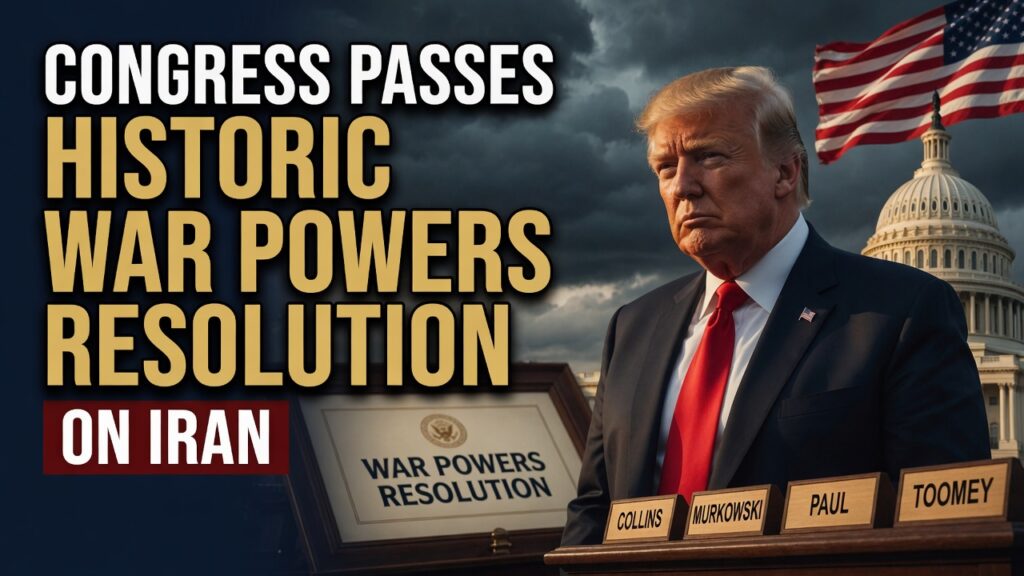
For the first time in American history, a war powers resolution has passed both chambers of Congress. The question now: will it matter?
The United States Senate voted 50-48 Tuesday to direct President Donald Trump to remove U.S. forces from hostilities with Iran — a historic rebuke that marks the first time a war powers resolution has ever cleared both the House and the Senate simultaneously. Four Republican senators broke with their party to make it happen, and Trump is already calling them traitors.
The four Republicans who crossed the line were Sens. Bill Cassidy (La.), Susan Collins (Maine), Lisa Murkowski (Alaska), and Rand Paul (Ky.). The lone Democrat to side with Republicans against the resolution was Pennsylvania’s John Fetterman. Two Republicans — Mitch McConnell, who has been hospitalized, and Dave McCormick, who traveled with Trump to a Pennsylvania rally — did not vote. Their absences proved decisive.
Support Independent Local Journalism
TheTownHall.News is a non-profit reader-supported journalism. Just $5 helps us hire local reporters, investigate important issues, and hold public officials accountable across Alameda County. If you believe our community deserves strong, independent journalism, please consider donating $5 today to support our work.The resolution, which does not carry the force of law and will not go to the White House for a signature, is nonetheless one of the most significant congressional rebukes of a wartime president in modern history. It is the tenth time the Senate has voted on such a measure since the Iran war began on February 28.
Why Four Republicans Finally Said Enough
Each of the four Republican defectors has a distinct reason for crossing the aisle, and understanding those reasons tells you everything about where the GOP stands heading into November.
Bill Cassidy is the most politically explosive case. The Louisiana senator voted against every previous war powers resolution — until last month, days after losing his primary to a Trump-backed challenger. With nothing left to lose electorally, Cassidy has been increasingly outspoken. “Until the administration provides clarity, no congressional authorization or extension can be justified,” Cassidy said in a statement. Critics will note the timing. Supporters will note that he’s right.
Rand Paul has been the most consistent voice among Republican dissenters. Paul represents the libertarian-leaning, non-interventionist wing of the Republican Party that has always viewed the Iran conflict skeptically. “Peace is preferable to war,” Paul wrote on X Tuesday. “President Trump deserves the opportunity to negotiate a lasting agreement that prevents Iran from obtaining a nuclear weapon while avoiding another endless conflict in the Middle East.” Paul’s position has not changed — but his influence within the party has grown as the war drags on.

Susan Collins and Lisa Murkowski are the two Republicans who have consistently broken with Trump throughout his second term. Both represent blue-leaning states where the war’s economic fallout — gas prices, inflation, higher food costs — has hit voters hard. Neither faces imminent political pressure from Trump’s base, and both have signaled they view congressional war authority as a constitutional matter, not a partisan one.
What Does the Vote Actually Do?
Here is where the accountability journalism matters: very little, legally — but politically, quite a lot.
The concurrent resolution passed by the House on June 3 (215-208) and now by the Senate does not go to the president’s desk, cannot be vetoed, and does not carry the force of law. It is a directive — a formal, bipartisan instruction from Congress telling the commander-in-chief to stand down.
Trump has already signaled he won’t comply. His administration has argued the War Powers Act of 1973 is unconstitutional, and the White House has claimed that ceasefire days don’t count toward the law’s 60-day clock for congressional authorization. Legal scholars are skeptical of that position.
If Congress wants to go further — passing binding legislation that actually forces a withdrawal — it would need a two-thirds majority in both chambers to override a presidential veto. That math does not currently exist.
Support Independent Local Journalism
TheTownHall.News is a non-profit reader-supported journalism. Just $5 helps us hire local reporters, investigate important issues, and hold public officials accountable across Alameda County. If you believe our community deserves strong, independent journalism, please consider donating $5 today to support our work.“It’s going to have no effect. The president isn’t going to pay any attention to it,” said Sen. James Risch (R-Idaho), one of the resolution’s opponents.
The Price Tag Congress Is Refusing to Ignore
The war powers vote didn’t happen in a vacuum. It came the same week the Pentagon submitted a request for $80 billion in supplemental funding — mostly to cover the cost of the Iran conflict — on top of Trump’s already historic $1.5 trillion defense budget request.
The numbers are staggering:
- The Department of Defense has spent an estimated $40 billion on the conflict so far, according to the Center for Strategic and International Studies
- The first 100 hours of Operation Epic Fury alone cost $3.7 billion
- Moody’s Analytics estimates the total cost to U.S. consumers and taxpayers at $132 billion and counting
- American households paid a combined $27.1 billion extra for diesel fuel alone
- The nation’s Strategic Petroleum Reserve is now at its lowest level since 1983
- Gas prices rose from under $3 per gallon to a peak of $4.56 per gallon, with diesel topping $5
Only 24% of Americans believe the Iran war was worth the cost, according to a Reuters/Ipsos poll released Tuesday. Half of respondents said it was not worth it. And 63% of Americans say they doubt the preliminary ceasefire deal will hold.
Trump’s approval rating now sits at 37% on economic handling and 35% on Iran, according to Fox News polling.
Trump’s Response: “GRANDSTANDERS”
Trump has not taken the rebuke quietly. When the House passed its version of the resolution earlier this month, he fired off a Truth Social post that left little to the imagination:
“Yesterday, in a meaningless vote, the House voted, 4 bad Republicans and all of the Dumocrats, to limit my War Powers, right in the middle of my final negotiations to end the War with the Islamic Republic of Iran. Who would do such an unpatriotic thing… The four Republicans, that’s a whole other story — They’re GRANDSTANDERS! They should be ashamed of themselves.”
There is no indication Trump’s posture toward Tuesday’s Senate vote will be any different.
A Constitutional Clash That Could Reach the Supreme Court
The deeper story here is about the Constitution itself. Congress has the sole power to declare war — a power it has effectively ceded to the executive branch for decades. The War Powers Resolution of 1973 was designed to reclaim some of that authority, but presidents of both parties have routinely ignored or circumvented it.
“The most solemn power for Congress is the power to declare war, not the president,” Sen. Tim Kaine (D-Va.), the resolution’s sponsor, said on the Senate floor Tuesday.
Legal analysts say if Trump simply ignores the resolution, the dispute could end up before the Supreme Court — which has repeatedly declined to rule on the War Powers Act’s constitutionality over the past five decades. “If Congress were to pass the legislation, the Trump administration would develop a legal rationale for not complying, and the issue would end up in front of the Supreme Court,” said Mark Cancian, a senior adviser at the Center for Strategic and International Studies.
The Midterm Calculation
Perhaps the most important context for Tuesday’s vote is what it signals about November.
Republicans hold majorities in both chambers. The midterm elections will determine whether they keep them. And the Iran war is deeply unpopular — with gas prices still elevated, inflation at 4%, and 13 American service members dead.
“I don’t know that we would get an additional vote last week,” Sen. Kaine told reporters before the vote. “But I do know this: I know what we are all hearing from our constituents, and that is, they are deeply opposed to this war.”
The political math is shifting. Four Republican senators just proved it.
Key Questions
- Will Trump veto binding war powers legislation if Congress pursues it? Almost certainly yes — and an override would require two-thirds of both chambers, a threshold that appears unreachable.
- Could the Supreme Court be forced to rule on the War Powers Act’s constitutionality? Legal scholars say it’s possible if Trump openly defies the congressional directive.
- How many more Republican senators could defect before November? Tuesday’s vote was 50-48. One or two more crossovers could change the trajectory of future votes.
- Will the $80 billion Pentagon supplemental request pass with the war this unpopular? That vote will be a far sharper test of Republican loyalty to the war.
Counterargument
Supporters of the president’s Iran policy argue the war achieved its primary objective: degrading Iran’s nuclear capabilities and military infrastructure. Rep. Mike Lawler (R-N.Y.) wrote this week that Trump “dismantled the leadership of the regime, including key figures within the IRGC” and forced Iran to the negotiating table for the first time in 47 years. They point to the preliminary ceasefire, the Strait of Hormuz reopening, and falling energy prices as evidence the strategy is working — and argue that the war powers resolution, whatever its symbolic weight, undermines active peace negotiations.
That case is harder to make when only 24% of Americans think the war was worth the cost.
The bottom line: Congress just did something it has never done before in the 53-year history of the War Powers Act. Whether it matters legally is an open question. Whether it matters politically — with November approaching, gas prices still elevated, and Republican senators beginning to break — is not.