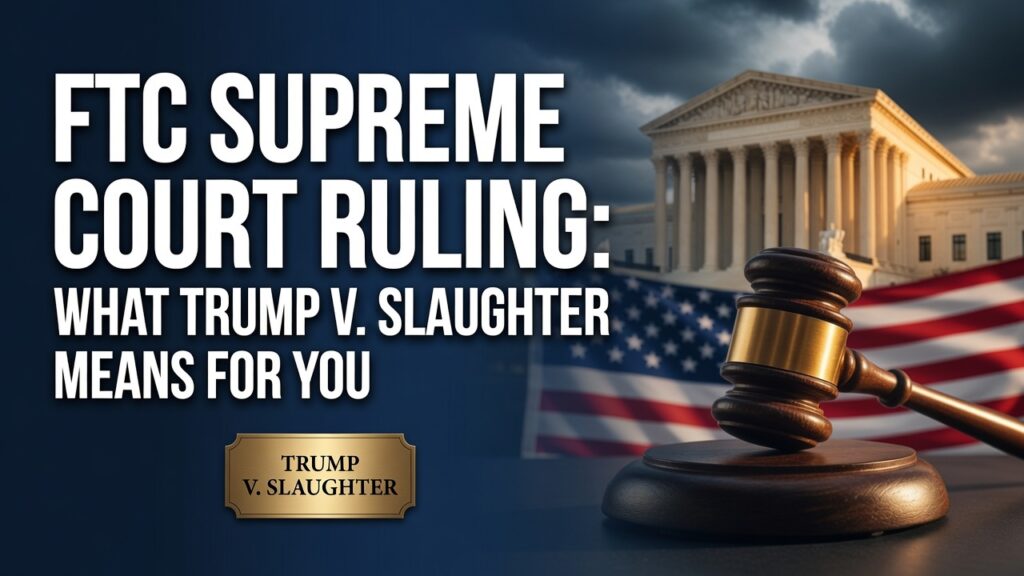
FTC Supreme Court Ruling: What Trump v. Slaughter Means for You
The Supreme Court just stripped a century-old shield from federal regulators. As Washington’s “independent” agencies lose their immunity from accountability, Americans are asking: who was actually running these agencies all along — and who finally answers for it?
Should unelected bureaucrats answer to anyone? On June 29, 2026, the Supreme Court said no more excuses.
In a 6-3 ruling in Trump v. Slaughter, the justices overturned a 1935 precedent that had let agency commissioners operate beyond the reach of the elected president who appointed them. The case centered on the Federal Trade Commission’s removal protections, first upheld in Humphrey’s Executor v. United States in 1935. For nine decades, that ruling shielded commissioners from removal except for cause. Now it’s gone. Wikipedia
Support Independent Local Journalism
TheTownHall.News is a non-profit reader-supported journalism. Just $5 helps us hire local reporters, investigate important issues, and hold public officials accountable across Alameda County. If you believe our community deserves strong, independent journalism, please consider donating $5 today to support our work.What Did the Supreme Court Actually Decide?
The Court ruled 6-3, overruling Humphrey’s Executor and invalidating tenure protections for FTC members that Congress had enacted more than a century ago. The case arose after Trump fired FTC Commissioner Rebecca Kelly Slaughter, a Democratic appointee, in 2025. The Detroit NewsNBC News
Chief Justice John Roberts didn’t hedge. He wrote plainly that “the FTC unquestionably exercises executive power and must therefore be controlled by the Chief Executive.” Translation: if an agency wields the power to investigate, regulate, and punish, the person running it has to answer to someone the public actually elected. Newsweek
That’s not a fringe legal theory. It’s the foundational argument behind decades of conservative legal scholarship known as the unitary executive theory — the doctrine holding that the president possesses sole authority over the executive branch, including the power to fire and replace heads of independent agencies. U.S. News & World Report
Who Was Really in Charge of the FTC Before This Ruling?
For 90 years, the honest answer was: not the president. Humphrey’s Executor held that the FTC’s commissioners exercised “quasi-legislative and quasi-judicial” duties, not purely executive ones — which let Congress wall the agency off from presidential oversight. Wikipedia

That distinction made sense in 1935, when the FTC was a small consumer-protection outfit. It doesn’t make sense now. In its present form, the FTC enforces and administers roughly 80 federal statutes covering nearly every facet of the American economy. That’s not a quasi-anything. That’s raw regulatory power, exercised by commissioners who, until Monday, couldn’t be fired for getting it wrong, ignoring the priorities of the sitting administration, or simply disagreeing with the people voters actually elected. The Detroit News
The accountability gap was the point, not a flaw. Agencies insulated from elections answer to no one between confirmation hearings — and by the time voters notice, the damage is already regulatory history.
What Do the Numbers Actually Tell Us?
80 statutes. The question Washington never had to answer until now: who exactly was enforcing them, and on whose authority?
Congress originally permitted FTC commissioners to be removed only for cause — inefficiency, neglect of duty, or malfeasance — never for policy disagreements. In practice, that meant a commissioner could openly reject an elected president’s regulatory agenda and remain untouchable, protected by a Depression-era legal technicality. The Detroit News
“The FTC unquestionably exercises executive power, and must therefore be controlled by the Chief Executive, in whom such power is vested.”
That single line from Roberts’ majority opinion is the whole case in miniature: power without accountability isn’t independence. It’s a loophole.
Support Independent Local Journalism
TheTownHall.News is a non-profit reader-supported journalism. Just $5 helps us hire local reporters, investigate important issues, and hold public officials accountable across Alameda County. If you believe our community deserves strong, independent journalism, please consider donating $5 today to support our work.Is This the End of the Unaccountable Bureaucracy?
Not entirely — and that’s worth being honest about. The Court explicitly limited its ruling to agencies exercising executive power and declined to decide whether other entities, including the Federal Reserve, would be treated the same way. Newsweek
In a companion case decided the same day, Trump v. Cook, the justices ruled 5-4 that Federal Reserve Governor Lisa Cook could keep her seat while litigation continues, with the Court treating the Fed as structurally distinct from other independent agencies. Roberts and Justice Brett Kavanaugh were the only justices in the majority on both rulings, signaling a deliberate, narrow line rather than a blanket takeover of every federal body. NBC News
This was not a power grab. It was a course correction, and the Court drew the boundary carefully enough to leave the central bank’s independence untouched — for now.
Why Are So Many Americans Starting to Ask Questions About These Agencies?
Because most people have never heard of the commissioners regulating their internet providers, their pharmaceuticals, or their bank fees — and that’s by design, not accident. The ruling will allow presidents to exert far greater control over major regulators including the FTC and the SEC, along with other independent bodies like the National Labor Relations Board and the Federal Communications Commission. The New Republic
These aren’t ceremonial posts. They set the rules that govern entire industries Americans depend on every day. If the people enforcing 80 federal statutes can’t be fired by anyone voters elected, who exactly are they accountable to? For 90 years, the answer was effectively no one — until Monday.
What Do Supporters of Humphrey’s Executor Actually Believe?
This is a fair question, and the opposing argument deserves a real hearing rather than a strawman. Defenders of the old precedent, including Justice Ketanji Brown Jackson, warned that a president firing agency experts — “scientists, doctors, economists” — and replacing them with loyalists isn’t actually in the best interest of ordinary citizens. Sotomayor’s dissent went further, arguing the ruling abandons nearly a century of settled constitutional understanding and replaces it with what she called a loyalty test. WikipediaNewsweek
It’s a legitimate worry. Expertise matters, and turnover at the top of regulatory agencies can disrupt continuity. But the rebuttal is straightforward: expertise without accountability isn’t a safeguard, it’s a blind spot. Career staff and technical expertise remain in place under any administration; what changes is who sits at the top answering for the agency’s direction. Congress can still legislate the substantive rules agencies must follow — this ruling addresses who supervises the people enforcing those rules, not the rules themselves. An agency that cannot be steered by anyone accountable to voters isn’t neutral. It’s a fourth branch of government nobody approved. The Detroit News
What Happens Next?
Legal observers expect the ruling to extend control over a wide range of independent agencies beyond the FTC, reshaping how the executive branch interacts with federal regulators going forward. Expect litigation testing those boundaries agency by agency — and expect Congress to face renewed pressure to either codify protections legislatively or accept that Article II means what it says. The New Republic
Trump celebrated the decision as a major win for presidential authority, calling it confirmation of his power under Article II to remove executive branch officials. Whether that authority gets used responsibly is now a political question, not a constitutional one — which is exactly where the Founders put it. Newsweek
Key Questions This Ruling Leaves Unanswered
- If unelected commissioners can no longer hide behind for-cause protections, will future administrations finally face real consequences when agencies overreach?
- Does the Federal Reserve carve-out hold permanently, or is it the next domino once a case squarely tests it?
- Will Congress attempt to legislate new protections — and would that survive the same constitutional logic that just struck down Humphrey’s Executor?
Could This Be the Accountability Moment Washington Has Avoided for 90 Years?
The real question isn’t whether federal agencies will resist this change — it’s whether voters will keep paying attention once the headlines fade.
For nine decades, regulatory power expanded while accountability stayed frozen in 1935. That gap is now closing, agency by agency, case by case. The Federal Reserve carve-out proves this wasn’t a blank check — it was a boundary, drawn deliberately. The next test will be whether Washington treats this as the correction the Constitution demanded, or finds new ways to rebuild the wall.
What do you think — is this overdue accountability, or a dangerous concentration of power? Share this article and let us know.
Still have questions about what this means for federal agencies near you? Stay informed — subscribe for daily coverage. Think your neighbors need to see this? Share the article. Want your voice to count? Contact your member of Congress and ask where they stand on agency accountability versus unchecked regulatory power.