IRS Refund Deadline: Why Millions May Need to File Before July 10, 2026
Washington is very good at collecting penalties from taxpayers. It should be just as serious about correcting its own mistakes. A little-known refund window tied to COVID-era IRS penalties and interest is now creating a test of fiscal accountability—and millions of Americans may have a reason to pay attention.
The internet is full of overheated tax headlines, and most of them deserve skepticism. But this story is different. The latest claims that the IRS may owe money to millions of taxpayers are rooted in a real legal dispute, a real filing deadline, and real guidance from the Taxpayer Advocate Service, the independent watchdog within the IRS. Taxpayer Advocate Service
What makes this issue urgent is not just the money. It is the principle. If the federal government can impose penalties on citizens for missed deadlines, then the government should face equal scrutiny when it may have charged those penalties improperly. That is not anti-government. It is basic fairness, basic competence, and basic respect for the people who fund Washington in the first place.
Support Independent Local Journalism
TheTownHall.News is a non-profit reader-supported journalism. Just $5 helps us hire local reporters, investigate important issues, and hold public officials accountable across Alameda County. If you believe our community deserves strong, independent journalism, please consider donating $5 today to support our work.Why This Issue Matters Now
This debate centers on COVID-era tax penalties and interest that may have been assessed during a period when filing and payment deadlines were arguably postponed under federal disaster rules. In a case known as Kwong v. United States, a federal court found that the IRS should not have assessed certain penalties and interest for a broad stretch of time running from Jan. 20, 2020, through July 10, 2023. Taxpayer Advocate Service CNBC
That does not mean everyone gets an automatic check. It does mean the issue is serious enough that the Taxpayer Advocate Service has publicly warned that “tens of millions” of taxpayers may need to review their records and file claims to protect their rights. This is exactly the kind of bureaucratic failure that fuels public distrust: government agencies move quickly when money is owed to them, but far more slowly when the mistake runs the other way. Taxpayer Advocate Service
Government deadlines should not run in only one direction.
If Washington can charge on time, it can refund on time.

What the Deadline Actually Is
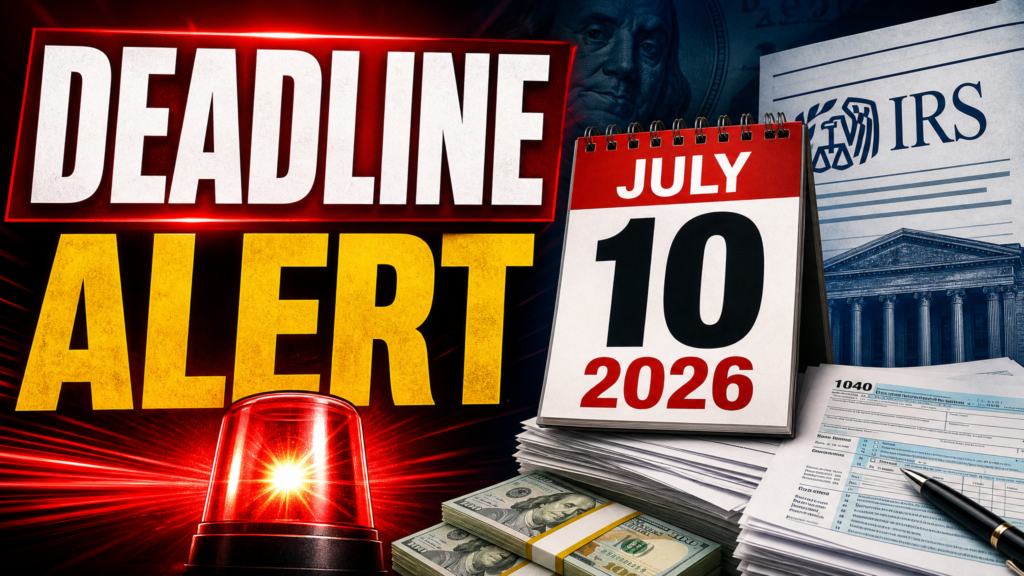
The most important date in this story is July 10, 2026. The Taxpayer Advocate Service says most taxpayers must file a refund claim generally by that date to preserve their rights. The word “generally” matters because tax filing statutes can vary by circumstance, but for most people, July 10 is the date to remember. Taxpayer Advocate Service
The IRS’s own general rules help explain why. The agency says a refund claim is usually allowed within the later of three years after filing a return or two years after paying the tax. That timeline is one reason advocates are telling taxpayers not to wait around for Washington to sort this out internally. IRS
There is another reason for urgency: the legal issue is still unsettled. CNBC reported that the court decision is not final and the government could still appeal. That is why the Taxpayer Advocate Service is recommending that some taxpayers file a protective claim now rather than assume the IRS will eventually fix everything on its own. CNBC Taxpayer Advocate Service
Who May Actually Qualify
This issue potentially affects more than one narrow slice of taxpayers. According to the Taxpayer Advocate Service, possible qualifying charges include penalties for failure to file on time, failure to pay on time, and failure to make estimated tax payments, along with related interest that may have started accruing too early or should not have accrued at all. Taxpayer Advocate Service
The same guidance says the affected population may include individuals, small businesses, large corporations, estates, and trusts. It may also reach taxpayers dealing with income, employment, estate, gift, and excise taxes, and even some taxpayers penalized for late international information returns. In other words, this is not a niche issue for accountants alone. It touches workers, families, business owners, and people who were trying to keep up during an extraordinary period of government disruption. Taxpayer Advocate Service
Support Independent Local Journalism
TheTownHall.News is a non-profit reader-supported journalism. Just $5 helps us hire local reporters, investigate important issues, and hold public officials accountable across Alameda County. If you believe our community deserves strong, independent journalism, please consider donating $5 today to support our work.The practical test is straightforward. If you filed late, paid late, paid penalties, still owe penalties, or were charged interest during the COVID disaster window, you may have a reason to review your records. That does not guarantee a refund. It does mean ignoring the issue could be costly. Taxpayer Advocate Service
What Documents You Need to File a Claim
For most taxpayers pursuing this issue, the key form is Form 843. The IRS says Form 843 is used to claim a refund or request an abatement of certain taxes, interest, penalties, fees, and additions to tax. IRS
The Taxpayer Advocate Service says a proper filing should generally include a copy of your IRS transcript with the relevant entries identified, an explanation connecting the penalties or interest to the COVID disaster-relief period, the specific amounts at issue, and copies of IRS notices or correspondence if you received them. In most cases, taxpayers should file a separate Form 843 for each tax period and each type of tax rather than lumping multiple years together. Taxpayer Advocate Service
The most useful record for many people will be the tax account transcript. The IRS says that transcript shows account activity such as filing status, income, payments, and later changes. TAS specifically recommends reviewing IRS account transcripts because they help identify when penalties, interest, payments, refunds, and adjustments hit your account. Taxpayers can access transcripts through an IRS online account, by mail, by phone, or through Form 4506-T. IRS Taxpayer Advocate Service
What Critics Get Wrong
Some skeptics hear “millions may be owed money” and assume it is just another round of viral tax misinformation. That caution is healthy. In fact, social media has mixed together several unrelated IRS stories. The deadline to claim the 2021 Recovery Rebate Credit was April 15, 2025, and the IRS’s announced deadline for many unclaimed 2022 refunds was April 15, 2026. Those are real stories—but they are not the same as the current dispute over COVID-era penalties and interest. IRS IRS
The better response is not to dismiss every viral claim, but to separate the noise from the facts. On this issue, the facts are clear enough to matter: there is a court ruling, there is a live filing deadline, there is official IRS paperwork involved, and there is explicit guidance from the Taxpayer Advocate Service urging taxpayers to act if they may be affected. That is not hype. That is a warning label.
The Counterargument—and the Better Answer
Defenders of the current system will argue that tax administration is complicated, that the law is unsettled, and that the IRS cannot responsibly send out refunds until every legal question is resolved. That much is fair. No serious observer should want the agency to spray money out the door without legal authority. CNBC
But that argument proves too little. Complexity is not an excuse for opacity. When a legal dispute could affect millions of taxpayers, the government has a duty to communicate clearly, publish simple guidance, and make compliance realistic. The citizen’s job is to obey the law. The government’s job is to administer it competently. Fiscal accountability means holding both sides to the same standard.
Key Takeaway for Taxpayers and Families
Here is the bottom line. If you or your business paid IRS penalties or interest connected to late filing, late payment, or estimated tax issues during the COVID period, do not assume the matter will resolve itself. Pull your transcript. Review the dates. Consider whether Form 843 may be necessary. And if the facts fit, do not let the July 10, 2026 window close without action. Taxpayer Advocate Service IRS
This is about more than a refund. It is about whether ordinary Americans are expected to navigate a maze while the institutions that built the maze avoid accountability.
Why Fiscal Accountability Cuts Both Ways
Washington talks endlessly about fairness in the tax code. Fine. Then fairness should apply when the citizen may have been overcharged. A limited-government view does not mean no government; it means a government disciplined by rules, deadlines, and transparency.
That principle matters for families trying to manage a household budget, for small businesses operating on tight margins, and for communities that have learned the hard way that bureaucracy often expands faster than responsibility. When taxpayers miss a deadline, penalties arrive with precision. When taxpayers may deserve relief, they should not have to learn about it from rumor, confusion, or a lucky scroll through social media. Public trust requires better than that.
The responsible response is calm but firm: verify the facts, meet the deadline, and insist that government follow the same standards of order and accountability it demands from everyone else.
Conclusion
The emerging IRS refund dispute is not a fringe theory and not a free-money fantasy. It is a live, fact-based issue involving COVID-era penalties, a federal court ruling, a clear filing pathway through Form 843, and a deadline that could matter to millions of taxpayers. Taxpayer Advocate Service IRS
Americans should expect personal responsibility from taxpayers and institutional responsibility from government. Those two ideas belong together. If that standard still means anything, then this story deserves far more attention than it is getting.
Stay informed. Share this article with someone who filed or paid late during the pandemic years. Support independent journalism that follows the paper trail instead of the talking points—and stay engaged in civic life, because accountability rarely arrives on its own.