FBI Executes 22 Raids in Minneapolis Childcare Fraud Crackdown — Taxpayers Are Owed Answers
Federal agents swept through the Twin Cities in a massive coordinated operation targeting Medicaid-funded daycare centers. After years of red flags and more than $20 billion in high-risk government spending, the reckoning has finally arrived.
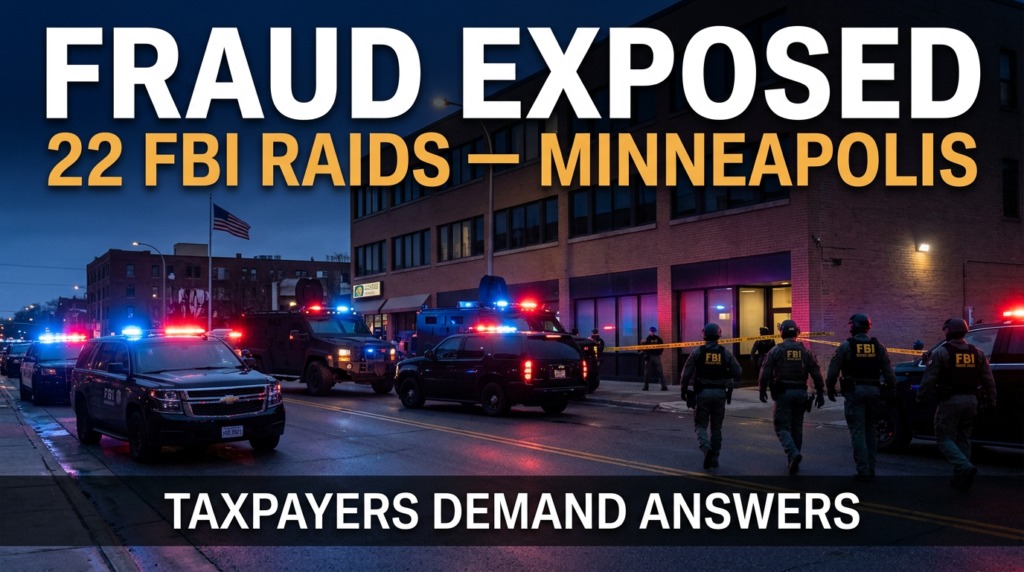
On the morning of April 28, 2026, federal agents fanned out across Minneapolis in one of the most significant coordinated law enforcement operations the city has witnessed in years. The FBI, Homeland Security Investigations (HSI), the Department of Justice, and state and local law enforcement executed 22 simultaneous search warrants at businesses across the Twin Cities — the majority of them childcare and daycare providers billing the government under Medicaid.
The operation, referred to by sources as “Operation Metro Surge,” is not an immigration action. Authorities have been explicit: this is a fraud crackdown. And if the early evidence holds, it may expose one of the most sustained misuses of public funds in recent state history — a story that cuts directly to the heart of government accountability and the civic obligation to protect taxpayer dollars.
Support Independent Local Journalism
TheTownHall.News is a non-profit reader-supported journalism. Just $5 helps us hire local reporters, investigate important issues, and hold public officials accountable across Alameda County. If you believe our community deserves strong, independent journalism, please consider donating $5 today to support our work.A Pattern of Fraud That Was Years in the Making
This sweep did not come out of nowhere. Federal and state investigators have spent years tracking a labyrinthine web of fraudulent billing practices tied to Minnesota’s Medicaid-funded social service ecosystem. At the center of today’s operation are childcare centers accused of billing the government for care they never actually provided — so-called “phantom services” — alongside allegations of forged documents, hidden ownership structures, and cash kickbacks used to recruit clients onto government program rolls.
Two locations specifically named in connection with today’s warrants — the Quality Learning Center and Baby Halimo Child Care, both in Minneapolis — had previously attracted scrutiny. The Quality Learning Center had been flagged for suspicious activity: investigators reportedly encountered vacant storefronts and non-operational facilities tied to the address, yet government billing records continued flowing uninterrupted.
Today’s operation is also directly tied to the sprawling Feeding Our Future scandal — a $300 million pandemic-era fraud case that rattled Minnesota and drew national attention. In that investigation, 47 individuals were originally charged; to date, 57 have been convicted. Authorities have been unambiguous: this investigation is driven by evidence of financial crimes, not ethnicity or immigration status.
The Real Cost — $20 Billion in High-Risk Spending
Here is the number every Minnesota taxpayer deserves to know: since 2018, the state has spent $20.83 billion across 14 Medicaid programs that state oversight bodies have themselves flagged as being at “high risk for fraud.”

Twenty billion dollars. Programs identified as structurally vulnerable — and yet the money kept flowing with insufficient accountability.
The breakdown is sobering. Personal care and community support programs account for $10.73 billion alone. Autism services and non-emergency medical transport represent more than $2.3 billion combined. Adult day services, mental health programs, and housing stabilization services add hundreds of millions more. Across each, investigators have uncovered varying degrees of billing manipulation and systemic exploitation.
Daycare centers captured in a viral investigative video — the footage that helped accelerate federal resource deployment to Minnesota — reportedly received a combined $6.3 million from the Feeding Our Future program alone. That video and the public outrage it generated appear to have been a turning point, prompting the FBI to surge investigators into the state.
“When government programs grow faster than the oversight designed to monitor them, fraud doesn’t just become possible — it becomes predictable.”
Who Is Responsible for Letting This Happen?
This is the question that demands an honest answer — and one that no political figure should be allowed to sidestep.
Minnesota Governor Tim Walz has stated that state agencies “caught irregular behavior and reported it,” framing the federal action as evidence the system is working. But critics argue the record tells a different story: that systemic failures allowed billions in questionable payments to flow for years before a viral video and federal pressure forced a response.
Support Independent Local Journalism
TheTownHall.News is a non-profit reader-supported journalism. Just $5 helps us hire local reporters, investigate important issues, and hold public officials accountable across Alameda County. If you believe our community deserves strong, independent journalism, please consider donating $5 today to support our work.The programs under investigation — Medicaid-funded childcare, personal care services, mental health support — are not inherently broken. They exist to serve vulnerable Minnesotans. But when enrollment standards are lax and auditing is underfunded, the damage extends far beyond the dollars stolen.
A federal payment freeze tied to the investigation has already disrupted childcare access for some Minnesota families — an outcome no one sought, but one that flows directly from years of oversight failure. The people most harmed by this fraud are not abstract taxpayers. They are real families and legitimate beneficiaries left behind when bad actors hollow out the system.
The Counterargument — and Why It Doesn’t Hold
Some advocacy groups and community leaders will argue that these raids represent overzealous federal enforcement targeting a minority community already under political pressure. That concern warrants a fair hearing.
It is true that Trump administration officials — including DHS Secretary Kristi Noem — have been vocal about using federal resources to crack down on Medicaid fraud in Minnesota. Critics contend that political motivation risks sweeping innocent people into a high-profile investigation driven as much by optics as evidence.
Those concerns reflect legitimate principles. No one should face prosecution based on ethnicity, community ties, or political usefulness. Scrutiny of government power is healthy in any functioning democracy.
But here is the critical distinction: authorities have not alleged crimes based on community membership. They have alleged specific documented acts — billing for services never rendered, forging records, concealing ownership, paying kickbacks. The Feeding Our Future prosecutions — pursued under the previous administration — demonstrated that evidence-based cases in this space hold up in court. Questioning the government’s methods is appropriate. Using that scrutiny as a blanket shield against accountability is not.
What This Means for Families, Communities, and the Rule of Law
At its core, this story is about three things: accountability, trust, and civic responsibility.
Accountability — because public money is not a limitless resource. Every dollar fraudulently claimed from Medicaid is a dollar unavailable for a child who needs early education, a senior requiring home care, or a family in crisis. Fiscal responsibility is not partisan. It is a fundamental obligation of honest governance.
Trust — because social programs survive only as long as the public believes they work as intended. Widespread fraud left unaddressed doesn’t just drain budgets — it corrodes the civic confidence required to sustain them. The strongest defense of these programs is rigorous, transparent oversight.
Civic responsibility — because citizens have a right and a duty to know how government spends public funds. Journalists, watchdogs, and engaged voters are the last meaningful line of defense when institutions fail.
“The message from today’s operation is direct: no business, no nonprofit, and no institution is exempt from accountability when public dollars are at stake.”
Key Takeaway
Operation Metro Surge is a reckoning years in the making. More than $20 billion in high-risk Medicaid spending. A $300 million fraud case that produced dozens of convictions. And now, 22 federal search warrants executed in a single coordinated morning sweep.
The full scope will emerge in the coming days as investigators process evidence and prosecutors prepare charges. What is already clear: the systems designed to protect public dollars failed for too long, and the cost of that failure falls on taxpayers and the communities depending on these programs to function as promised.
The Bottom Line — Accountability Cannot Be Optional
Operation Metro Surge is not the final chapter of this story. It may not even mark the beginning of the end. But it is an unambiguous signal that the era of consequence-free exploitation of government social programs is being confronted directly.
Those who committed fraud — if proven in court — deprived real people of real resources and real trust in public institutions. They deserve the full weight of the law. Those who allowed oversight systems to remain vulnerable for so long owe the public a serious accounting.
For every American who believes in fiscal responsibility, transparent institutions, and the rule of law, this story is a clear reminder: vigilance is not optional, and silence is not neutral.
Stay informed. Share this story. Ask your elected officials what they knew, and when they knew it.
This story is developing. The Town Hall News will continue reporting as charges are filed and new details emerge. If you believe in independent, accountability-driven journalism, share this article and subscribe for updates.