The One Thing Every Lebanon Ceasefire Story Is Leaving Out”
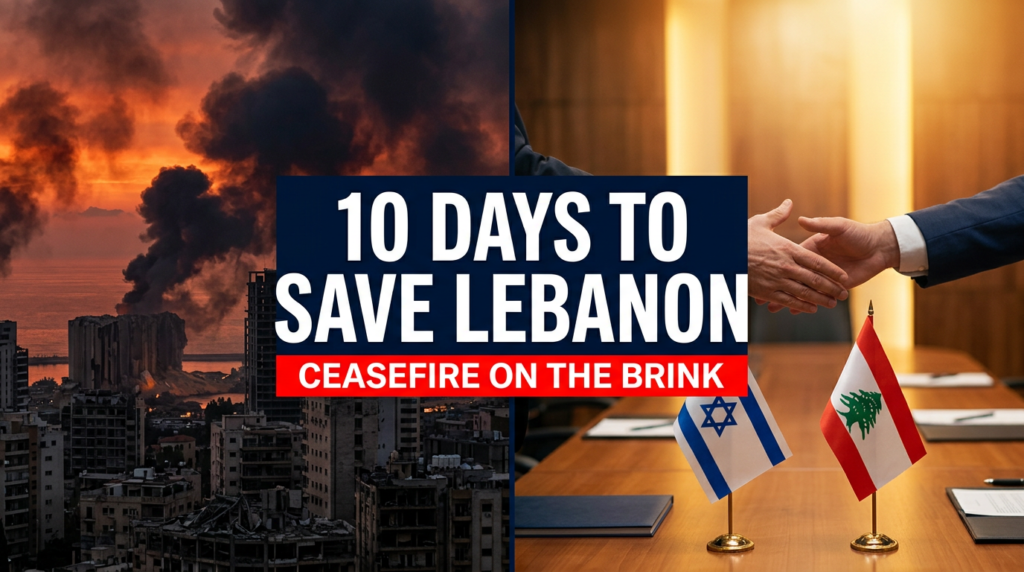
After weeks of escalating conflict, diplomatic confusion, and a fragile U.S.-Iran truce that nearly unraveled, a 10-day Lebanon-Israel ceasefire is now in effect. The agreement is a diplomatic win — but the real story is far more complicated, and every American taxpayer should be paying attention.
On April 16, 2026, President Donald Trump announced that Israel and Lebanon had agreed to a 10-day ceasefire, effective 5 p.m. Eastern time. Within hours, he suggested that Israeli Prime Minister Benjamin Netanyahu and Lebanese President Joseph Aoun might meet at the White House — a historic diplomatic signal in a region that has seen precious few of those lately.
For weeks, Lebanon had been the overlooked front of a much larger conflict. While the world focused on U.S.-Iran negotiations mediated by Pakistan, Israel was conducting its most intensive assault on Lebanese territory in over a month, striking more than 100 sites in just 10 minutes — targeting what it described as Hezbollah command centers embedded within civilian neighborhoods in Beirut, the south, and the east. Four Lebanese paramedics were killed in a triple-tap Israeli strike. The last working bridge over the Litani River was destroyed. At least three more civilians were killed and 21 wounded in strikes that continued even as the ceasefire was being announced. The situation demanded American leadership — and, finally, it arrived.
Support Independent Local Journalism
TheTownHall.News is a non-profit reader-supported journalism. Just $5 helps us hire local reporters, investigate important issues, and hold public officials accountable across Alameda County. If you believe our community deserves strong, independent journalism, please consider donating $5 today to support our work.How the Ceasefire Deal Came Together — and Why It Almost Didn’t
The path to Thursday’s agreement was anything but clean. A separate two-week ceasefire between the United States and Iran had already been brokered, but it contained a critical ambiguity: was Lebanon included?
Iran and Pakistan — serving as mediators — insisted it was. Netanyahu’s office said explicitly that the deal “does not include Lebanon.” Trump, at least initially, sided with Israel, dismissing the Lebanon fighting as a “separate skirmish.” Meanwhile, Iran reportedly closed the Strait of Hormuz in retaliation for continued Israeli strikes on Lebanese territory — a move with enormous implications for global oil markets and, by extension, every American household’s energy costs.
This is precisely the kind of muddled, multi-front diplomacy that erodes credibility and emboldens adversaries. Ambiguity in international agreements is not a virtue — it is a vulnerability. When a ceasefire’s scope is disputed before the ink is dry, it invites exploitation. Every party reads the fine print to suit its own agenda.
What ultimately produced Thursday’s announcement was direct, bilateral pressure — Trump engaging Netanyahu and Aoun personally, cutting through the noise of multilateral confusion. That is the kind of decisive executive diplomacy that produces results.

The Real Cost of Prolonged Conflict — Fiscal and Human
It is impossible to discuss this ceasefire without addressing the broader financial reality. The United States has poured billions into Middle Eastern security commitments over the past two decades. Every extended conflict in the region carries a price tag that flows, in some form, back to the American taxpayer.
Arms transfers, intelligence sharing, diplomatic missions, sanctions enforcement, naval deployments — none of this is free. Iran’s closure of the Strait of Hormuz, even temporarily, sent ripple effects through energy markets that hit consumers at the pump. These are not abstractions. These are line items in a budget that demands accountability.
“Foreign policy is fiscal policy. Every conflict extended by diplomatic failure is a bill sent to the American public.”
A ceasefire — even a temporary one — has tangible economic value. It reduces the risk of wider regional escalation, protects shipping lanes, and creates space for negotiated resolutions that don’t require military expenditure. Fiscal conservatives who care about government spending should care deeply about the resolution of conflicts like this one.
Hezbollah’s Role — Calling a Terrorist Organization What It Is
Let’s be direct about something that too much mainstream coverage dances around: Hezbollah is a designated terrorist organization. It is funded by Iran, embedded in Lebanese civilian infrastructure, and has spent decades destabilizing the region while hiding behind the population it claims to represent.
Israel’s stated military objective — targeting Hezbollah command-and-control centers — is grounded in legitimate security doctrine. The tragic deaths of civilians, including paramedics, demand accountability and independent investigation. But the responsibility for placing military infrastructure in hospitals, residential neighborhoods, and near civilian transport cannot be laid solely at Israel’s feet. Hezbollah has made Lebanese civilians into human shields, and that fact must be part of any honest accounting of the violence.
Support Independent Local Journalism
TheTownHall.News is a non-profit reader-supported journalism. Just $5 helps us hire local reporters, investigate important issues, and hold public officials accountable across Alameda County. If you believe our community deserves strong, independent journalism, please consider donating $5 today to support our work.Law and order — principles that resonate not just domestically but in the international arena — require calling aggression by its proper name, regardless of which side commits it. A ceasefire that ignores Hezbollah’s structural role in perpetuating conflict is not a peace agreement. It is a timeout.
What the International Community Is Getting Wrong
In the wake of the latest escalation, UN experts called on member states to suspend arms transfers to Israel, describing the April 8 bombardment of Lebanon as “a blatant violation of the UN Charter.” Italy’s Prime Minister Giorgia Meloni — long considered one of Israel’s staunchest European allies — suspended her country’s defense pact with Israel.
These moves reflect a broader international pressure campaign that, whatever its intentions, risks producing the wrong outcome. Pressuring democracies to disarm while failing to equally pressure state sponsors of terrorism creates a dangerous asymmetry. Iran’s parliament speaker Mohammad Bagher Ghalibaf declared Thursday that a Lebanon ceasefire is “as important” as any Iran deal — a statement from a government that has funded proxy warfare across the region for decades.
The international community’s credibility on this issue depends on moral consistency. Condemning civilian casualties is correct and necessary. But doing so selectively, without equal force directed at the actors who deliberately trigger those casualties, is not justice — it is politics.
What Critics of the Ceasefire Get Wrong
Some voices on the left will argue this ceasefire doesn’t go far enough — that it should be permanent, unconditional, and accompanied by an immediate arms embargo on Israel. Others will claim the 10-day window is a stunt, a diplomatic performance with no structural follow-through.
These critiques deserve a fair hearing. A 10-day ceasefire is not a peace deal. It is a pause. And history in this region offers ample evidence that pauses can collapse quickly when underlying conditions remain unchanged. The displaced Lebanese families sheltering along Beirut’s seafront say they do not yet trust whether this ceasefire will hold. That skepticism is earned.
But the alternative — dismissing the agreement as meaningless because it isn’t perfect — is the kind of ideological rigidity that produces nothing. Diplomacy moves incrementally. A ceasefire creates the conditions for the next step: direct talks, confidence-building measures, and eventually a negotiated framework. The White House has signaled it wants Netanyahu and Aoun in the same room. That is significant. Start there.
Key Takeaway
A ceasefire is not peace — but it is the prerequisite for it. American leadership produced this pause. American engagement must now build on it — with clear eyes about who the actors are, what the costs are, and what accountability looks like.
What Happens Next — And Why Every American Should Stay Engaged
Pakistan-mediated U.S.-Iran talks are scheduled for Islamabad this Friday. Those negotiations will determine whether the broader regional ceasefire holds — and whether Lebanon remains a flashpoint or becomes part of a durable framework.
The stakes could not be higher. A Strait of Hormuz closure affects oil prices worldwide. A resumed Lebanon war risks drawing in Iran more directly. A collapse of the U.S.-Iran process sends a message to every adversary watching: that American diplomatic commitments are short-lived and exploitable.
Citizens who believe in personal responsibility, limited government, and fiscal accountability should demand that their elected representatives stay actively engaged on this issue — not just in the next 10 days, but in the months that follow. Diplomatic failure is expensive. Strategic incoherence is dangerous. And the public has every right to demand better from those making decisions in Washington.
Conclusion
Thursday’s Lebanon ceasefire announcement is a genuine, if fragile, achievement. It reflects the value of direct presidential engagement over bureaucratic multilateralism. It creates space — however brief — for diplomacy to advance. And it puts a temporary halt to a cycle of violence that has been costing lives, resources, and regional stability.
But a 10-day window closes fast. The hard work begins now: in Islamabad, in Washington, and in whatever room Netanyahu and Aoun eventually share. The American public deserves transparency about what is being agreed to in their name, with their resources, and on behalf of their security.
Stay informed. Ask hard questions. And hold every party — including your own government — accountable.
If this article informed your perspective, share it with someone who needs the full picture. Independent, fact-based journalism depends on readers who refuse to settle for spin.