US Crude Oil Exports to Japan Surge as $550 Billion Trade Deal Reshapes Global Energy Markets
While Washington bickers and pundits debate “energy transition” timelines, Texas crude is crossing the Pacific. Japan is buying American oil in bulk — and the deal behind it could reshape global energy markets for a generation.
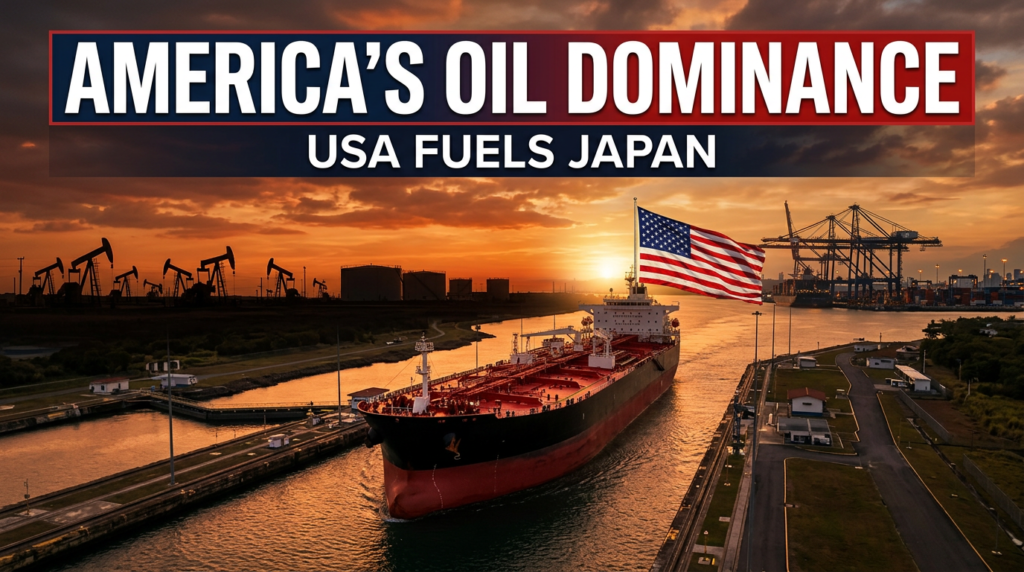
When a tanker carrying approximately 900,000 barrels of Texas crude oil traversed the Panama Canal and docked in Japan, it barely registered in the American press. No front-page splashes. No prime-time segments. Just a ship, a cargo, and a transaction that quietly illustrated something the critics of American energy policy have worked hard to ignore: the world runs on oil, and right now, the world is coming to us for it.
That isn’t rhetoric. It isn’t a campaign slogan. It’s a supply chain. And for American workers, taxpayers, and policymakers who believe the country’s strength flows from its productivity rather than its dependency, it is one of the most important economic stories of the year.
Support Independent Local Journalism
TheTownHall.News is a non-profit reader-supported journalism. Just $5 helps us hire local reporters, investigate important issues, and hold public officials accountable across Alameda County. If you believe our community deserves strong, independent journalism, please consider donating $5 today to support our work.The Shipment Behind the Headlines
The tanker in question was carrying West Texas Intermediate crude — the benchmark American grade produced from the shale-rich fields that made the U.S. the world’s largest oil producer. It made the long journey from Texas, through the Panama Canal, and across the Pacific to Japan, one of the world’s largest energy importers and a nation with virtually zero domestic oil production.
This is not an anomaly. According to data from Japan’s Institute of Energy Economics, American crude oil and liquefied petroleum gas have been taking a growing share of Japan’s import mix in recent years, as the country deliberately diversifies away from Middle Eastern suppliers. For an island nation whose entire industrial economy depends on imported energy, that decision is not ideological — it is strategic survival.
And America, sitting atop record production of 13.6 million barrels per day in 2025 — a new national high — is uniquely positioned to meet that demand.
A $550 Billion Handshake Between Allies
That single tanker, however, is only the most visible symbol of a much larger realignment. In October 2025, President Trump traveled to Tokyo and signed a sweeping strategic trade and investment agreement with Japanese Prime Minister Sanae Takaichi. Under the deal — framed by both governments as an agreement toward a “New Golden Age” in US-Japan relations — Japan committed to $550 billion in US investments, in exchange for tariff relief and guaranteed access to American energy and critical minerals.

By February 2026, the first concrete results were on the table: $36 billion in initial energy and critical minerals projects jointly announced by Washington and Tokyo. In March, the U.S. Department of Commerce confirmed three specific, named deals with real operators, real locations, and real dollar figures:
- $40 billion for Small Modular Nuclear Reactors in Tennessee and Alabama, operated by GE Vernova Hitachi
- $17 billion for a 4.3 GW natural gas generation hub in Southwest Pennsylvania, tapping the Marcellus and Utica shale region
- $16 billion for a 5.2 GW natural gas hub in Anderson County, Texas
Beyond those three, a planned GulfLink deepwater terminal is expected to generate between $20 and $30 billion per year in American crude exports once operational — institutionalizing the US role as Asia’s primary energy supplier.
These are not aspirational targets floated at a press conference. These are government-confirmed, operator-named, location-specific infrastructure investments backed by two of the world’s largest economies.
What This Means for American Workers
Let’s be direct about who benefits from these deals — because it isn’t Wall Street bankers or Washington lobbyists.
Energy export revenue flows into the communities that produce energy. The roughnecks and engineers in the Permian Basin. The pipeline workers in Pennsylvania. The refinery operators along the Gulf Coast. When Japan buys American oil, those are the paychecks that grow. Those are the small businesses in energy towns that stay open.
Support Independent Local Journalism
TheTownHall.News is a non-profit reader-supported journalism. Just $5 helps us hire local reporters, investigate important issues, and hold public officials accountable across Alameda County. If you believe our community deserves strong, independent journalism, please consider donating $5 today to support our work.America’s record crude output in 2025 wasn’t manufactured in a government agency. It was produced by private industry operating in competitive markets, backed by infrastructure built over decades. When policymakers allow that industry to reach global markets, the returns come back to working Americans in the form of wages, tax revenue, and energy-sector investment — not foreign aid or international transfers.
“The world will use energy for decades to come. The only question is whether it’s made in America or somewhere else.”
That question has a correct answer. And right now, the correct answer is being shipped through the Panama Canal on a daily basis.
What Critics Get Wrong
Opponents of American energy expansion typically advance two arguments. The first is that large-scale trade deals produce more press releases than results. The second is that exporting fossil fuels undermines the global transition to clean energy.
On the first point: three Commerce-Department-confirmed projects totaling $73 billion, tied to a $550 billion bilateral framework signed by two heads of government in Tokyo, represents a degree of commitment that is materially beyond rhetoric.
On the second: the climate transition argument, however earnestly made, runs into hard physical and geopolitical limits. Japan cannot replace baseload energy demand with intermittent renewables on the timeline its grid requires. The energy Japan needs today will come from somewhere. The choice is not between fossil fuels and clean energy. It is between American oil — produced under some of the world’s most rigorous environmental and labor regulations — and the alternatives: Russian pipeline gas, Venezuelan crude, and supply chains routed through geopolitical adversaries. Choosing not to export American energy does not reduce global consumption by a single barrel. It simply redirects the revenue — and the influence — to someone else.
The Lesson Europe Already Learned the Hard Way
Germany built its energy security on Russian natural gas, convinced that economic interdependence would moderate geopolitical behavior. When Russia invaded Ukraine in 2022, that theory collapsed — and European households paid for it in doubled energy bills, shuttered factories, and a frantic scramble for alternative suppliers.
Japan watched that sequence unfold and reached the obvious conclusion. So did South Korea, Taiwan, and India. Nations that depend on energy imports are not interested in philosophical debates about fossil fuels. They are interested in reliable supply from trustworthy partners who operate under the rule of law.
“Energy security isn’t just an economic issue. It’s a question of who you trust when the pressure is on.”
America has spent decades building the credibility to be that trusted partner. The Trump administration is now monetizing that credibility — and the checks are coming in.
The Bigger Principle at Stake
Underneath the shipping manifests and the Commerce Department fact sheets is a principle that goes beyond any single deal or any single administration.
America’s founding promise was never that the government would manage prosperity on behalf of its citizens. It was that free citizens, operating in free markets, would out-produce and out-innovate any competitor on Earth. The US energy sector — private, competitive, and built on market incentives — is delivering exactly that result. Record production. Record exports. Billion-dollar deals with allies. Jobs in communities that Washington too often overlooks.
This is what limited government and market-driven prosperity look like when they function as designed. The question for American voters and policymakers is whether they have the discipline to sustain it — or whether the next policy cycle will trade this momentum for something that merely looks better in a press release.
Key Takeaway
900,000 barrels of Texas crude in a Japanese port is not a footnote. It is proof of concept — that American energy, American workers, and American strategic leadership can shape the global order without firing a shot.
The $550 billion Japan deal is the largest bilateral investment commitment of its kind. The three confirmed infrastructure projects will add gigawatts of capacity and billions in export revenue. The GulfLink terminal could lock in American energy dominance in Asia for a generation. This story deserves sustained attention — from the public, from policymakers, and from a press corps willing to cover economic strength with the same intensity it brings to economic anxiety.
Stay Informed — and Make Your Voice Heard
The decisions being made right now about American energy, trade relationships, and infrastructure investment will shape this economy for decades. These are not inside-baseball policy discussions. They affect fuel prices, employment, national security, and the global balance of power.
If this reporting provided value, share it with someone who should be paying attention. Subscribe for independent analysis that follows the facts wherever they lead. And if you believe in civic engagement, economic accountability, and a free press that covers consequential stories — support the outlets doing that work.
The world is watching what America does with its energy advantage. So should every American.