Is Oakland’s Police Staffing Crisis Finally Too Dangerous to Ignore?
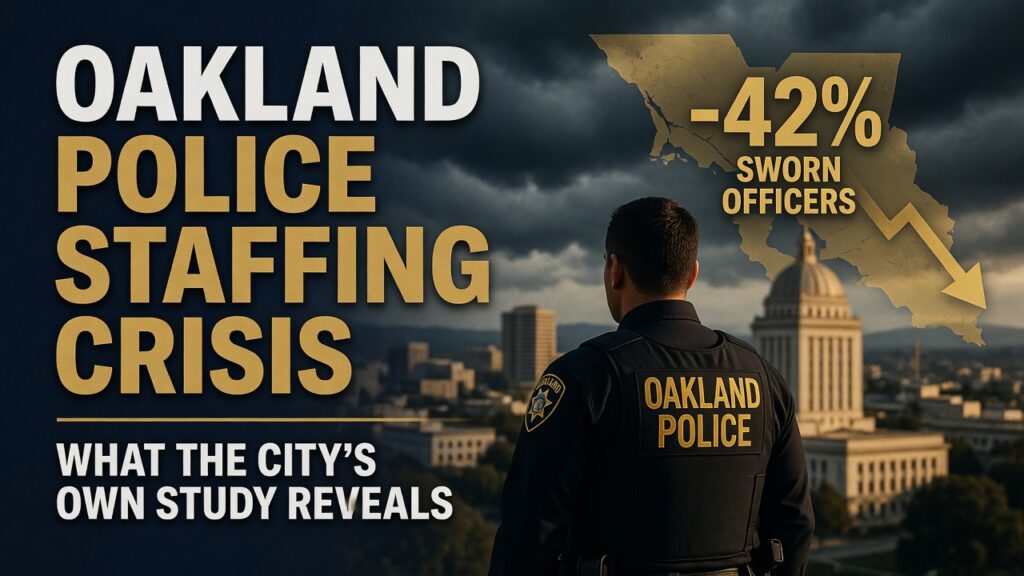
A city-commissioned study demands 877 officers. Oakland has roughly 509 on active duty. Someone has to answer for that gap — and it isn’t the criminals.
Oakland is running out of cops. Not metaphorically — mathematically. While city officials celebrate declining crime headlines, a damning independent study commissioned by Oakland’s own government and buried for months tells a different story: the department charged with protecting 430,000 residents is so dangerously understaffed that it cannot do its job. The question isn’t whether there is a crisis. The question is who in city hall is going to be held accountable for creating one.
The stakes couldn’t be higher — or more personal. According to FBI crime data released in 2025, Oakland recorded the highest property crime rate of any large American city in 2024, at 7,230 incidents per 100,000 residents [FBI Uniform Crime Report, 2024]. That means the odds of becoming a property crime victim in Oakland stand at roughly one in eleven [NeighborhoodScout, 2024 FBI data]. Those aren’t statistics. Those are neighbors. Business owners. Parents walking to their cars.
Support Independent Local Journalism
TheTownHall.News is a non-profit reader-supported journalism. Just $5 helps us hire local reporters, investigate important issues, and hold public officials accountable across Alameda County. If you believe our community deserves strong, independent journalism, please consider donating $5 today to support our work.What Does the City’s Own Study Actually Say?
The city didn’t need outside critics to expose the problem — it paid $310,000 for a consultant to do it internally. In a staffing study commissioned in 2023 and completed by Philadelphia-based PFM Group Consulting, the findings were unambiguous: Oakland needs a minimum baseline of 877 sworn officers to manage its current workload [PFM Group Consulting / Oakland OIG, 2025]. At the time the study was delivered, only 600 sworn positions were authorized. A December 2024 contingency budget then cut an additional 78 sworn positions, pushing authorized staffing down further [Oakland Report, April 2025].
The gap isn’t close. It isn’t a rounding error. It is a structural collapse.
Oakland currently has about 509 sworn officers on active duty — roughly 277 fewer than the city’s own expert study says are the bare minimum needed. [Oakland Report, March 2026]
Then there is the clearance rate problem — arguably the most damning detail in the entire report. For property crimes, Oakland’s clearance rate averaged just 0.5%, compared to a benchmark median of 7.3% among comparable cities. For violent crimes, OPD resolved just 9.8% of cases from 2019 to 2023, against a benchmark median of 29.9% [PFM / Oakland OIG study, 2025]. In practical terms, if your car is stolen in Oakland, there is less than a one-in-two-hundred chance anyone is ever charged with stealing it.

Are Residents Being Asked to Pay More While Getting Less?
Oakland voters approved Measure NN in November 2024 — a measure that raised taxes and required the city to budget for and maintain a minimum of 700 sworn officers [Measure NN, City of Oakland, 2024]. That was the deal. Voters held up their end. The city has not. As of early 2026, the department sits at roughly 509 officers actively on duty — 191 short of the voter-mandated floor [Oakland Report, March 2026]. Rather than comply, the city council invoked a formal declaration of “extreme fiscal necessity” to legally suspend the staffing requirement, a workaround that has been in place for nearly two years since the measure passed.
If a government can simply suspend the legal commitments it makes to voters whenever budgets get tight, what exactly does a voter mandate mean?
The overtime math makes the situation even more absurd. OPD’s salary budget for sworn officers was cut by $12 million this fiscal year. To compensate, the department’s overtime budget was simultaneously increased by $20 million [PFM study / Oakland OIG, 2025]. The city is spending more money to have fewer officers work longer hours under worse conditions. That is not fiscal discipline. That is fiscal dysfunction wearing a budget-cut costume.
“Current conditions are not well-suited for long-term safety goals of the City and OPD.” — PFM Group Consulting, official staffing study commissioned by the City of Oakland, 2025
Who Is Really Paying for This Policy?
7,230. That is the number of property crimes per 100,000 Oakland residents recorded in 2024 — the highest rate of any large American city [FBI UCR, 2024]. The question city council hasn’t answered: who is paying for that?
Small business owners who have shuttered storefronts are paying for it. Residents in East and West Oakland flatlands — the neighborhoods most exposed to violent crime — are paying for it. Officers on mandatory overtime shifts, carrying caseloads that independent analysts describe as nearly double the benchmark median, are paying for it. And in a final cruel irony, it is Oakland’s most vulnerable communities — those in the highest-crime corridors — who bear the heaviest cost when a police force cannot respond, cannot investigate, and cannot follow through.
Support Independent Local Journalism
TheTownHall.News is a non-profit reader-supported journalism. Just $5 helps us hire local reporters, investigate important issues, and hold public officials accountable across Alameda County. If you believe our community deserves strong, independent journalism, please consider donating $5 today to support our work.The city that most needs robust public safety is the one that has spent years dismantling it — and the people who suffer most are not the officials making those decisions.
What Has Changed — and What Hasn’t?
To be fair, the data shows real progress. Violent crime in Oakland fell 25% in 2025 compared to 2024, and the first quarter of 2026 showed serious crime down nearly 30% year-over-year [KTVU FOX 2, January 2026; Local News Matters, April 2026]. Homicides dropped from 125 in 2023 to 82 in 2024, and then to 67 in 2025 — the lowest figure since 1967 [City of Oakland data, January 2026]. Those numbers matter. They represent lives.
Contributing factors include the return of the Ceasefire violence intervention program, deployment of California Highway Patrol officers in Oakland, expanded camera networks, and a change in pursuit policies that now allow officers to chase fleeing suspects [KTVU, January 2026]. Credit where it is due: these are tangible improvements.
But improvement is not the same as adequate. A department that remains 368 officers below its own baseline minimum, solves fewer than one in ten violent crimes, and is operating on mandatory overtime to fill shifts is not a department that has turned a corner. It is a department running on borrowed time.
What Do Supporters of This Policy Actually Believe?
Proponents of Oakland’s current approach make several arguments worth engaging honestly. First, they point to the demonstrable crime decline of 2024–2026 as proof that a leaner, technology-augmented department combined with community intervention programs can deliver results without simply throwing more officers at the problem. Mayor Barbara Lee has specifically credited the Ceasefire program’s deterrence model and multi-agency partnerships as the engines of improvement [KTVU, January 2026].
Second, advocates argue that over-policing historically harms Black and Brown communities disproportionately, and that reform-oriented strategies targeting root causes — housing, employment, violence intervention — are more equitable long-term solutions. These are legitimate concerns, not excuses, and any credible public safety strategy must grapple with them.
Third, Oakland’s $360 million-plus budget shortfall is real [KQED, 2024]. The fiscal constraints forcing staffing decisions are not invented.
The problem with these arguments is one of consistency. A clearance rate of 0.5% on property crimes does not protect vulnerable communities — it abandons them. An overtime bill that exceeds the salary savings from cutting officers is not fiscal responsibility — it is shell-game accounting. And a crime improvement rate, however welcome, that still leaves Oakland ranked second most dangerous in the country by U.S. News & World Report [NBC Bay Area, August 2025] is not a victory lap. It is a starting point.
Is This the Accountability Moment Oakland Has Been Waiting For?
Oakland voters sent a clear message in November 2024 when they passed Measure NN: fund the police, maintain the numbers, and deliver on public safety. The city’s response was to declare fiscal emergency and suspend its own legal obligation. The OPD staffing study — paid for with taxpayer dollars — was initially withheld from the public and from the full city council before being released under pressure [Oakland Report, April 2025].
Citizens deserve to know what their government knows. They deserve to vote on measures that are actually enforced. And they deserve a police department staffed at levels that make it possible to do the job.
The progress of the past two years is real. But progress built on the labor of an understaffed, overworked department — running on mandatory overtime, resolving fewer than one in ten violent crimes, and operating 368 officers below its own minimum baseline — is fragile. One budget cut, one reform reversal, one spike in attrition, and the floor gives way.
The real question isn’t whether Oakland can afford to staff its police department. It’s whether Oakland can afford not to.
Key Questions This Story Raises
- Will Oakland enforce Measure NN? Voters mandated 700 sworn officers in 2024. The city suspended that requirement. What legal or political mechanism forces compliance?
- What happens to crime trends when overtime and technology substitutes run dry? Current progress may be built on unsustainable short-term fixes — who is stress-testing that assumption?
- Why was a $310,000 city-commissioned staffing study initially withheld from the public and the full city council? And what else isn’t being shared?
Think other Oaklanders and Californians need to hear this? Share this article. Want to make your voice count? Contact your Oakland City Council representative and ask them directly: when will the city comply with Measure NN? Stay informed — subscribe to The Town Hall for daily coverage of Alameda County and beyond.