IDF Synagogue Tehran Strike: Why the Destruction of Rafi-Nia Demands a Full Accounting
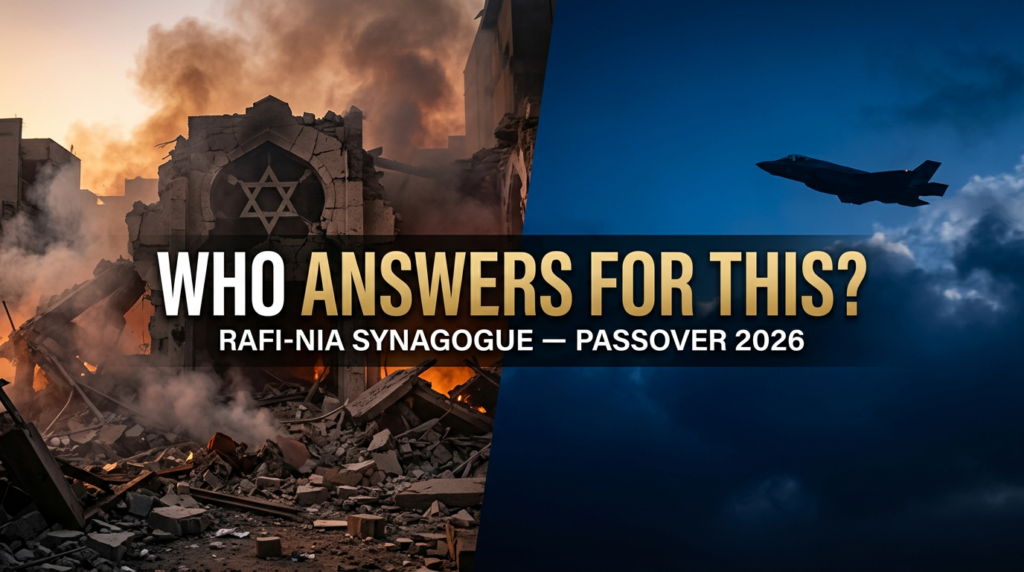
The IDF’s strike that leveled the Rafi-Nia Synagogue during Passover raises urgent questions about military accountability, the protection of religious sites, and the true cost of modern warfare — questions that transcend partisan politics and demand honest answers.
On the morning of April 7, 2026 — during the Jewish holiday of Passover — an Israeli airstrike reduced the Rafi-Nia Synagogue in central Tehran to rubble. Torah scrolls lay buried under concrete. Two worshippers were trapped and had to be rescued by the Iranian Red Crescent. A 68-year-old house of prayer, built by a Jewish community that predates the State of Israel itself, was gone.
The Israeli Defense Forces acknowledged the destruction, expressed regret for the “collateral damage,” and explained that the real target was a senior Iranian military commander at the adjacent Khatam al-Anbiya headquarters. The precision munitions, they said, were aimed elsewhere. That explanation may be technically accurate. It is not, however, sufficient — and in a world where accountability and transparency still mean something, it shouldn’t be treated as one.
Support Independent Local Journalism
TheTownHall.News is a non-profit reader-supported journalism. Just $5 helps us hire local reporters, investigate important issues, and hold public officials accountable across Alameda County. If you believe our community deserves strong, independent journalism, please consider donating $5 today to support our work.A Strike That Cannot Be Dismissed as a Footnote
Let’s be clear about what happened here. The Rafi-Nia Synagogue was not a casualty of a stray rocket or an imprecise battlefield skirmish. It was destroyed in a deliberate strike in the heart of Tehran, during one of the holiest periods in the Jewish calendar, in a country that is home to the second-largest Jewish population in the Middle East outside of Israel.
Iran’s Jewish community — numbering in the tens of thousands, with roughly 25 active synagogues, 10 to 15 of them in Tehran — has survived Islamic Revolution, international isolation, and decades of state-sponsored anti-Israel rhetoric. They are not Zionists, at least not by the Islamic Republic’s definition. They are Iranians. They are a minority. And their synagogue is now a pile of dust.
The IDF said it took steps to “minimize the risk of harm to civilians,” including aerial surveillance and precise munitions. Those steps clearly did not prevent the complete destruction of a functioning religious site. That gap — between stated intent and actual outcome — is exactly where accountability must live.
Why Accountability Matters More Than Optics
Conservatives who believe in law, order, and the rule of law — including the laws of armed conflict — should be the first to demand a full accounting here, not the last.

Supporting Israel’s right to defend itself against a regime that has funded terrorism, pursued nuclear weapons, and called for the erasure of a democratic nation is not the same as giving any military a blank check. Those are two different things, and conflating them is intellectually dishonest.
The laws of armed conflict — specifically the principles of proportionality and distinction — exist precisely for situations like this. They are not bureaucratic red tape. They are the moral architecture that separates legitimate military action from something far darker. A society that values law and order at home must demand that its allies uphold those same standards abroad.
If we abandon accountability the moment it becomes inconvenient, we don’t actually believe in it — we just use it selectively.
The Iranian Government’s Cynical Exploitation
It would be naive to ignore how the Iranian government has weaponized this incident. Tehran’s leadership has been quick to amplify the synagogue’s destruction as proof that Israel — which they call the “Zionist regime” — is the enemy of all people, including Jews. That framing is deliberate propaganda, and it deserves to be called out.
Iran’s Islamic Republic has a long and documented record of treating its own Jewish community as political instruments. They pressure Jewish citizens to publicly denounce Israel. They restrict Jewish community institutions. In November 2024, a 20-year-old Jewish man, Arvin Ghahremani, was executed — denied the legal option of paying blood money reportedly because of his religion, according to the U.S. Commission on International Religious Freedom.
Support Independent Local Journalism
TheTownHall.News is a non-profit reader-supported journalism. Just $5 helps us hire local reporters, investigate important issues, and hold public officials accountable across Alameda County. If you believe our community deserves strong, independent journalism, please consider donating $5 today to support our work.The Iranian government does not protect its Jewish citizens out of principle. It protects them — when it does — out of political convenience. Using the Rafi-Nia Synagogue’s destruction to score propaganda points while simultaneously persecuting Jewish Iranians is a breathtaking display of hypocrisy.
But Iranian hypocrisy does not erase Israeli accountability. Both things can be true.
What Critics Get Wrong — And What They Get Right
Some voices on the left have used this incident to broadly condemn Israel’s entire military campaign against Iran, a regime that has spent decades destabilizing the region, arming proxy militias, and threatening civilian populations across the Middle East. That broader condemnation ignores the genuine security threat Israel faces and the legitimate military objectives it has pursued.
They are wrong to use one tragic incident to delegitimize a nation’s right to self-defense.
But critics who raise the specific question of religious site protection are not wrong to do so. Homayoun Sameh, a Jewish representative in Iran’s parliament — not exactly a platform for pro-Israel sentiment — stated plainly: “The Zionist regime showed no mercy to this community during the Jewish holidays and targeted one of our ancient and holy synagogues.” That condemnation came from within Iran’s own Jewish community, the very people the IDF claimed to be mindful of.
When the people most directly affected are speaking, it is worth listening — even when their government uses their words for its own ends.
Religious Freedom Is Not a Regional Issue
Here is the principle that should unite readers across the political spectrum: the protection of religious sites and minority communities is not negotiable, regardless of geography or geopolitics.
Conservatives who have rightly championed religious freedom domestically — defending churches, synagogues, and mosques from government overreach and hate-motivated attacks — cannot apply that principle selectively. Religious freedom is either a universal value or it is a talking point. The Rafi-Nia Synagogue served a community of Jews who have worshipped in Persia since the Babylonian exile in the 6th century BCE. Their faith, their heritage, and their place of worship deserved protection.
The ceasefire that followed days after this strike, and the subsequent Islamabad Talks, represent an opportunity. Any lasting diplomatic framework must include explicit protections for religious and cultural sites — binding, verifiable, and enforced. That is not idealism. That is the minimum standard of civilized conflict resolution.
Key Takeaway
The destruction of the Rafi-Nia Synagogue is not simply a tragic footnote in a complex war. It is a test of whether accountability means anything when applied to allies, not just adversaries. It is a test of whether religious freedom is a principle or a political tool. And it is a test of whether the rules that govern warfare — rules built on hard lessons from the worst conflicts in human history — still carry moral weight in the 21st century.
A military that strikes a synagogue during Passover and calls it collateral damage owes more than regret. It owes a transparent investigation, a clear accounting of the decision-making chain, and a commitment to ensuring it does not happen again.
That is not anti-Israel. That is pro-accountability — and accountability is the foundation on which every free and ordered society stands.
Conclusion: Principle Over Politics
The easy response to the Rafi-Nia Synagogue story is to pick a side and stay there. The harder — and more honest — response is to hold multiple truths simultaneously: that Israel faces a genuine existential threat from the Iranian regime; that the Iranian government exploits its own Jewish minority; and that the complete destruction of a Jewish house of worship during Passover demands more than an expression of regret.
We do not defend our values by suspending them in wartime. We prove their worth by holding to them precisely when it is difficult.
If we believe in law and order, in religious freedom, in personal accountability, and in the idea that no institution — military or civilian — is above scrutiny, then this story demands our attention and our honest engagement.
The Rafi-Nia Synagogue stood for 68 years. It is gone. The questions its destruction raises are not.
Stay informed on stories that matter. Share this article with someone who values accountability and honest journalism. Support independent reporting that holds all sides to the same standard.