US Marines Seize Iranian Ship Touska — China’s Role Raises Urgent Questions
While nuclear talks stalled and tensions with Tehran simmered, the U.S. Navy made a move that exposed a dangerous alliance — and forced a reckoning over who is really fueling instability in the Middle East.
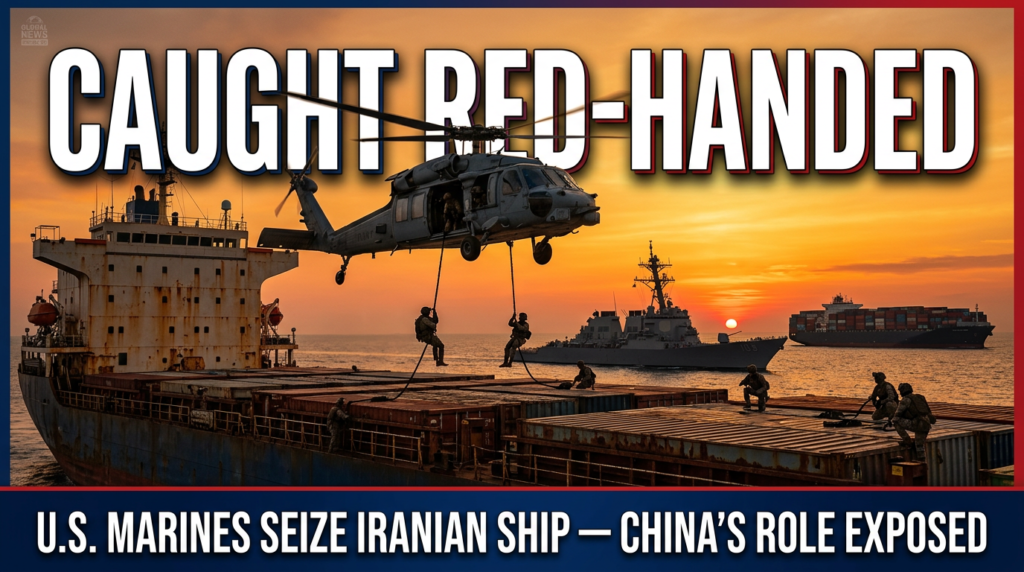
The images tell a story that no diplomatic communiqué can spin away. On April 19, 2026, U.S. Marines rappelled from helicopters onto the deck of the M/V Touska, an Iranian-flagged cargo vessel steaming toward Bandar Abbas in the Gulf of Oman. It wasn’t a drill. It wasn’t a warning shot. It was a full seizure — and it has sent shockwaves from Washington to Beijing.
The Touska had spent months shuttling between Chinese ports and Iranian destinations. Its owner, Mosakhar Darya Shipping Co., has been under U.S. sanctions since 2012. The ship belongs to Iran’s state-owned IRISL group — an entity the U.S. Treasury has described as “the preferred shipping line for Iranian proliferators and procurement agents.” This wasn’t a vessel that wandered into trouble. It was a vessel that had been living in it for years.
Support Independent Local Journalism
TheTownHall.News is a non-profit reader-supported journalism. Just $5 helps us hire local reporters, investigate important issues, and hold public officials accountable across Alameda County. If you believe our community deserves strong, independent journalism, please consider donating $5 today to support our work.What Actually Happened in the Gulf of Oman
The USS Spruance, an Arleigh Burke-class guided-missile destroyer, tracked the Touska for six hours and issued repeated warnings to stand down. The ship’s crew ignored every one of them. The Spruance then fired rounds from its 5-inch gun, targeting the engine room to disable the vessel without sinking it. Marines from the 31st Marine Expeditionary Unit, operating from the amphibious assault ship USS Tripoli, then boarded the ship by helicopter rappel and took custody.
U.S. Central Command released video footage of the operation. The entire sequence — from warning to boarding — was methodical, professional, and proportionate. This is what law and order looks like on the high seas.
The ship is now in U.S. custody and is being taken to port for full cargo inspection. Legal experts have noted it could be declared “spoils of war” under the laws of naval warfare — a designation that would make it property of the U.S. government following a prize court process.
The China Connection That Cannot Be Ignored
Here is where the story becomes more than a naval operation. Ship-tracking data from MarineTraffic.com confirms that the Touska had been operating regularly between Zhuhai, China and various Iranian ports before its seizure. Its last recorded port of call was Port Klang, Malaysia, on April 12 — just one week before U.S. forces intercepted it.

U.S. Central Command has confirmed that the vessel was assessed as likely carrying “dual-use items” — goods that have both civilian and potential military applications. Former U.S. Ambassador to the United Nations Nikki Haley went further, publicly claiming the ship was carrying chemical precursors used in the manufacture of ballistic missile propellant. The full cargo manifest is still being evaluated, and official confirmation is pending.
What is not pending is the pattern. The Touska is part of a fleet with documented ties to Chinese ports and a long record of sanctions violations. The question of whether Beijing knowingly facilitated this shipment is still being investigated — but the documented port history alone demands answers from Chinese authorities.
“You don’t repeatedly sail a sanctioned vessel between Chinese ports and Iran’s missile-program shipping line by accident.”
Why This Issue Matters Far Beyond the Persian Gulf
For Americans who believe in accountability — in government, in trade, and in international relations — this story cuts to the heart of a fundamental question: are the rules of the international order enforced, or are they merely suggestions for nations that choose to follow them?
China has long maintained that it does not support Iran’s weapons programs. Yet here is a ship — documented in Chinese ports, owned by a sanctioned Iranian entity, flagged for links to ballistic missile procurement — sailing openly through international waters. If Beijing had no knowledge of the Touska’s activities, that is a failure of oversight. If it did, that is something far more serious.
Either way, the American taxpayer — who funds the Navy, the sanctions enforcement apparatus, and the diplomatic machinery that attempts to hold bad actors accountable — deserves a straight answer.
Support Independent Local Journalism
TheTownHall.News is a non-profit reader-supported journalism. Just $5 helps us hire local reporters, investigate important issues, and hold public officials accountable across Alameda County. If you believe our community deserves strong, independent journalism, please consider donating $5 today to support our work.Iran’s Response: Defiance, Not Diplomacy
Tehran did not respond to the seizure with contrition. Iranian military officials called the boarding “armed piracy” and “blatant aggression.” The Iranian government threatened to withdraw from scheduled peace talks in Islamabad, Pakistan, until the U.S. lifts its naval blockade.
This is the same Iran that has spent decades funding proxy militias across the Middle East, threatening commercial shipping lanes, and pursuing a nuclear program the world has tried for years to constrain through diplomacy. The Touska seizure is not an isolated incident — it is one data point in a long pattern of behavior by a regime that treats international agreements as tactical tools rather than binding commitments.
The Trump administration, for its part, has stated it still expects peace talks to resume despite the incident. That measured confidence reflects a clear-eyed understanding of leverage: the U.S. is negotiating from strength, not desperation.
What Critics Get Wrong
Some voices on the left and in international legal circles will argue that seizing a vessel on the high seas sets a dangerous precedent — that it undermines diplomatic efforts and escalates tensions unnecessarily.
That argument deserves a direct response.
The Touska was owned by a company under U.S. sanctions for over a decade. It was part of a shipping group formally designated for its role in Iranian weapons procurement. Its crew was given six hours of warnings before any force was used. The operation was conducted in accordance with the laws of naval warfare, and the cargo is being inspected through a legal process.
Calling this “piracy” — as Iran has — is a rhetorical inversion of reality. Piracy is what happens when a sanctioned regime uses civilian shipping to move materials for ballistic missile programs. Enforcing the law is what the U.S. Navy did on April 19.
“Diplomacy without enforcement is not diplomacy — it’s theater.”
The Broader Stakes: Accountability in a Multipolar World
The Touska seizure arrives at a pivotal moment. The United States is navigating an increasingly complex multipolar world in which China, Russia, and Iran have deepened their strategic cooperation. Each of these nations has, at various points, tested the limits of American resolve.
What the USS Spruance and the 31st Marine Expeditionary Unit demonstrated last Sunday is that those limits are real and enforced. That matters not just for U.S.-Iran relations, but for every nation watching to see whether American commitments — to allies, to sanctions regimes, to freedom of navigation — mean anything in practice.
For American citizens who believe in a strong national defense, fiscal responsibility in foreign policy, and accountability for those who violate international law, this operation is a case study in what effective, proportionate action looks like. No boots on foreign soil. No open-ended military commitment. A targeted, lawful enforcement action — and a message sent.
Key Takeaway
The seizure of the Touska is more than a naval headline. It is a test of whether the international rules-based order has teeth. The ship’s documented ties to Chinese ports, its sanctioned owner’s history, and its suspected cargo all point to a pattern that demands scrutiny — of Iran, and of the partners enabling it. The U.S. response was measured, legal, and necessary.
Stay Informed. Stay Engaged.
Stories like the Touska seizure rarely get the sustained coverage they deserve. The details matter — the ship-tracking data, the sanctions history, the cargo inspection, the diplomatic fallout. Independent journalism that follows these threads, verifies the facts, and holds all parties accountable is more important than ever.
Share this article with someone who wants the full picture, not just the headlines. Subscribe to stay informed as this story develops. And if you believe in journalism that prioritizes truth over narrative, support independent outlets doing the work.
The world is watching. So should you.