Sheila Cherfilus-McCormick Resignation: Florida Rep. Quits Before Ethics Sanction — Federal Trial Still Ahead
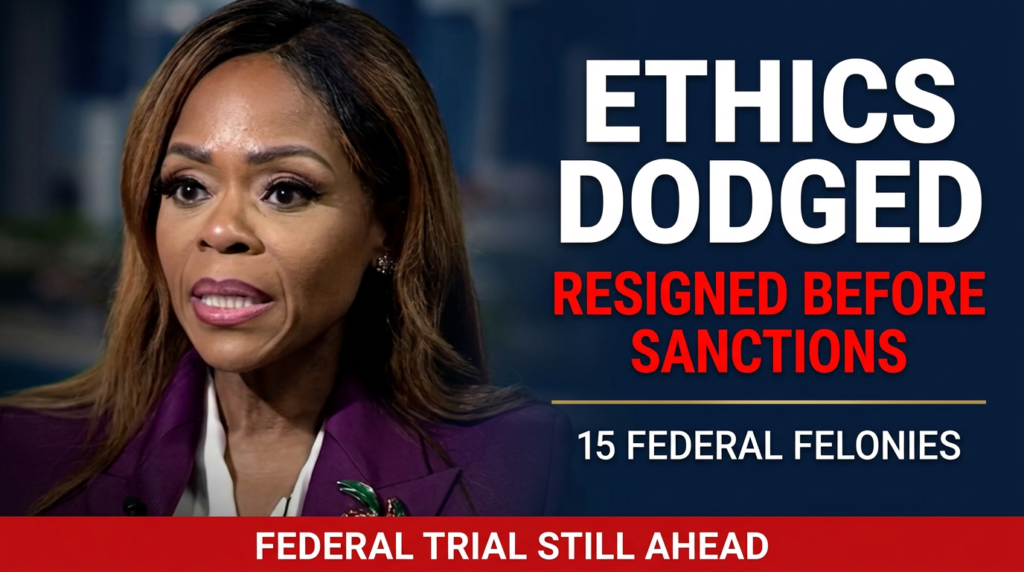
A sitting U.S. congresswoman walked away from her seat moments before a federal ethics committee was set to punish her for alleged corruption. The timing speaks volumes — and so does her party’s muted response.
When a member of Congress resigns minutes before a scheduled public hearing designed to hold them accountable, the question isn’t whether something went wrong. The question is how long it was allowed to go on — and who looked the other way.
On April 21, 2026, Democratic Rep. Sheila Cherfilus-McCormick of Florida submitted her resignation from the 119th Congress effective immediately, just as the House Ethics Committee was convening to determine her punishment. In doing so, she stripped the committee of its jurisdiction, avoided a formal sanction, and walked away from a seat she was elected to hold. For the taxpayers of Florida’s 20th congressional district — and for every American who believes elected officials should be held to the highest standard — that is not justice. That is a loophole.
Support Independent Local Journalism
TheTownHall.News is a non-profit reader-supported journalism. Just $5 helps us hire local reporters, investigate important issues, and hold public officials accountable across Alameda County. If you believe our community deserves strong, independent journalism, please consider donating $5 today to support our work.What the Ethics Committee Actually Found
This wasn’t a political witch hunt, despite Cherfilus-McCormick’s claims. The House Ethics Committee’s investigation began in 2023 following a formal referral from the Office of Congressional Conduct. After years of deliberate, methodical review, an adjudicatory subcommittee found clear and convincing evidence of more than two dozen separate ethics violations.
The core allegation is staggering in its audacity: Cherfilus-McCormick is accused of funneling $5 million in FEMA COVID relief funds — money intended for families recovering from disaster — into her 2021 congressional campaign. This wasn’t a paperwork error or a gray-area campaign finance question. These are allegations of systematic corruption involving federal disaster relief money.
Ethics Committee Chair Rep. Michael Guest (R-MS) was unambiguous in his response to her resignation: “This was not a rush to judgment. This was a very deliberate process to gather information into allegations that were extremely serious and extremely complicated.”
Years of work. Dozens of charges. And in the end, no formal sanction — because she resigned first.

A Federal Indictment Still Looms
Resigning from Congress does not make Cherfilus-McCormick’s legal problems disappear. In November 2025, a federal grand jury indicted her on 15 felony counts. She has pleaded not guilty, and her criminal trial is currently scheduled for 2027.
That distinction matters. The House Ethics Committee process and the federal criminal process are separate tracks. She may have outmaneuvered one, but she cannot outrun the other. If convicted, she faces the full weight of the federal justice system — as any private citizen would.
This is, in fact, how the rule of law is supposed to work. No title, no office, and no political affiliation shields anyone from accountability when federal funds are allegedly stolen and laundered into a personal political campaign.
“She stole $5 million, she’s been indicted with 15 felonies.” — Rep. Greg Steube (R-FL)
That quote, from a fellow Florida congressman, cuts through the noise. Whatever procedural arguments are made about due process and timing, the underlying facts of this case are not in dispute by investigators.
The Resignation Tactic: Accountability Dodged, Not Delivered
Let’s be precise about what happened on April 21st. The Ethics Committee had spent years building a case. A public hearing was scheduled. Punishment — potentially including expulsion from Congress — was imminent. And then, at the last possible moment, Cherfilus-McCormick resigned, triggering the committee’s loss of jurisdiction.
Support Independent Local Journalism
TheTownHall.News is a non-profit reader-supported journalism. Just $5 helps us hire local reporters, investigate important issues, and hold public officials accountable across Alameda County. If you believe our community deserves strong, independent journalism, please consider donating $5 today to support our work.This is not accountability. This is a procedural escape hatch.
Democratic challenger Elijah Manley, who ran against her, said it plainly: she resigned “to avoid being formally expelled from Congress by her own colleagues. She still stole $5 million meant for families recovering from disaster. She still laundered it into a congressional campaign built on a lie.”
The people of Florida’s 20th district now have no congressional representation until a special election is held. They didn’t ask for this vacancy. It was handed to them by a representative who prioritized self-preservation over public service — right up until the very end.
What Critics Get Wrong About “Due Process”
The most common defense offered on Cherfilus-McCormick’s behalf — including from House Minority Leader Hakeem Jeffries, who said she “did the right thing” — centers on due process. The argument goes: she hasn’t been convicted in a criminal court, so the Ethics Committee shouldn’t have proceeded.
This reasoning confuses two entirely separate standards.
Congressional ethics proceedings operate under their own rules and their own evidentiary standards, as they are designed to do. The House Ethics Committee is not a criminal court and was never required to wait for a criminal verdict before acting. Congress has both the authority and the obligation to police the conduct of its own members. That is not a violation of due process — it is the exercise of institutional accountability.
Rep. Joyce Beatty acknowledged the tension, saying, “everybody deserves the right to have due process.” That’s true. But due process was offered. Cherfilus-McCormick appeared before the Ethics Committee in March 2026. The process ran for years. She chose resignation over participation — and now frames that choice as victimhood.
Accountability is not persecution. And resigning to avoid consequences is not the same as being wrongly accused.
The Broader Cost: Fiscal Accountability and the Public Trust
This case is about more than one congresswoman. It is about what happens when elected officials treat public funds as personal resources — and whether the systems designed to stop them actually work.
FEMA disaster relief money exists for one reason: to help American families and communities rebuild after catastrophic events. Every dollar allegedly diverted from that mission is a dollar that didn’t reach a family whose home was destroyed, a small business that couldn’t reopen, a community still waiting for help.
Fiscal accountability isn’t a partisan talking point. It is the basic contract between government and the governed. When that contract is broken — when relief funds are allegedly stolen and weaponized for political gain — the damage extends far beyond the dollars. It erodes the public trust that makes functioning government possible at all.
The voters of Florida’s 20th district deserved better. So did every American taxpayer whose money flows into federal disaster relief programs.
Key Takeaway
Rep. Sheila Cherfilus-McCormick resigned from Congress on April 21, 2026 — minutes before the House Ethics Committee was set to sanction her for more than two dozen ethics violations tied to allegations she diverted $5 million in FEMA funds into her 2021 campaign. She still faces 15 federal felony charges and a criminal trial in 2027. Her resignation ended the Ethics Committee’s jurisdiction but does not end her legal exposure. The accountability process is incomplete — and the public deserves to see it through.
Conclusion: The Process Must Continue
Cherfilus-McCormick’s resignation is not the end of this story. It is a chapter break. The federal criminal case moves forward regardless, and the American justice system will have its opportunity to render a verdict.
But there is a lesson here that goes beyond one case. When elected officials face serious, well-documented allegations of corruption — especially corruption involving money meant for disaster victims — the institutions designed to hold them accountable must be strong enough, and fast enough, to act before the exit door is used.
The Ethics Committee did its job. Years of investigation. Dozens of verified charges. A public hearing scheduled. What it could not control was the clock — and a last-minute resignation that robbed constituents of a formal reckoning.
Personal responsibility, fiscal integrity, and the rule of law are not abstract values. They are the foundation of representative government. When a member of Congress allegedly steals disaster relief funds and then resigns to avoid punishment, those values are tested. The right response is not to move on quietly. It is to demand that the criminal process runs its full course — transparently, fairly, and without political interference.
The voters are watching. They always are.