Indonesia Enforces South China Sea Sovereignty — And Exposes China’s Illegal Maritime Claims
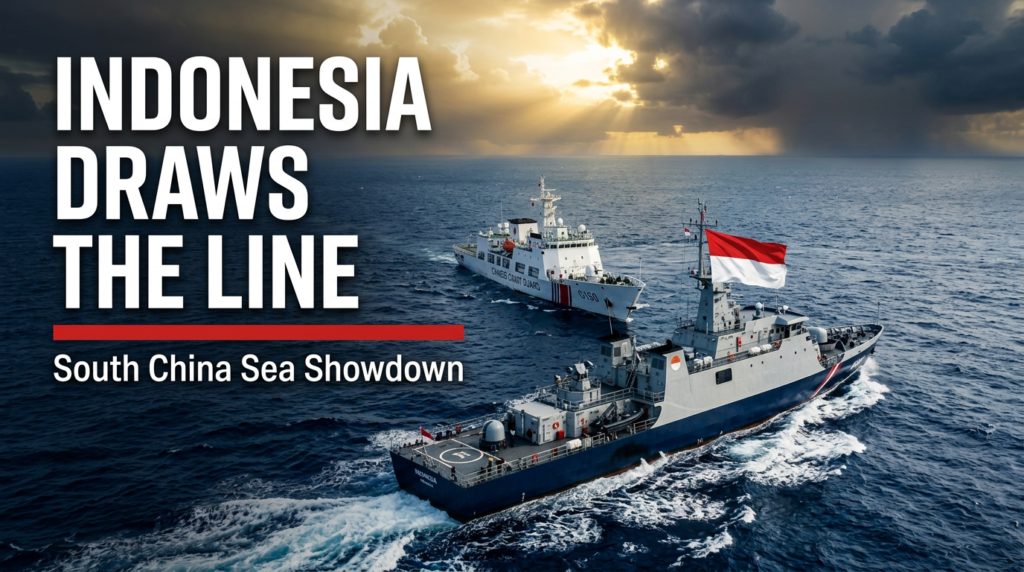
When a sovereign nation enforces its own maritime laws against an encroaching superpower, it sends a message every free country should hear loud and clear: international law is not optional.
The South China Sea is arguably the most contested body of water on the planet. Trillions of dollars in annual trade pass through its lanes. Its seabed holds vast reserves of oil and natural gas. Its waters teem with fish that feed hundreds of millions of people. And for years, one nation has been quietly — and illegally — claiming nearly all of it as its own.
China’s expansionist posture in the South China Sea is not new. But what is new is the growing willingness of its neighbors to push back. Indonesia, the world’s largest archipelagic state and Southeast Asia’s biggest economy, has emerged as one of the most assertive voices for maritime sovereignty in the region. Its message to Beijing is simple, direct, and grounded in international law: these are our waters, and we will defend them.
Support Independent Local Journalism
TheTownHall.News is a non-profit reader-supported journalism. Just $5 helps us hire local reporters, investigate important issues, and hold public officials accountable across Alameda County. If you believe our community deserves strong, independent journalism, please consider donating $5 today to support our work.A Sovereignty Dispute That Affects Every Nation
China’s so-called “nine-dash line” — a sweeping territorial claim that cuts across the exclusive economic zones (EEZs) of six neighboring countries — has been ruled illegal under international law. In 2016, the Permanent Court of Arbitration in The Hague delivered a landmark ruling in favor of the Philippines, finding that China’s expansive claims had no basis in the United Nations Convention on the Law of the Sea (UNCLOS). China dismissed the ruling. It has never complied.
Indonesia’s North Natuna Sea sits squarely within its internationally recognized EEZ. Yet Chinese coast guard vessels and state-backed fishing fleets have repeatedly entered those waters, treating Indonesian sovereignty as a suggestion rather than a legal fact. For a country that takes rule of law seriously, this is not a diplomatic inconvenience — it is a direct challenge to national integrity.
This is not merely a regional issue. When a permanent member of the UN Security Council openly flouts international maritime law, every coastal nation on earth has reason to pay attention.
Indonesia Responds — With Patrol Vessels, Not Platitudes
Indonesia has not responded to Chinese encroachment with strongly worded press releases. It has responded with action.

In October 2024, Indonesia deployed warships and aircraft to expel a Chinese coast guard vessel that had twice disrupted a state energy survey being conducted in Indonesian waters. The confrontation was direct, documented, and unambiguous. Jakarta did not apologize. It did not negotiate over whether its own EEZ belonged to it. It enforced the law.
That enforcement posture extends to illegal fishing — one of the most costly and underreported forms of maritime crime in the world. Between January and November 2025, Indonesia’s Ministry of Marine Affairs and Fisheries seized 255 vessels for illegal fishing violations in Indonesian waters. As recently as April 2026, Indonesian patrol vessels intercepted three foreign-flagged boats in the Strait of Malacca using prohibited trawl gear, preventing an estimated $3.9 million in losses to the Indonesian economy in that operation alone.
Indonesia has also maintained a long-standing policy — dating back to the administration of President Joko Widodo — of publicly destroying illegally seized foreign fishing vessels. The policy is deliberate. The symbolism is intentional. You do not fish illegally in Indonesian waters and sail home quietly.
“You do not get to ignore international law simply because you are powerful. Indonesia has made that point with patrol boats, not just press releases.”
What the Viral Misinformation Gets Wrong — And Why the Truth Matters More
It is worth addressing directly: claims circulating widely on social media that Indonesia recently “blew up 31 Chinese vessels” in the Natuna Sea in November 2025 have been fact-checked and debunked by multiple independent organizations, including AFP and Vera Files. The video attached to those claims dates to 2016 and shows the destruction of Vietnamese and Malaysian boats, not Chinese ones.
This matters — not to diminish Indonesia’s assertiveness, which is real and well-documented — but because misinformation ultimately weakens the very arguments it tries to support. When false claims go viral, they give bad-faith actors an easy target. They allow China’s state media to dismiss legitimate sovereignty concerns as propaganda. They undermine the credibility of the nations and journalists making the real case.
Support Independent Local Journalism
TheTownHall.News is a non-profit reader-supported journalism. Just $5 helps us hire local reporters, investigate important issues, and hold public officials accountable across Alameda County. If you believe our community deserves strong, independent journalism, please consider donating $5 today to support our work.The truth is powerful enough on its own. Indonesia has confronted Chinese vessels. It has expelled coast guard ships. It has seized hundreds of illegal fishing boats. It has refused to recognize Beijing’s illegal territorial claims. None of that requires embellishment.
The Cost of Doing Nothing — A Lesson for ASEAN
The broader ASEAN response to Chinese maritime aggression has been, to put it diplomatically, inconsistent. Several member states — dependent on Chinese investment, trade, and infrastructure financing — have softened their public positions even as their fishermen are harassed, their coast guard vessels are water-cannoned, and their sovereign resources are extracted without permission.
This is the real cost of appeasement: it is not paid in diplomatic capital. It is paid in fishing communities losing their livelihoods, in state energy revenues diverted by illegal extraction, and in the slow erosion of the legal frameworks that protect smaller nations from the unchecked power of larger ones.
A February 2026 report highlighted what analysts have long suspected: China deliberately wields its fishing fleet as a geopolitical instrument, using civilian vessels as a soft-power vanguard to establish presence and assert de facto control before coast guard or naval assets follow. This is not fishing. It is territorial expansion by other means.
Indonesia’s refusal to accommodate this strategy is not aggression. It is exactly what sovereignty looks like when it is taken seriously.
What Critics Get Wrong About “Escalation”
Critics of Indonesia’s assertive posture — and there are many, particularly among those who prioritize economic engagement with China above all else — argue that confrontation risks escalation and that diplomacy should take precedence.
This argument has a surface logic that collapses under scrutiny. Diplomacy requires a willing partner. China has had a decade to comply with the 2016 arbitration ruling. It has not. It has had years of ASEAN dialogue to de-escalate its fishing fleet deployments. It has not. Rewarding non-compliance with continued patience is not diplomacy. It is capitulation dressed in diplomatic language.
Law and order — whether within a nation’s borders or across its maritime boundaries — does not sustain itself through goodwill alone. It requires enforcement. Indonesia understands this. The question is whether its neighbors, and the broader international community, are willing to learn the same lesson before the cost of inaction becomes irreversible.
“Sovereignty without enforcement is just a line on a map. Indonesia is proving it can be something more.”
The Principle at Stake
At its core, this story is about something fundamental: whether international law means anything when a powerful nation decides it does not apply to them.
Indonesia’s stand in the South China Sea is not just about fish or oil or shipping lanes. It is about whether the rules-based international order — imperfect as it is — can be defended by the nations it is designed to protect. It is about whether smaller states can assert their legal rights without being economically coerced into silence. It is about whether law, rather than raw power, governs the conduct of nations.
These are not abstract principles. They are the foundation upon which stable, prosperous, and free societies are built. When they erode in one place, they erode everywhere.
Key Takeaway
Indonesia has demonstrated that asserting sovereignty under international law is both legally justified and practically achievable — even against a superpower. The verified record shows a nation that enforces its maritime laws, expels illegal vessels, and refuses to legitimize territorial claims that have been ruled unlawful by the world’s highest arbitration body. That is not provocation. That is governance.
Stay Informed. Stay Engaged.
The South China Sea will remain one of the defining geopolitical flashpoints of the coming decade. The decisions made by governments — and the pressure applied by informed citizens — will shape the outcome. Share this article to help others understand what is actually happening beyond the viral headlines. Support independent journalism that separates fact from fiction. And hold your elected representatives accountable for the positions they take on international law and national sovereignty.
The world is watching Indonesia. We should be too.