South Korean Tooth Regeneration Patch Could End the Dental Drill — Here’s What the Science Actually Says
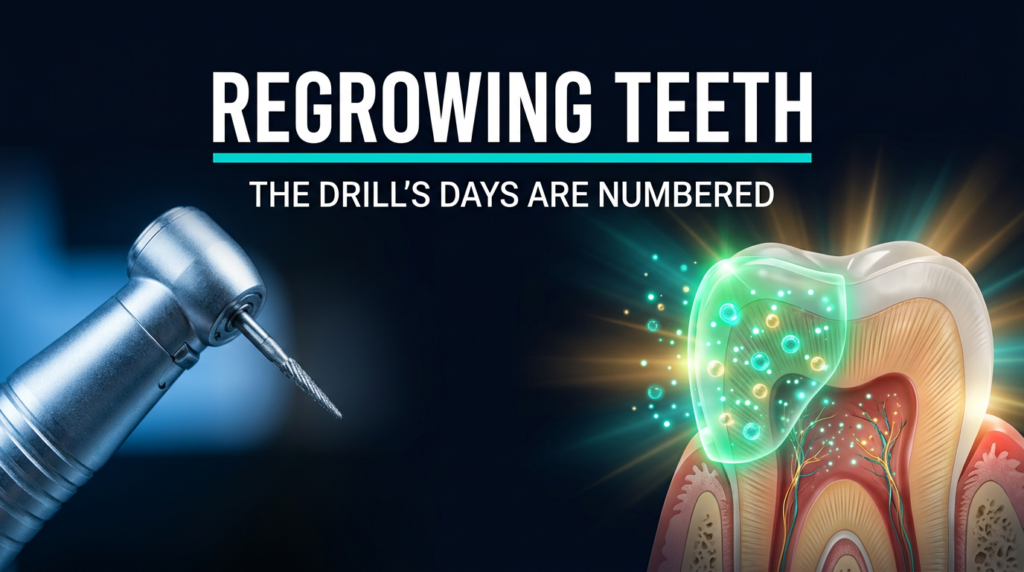
A biodegradable patch that activates your body’s own stem cells to rebuild dental tissue could make the drill obsolete. The science is moving fast. The real question is whether a heavily regulated, enormously profitable industry will let it reach patients before it’s forced to.
Every person who has ever sat in a dentist’s chair has felt the same thing: the quiet dread before the drill starts. For generations, that feeling has been treated as unavoidable. Pay the bill, endure the procedure, and come back in six months to do it again. Americans spend $189 billion on dental care annually, according to the American Dental Association — a staggering sum for an industry that has spent a century perfecting treatments that fix damage rather than reversing it.
That assumption — that lost dental tissue is gone forever — is now under serious scientific challenge. Researchers in South Korea have developed a biodegradable patch that delivers bioactive molecules directly into damaged dental tissue, activating dormant stem cells in the pulp to regenerate dentin, the hard structural layer beneath enamel. No drill. No injection. No surgical implant. The patch is applied, the body does the work, and the cavity fills with living material rather than synthetic composite. It is early-stage research, and the road to your dentist’s office is long. But the biology is real, and the implications are enormous.
Support Independent Local Journalism
TheTownHall.News is a non-profit reader-supported journalism. Just $5 helps us hire local reporters, investigate important issues, and hold public officials accountable across Alameda County. If you believe our community deserves strong, independent journalism, please consider donating $5 today to support our work.The Drill Hasn’t Changed. The Bill Has.
Modern dentistry is effective at what it does. Fillings prevent decay from spreading. Root canals save infected teeth. Implants restore function when teeth are lost. These are not trivial achievements. But they share a foundational limitation: every one of them is a management strategy, not a cure. They replace or contain biological failure without addressing the body’s latent capacity to repair itself.
Meanwhile, the cost of that management has compounded steadily. A single dental implant in the United States now routinely runs between $3,000 and $6,000. Root canals average $700 to $1,500 before the crown that typically follows. For the roughly 74 million Americans without dental insurance, these are not inconveniences — they are decisions that pit oral health against rent, groceries, and school supplies. Dental disease remains one of the most common and most economically punishing health problems in the country, and the existing system, for all its sophistication, has not solved that problem. It has organized around it.
What South Korean Researchers Actually Found
The South Korean research, which drew significant international attention in late 2025, centers on biodegradable patches and gels embedded with bioactive peptides. When applied to a damaged tooth or surrounding tissue, these compounds penetrate the dental structure and stimulate stem cells resident in the pulp — cells that are present in adult teeth but remain largely inactive. Those cells then begin producing new dentin, gradually filling the damaged area with biological material that behaves like the original tooth.
The research is currently in preclinical trials. That distinction matters. Claims that circulated widely on social media — that the patch could regrow full teeth in 20 minutes and would launch commercially in 2026 — were debunked by France 24’s fact-checking team in December 2025. Experts quoted in that investigation noted regulatory approval alone requires a minimum of five years.

What has been established is the scientific plausibility of the approach. Stem cells in the dental pulp can be reactivated. Bioactive molecules can direct that activation. The body’s blueprint for building dental tissue does not disappear after childhood — it goes quiet. The South Korean team’s contribution is a delivery mechanism that wakes it up.
The Broader Race to Rebuild What Was Lost
South Korea is not alone. At King’s College London, scientists have spent over a decade developing Tideglusib, a compound that activates dental pulp stem cells to repair deep cavities — with strong results in animal trials. At Kyoto University in Japan, researchers developed an antibody targeting USAG-1, the protein that suppresses tooth formation in adults. Deactivating it has, in animal models, allowed dormant tooth buds to resume development and produce functional teeth.
Three independent institutions, in three different countries, reaching the same biological conclusion: the machinery to rebuild teeth exists in every adult jaw. Science is no longer asking whether it can be reactivated — it is asking how reliably and how soon.
Professor Anne Poliard of Paris Cité University offers a calibrated estimate: “I am convinced that we will eventually be able to regenerate teeth — but solutions are not likely to arrive for another five to ten years.” For a field where the core technology has been largely unchanged for a century, that is a revolution on the horizon.
A $189 Billion Industry Built on Permanent Damage
Here is the uncomfortable arithmetic. The U.S. dental services market is projected to grow from $192 billion in 2023 to more than $234 billion by 2031, according to industry analysts. Dental implants alone represent a $23 billion market in the United States. These numbers reflect genuine need and real clinical value. They also reflect a business model built on the premise that lost dental tissue stays lost.
Support Independent Local Journalism
TheTownHall.News is a non-profit reader-supported journalism. Just $5 helps us hire local reporters, investigate important issues, and hold public officials accountable across Alameda County. If you believe our community deserves strong, independent journalism, please consider donating $5 today to support our work.Regenerative dentistry does not improve that business model. It disrupts it. A patch that enables a dentist to treat early decay without drilling — or that stimulates the body to rebuild what a filling would have replaced — does not generate the same revenue as an implant. Patients who regrow teeth do not need crowns. Tissue that regenerates naturally does not need composite bonding.
This is not a call for conspiracy thinking. It is a call for clear-eyed awareness. Regulatory capture is a documented phenomenon. Approval timelines in the United States routinely exceed those in other developed countries. The people who benefit most from the current system are not financially neutral actors in the debate over what replaces it.
What Critics Get Wrong About Regulatory Caution
Skeptics argue that caution is warranted — and they are right, to a point. Regenerative medicine has a history of overselling early results, and the France 24 fact-check serves as a necessary corrective to the viral exaggeration surrounding this story in late 2025. Stem cell therapies that looked transformative in animal models have taken decades to reach patients, and some never did.
But there is a meaningful difference between rigorous safety standards, which protect patients, and regulatory frameworks that function as moats around profitable incumbents. A system that takes a decade to approve a non-invasive patch while rubber-stamping filling materials unchanged since the 1970s is not protecting public health — it is protecting market share. Americans have a right to ask which dynamic is operating, and their representatives have an obligation to draw that line clearly.
The Real Barrier Isn’t the Science
The biology of tooth regeneration is advancing on multiple fronts simultaneously. What determines when those advances reach the people who need them — the 74 million uninsured Americans skipping dental appointments, the families choosing between a root canal and a car repair, the elderly patients on fixed incomes who lose teeth because implants cost more than their monthly income — is not scientific readiness alone. It is political will, regulatory priority, and whether the public demands accountability from the institutions that control the pipeline between discovery and access.
The drill has held a century-long monopoly on dental repair because nothing better existed. Something better is being built. Whether it arrives in five years or twenty depends less on the researchers in Seoul and London than on the choices made in Washington.
Key Takeaway: South Korean scientists have developed a biodegradable patch that activates dental stem cells to regenerate tooth tissue — currently in preclinical trials. Researchers at King’s College London and Kyoto University are pursuing parallel approaches. Experts project viable clinical solutions within five to ten years. The science is real. The timeline is honest. The systemic barriers are worth watching closely.
Stay Informed. Stay Engaged.
This story is moving faster than most people realize — and the institutions with the most to lose have the most resources to slow it down. Share this article with anyone who has ever winced at a dental bill or sat in that chair dreading what comes next. Subscribe for ongoing coverage of the science, policy, and economics shaping your healthcare choices. Independent journalism depends on readers who refuse to look away from the stories that matter.
The drill has had its century. What replaces it is being decided right now — and you have a stake in that decision.