President Xi Tells Trump “Partners Not Rivals”: A New Era for U.S.-China Ties?
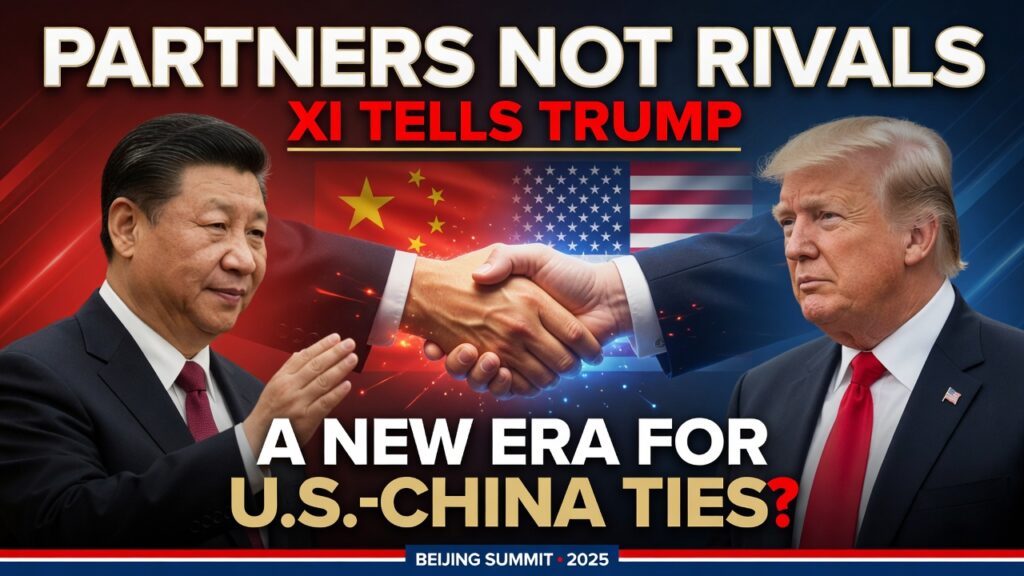
A seismic shift in Beijing has the globalist establishment on edge as President Trump and President Xi signal a new era of personal diplomacy and economic pragmatism.
The air in Beijing’s Great Hall of the People was thick with more than just history this Thursday. As President Donald J. Trump stood alongside Chinese President Xi Jinping, the world witnessed a rhetorical pivot that few experts thought possible. In a stunning reversal of years of “wolf warrior” hostility, Xi Jinping looked directly at the American president and declared, “We should be partners, not rivals.” For a world accustomed to the icy friction of a second Cold War, the statement was a diplomatic thunderclap that signaled the potential for a fundamental realignment of global power.
This was not merely a polite greeting for the cameras. Xi’s overture, made during Trump’s first state visit to China in nearly a decade, was a calculated appeal to the very brand of direct, leader-to-leader diplomacy that Trump has championed. By invoking the “Thucydides Trap”—the historical tendency for rising and established powers to stumble into war—and then explicitly rejecting it in favor of a “new paradigm,” Xi has effectively bypassed the traditional bureaucratic channels of the Washington establishment. The message is clear: the era of managed decline and endless proxy friction is under threat from a new brand of high-stakes, common-sense negotiation.
Why This Issue Matters Now
The timing of this “Partners, Not Rivals” doctrine could not be more critical. As the 250th anniversary of American independence approaches, the United States find itself at a crossroads. For years, the American taxpayer has subsidized a global security apparatus designed to contain threats that often seemed exacerbated by the very “Deep State” bureaucracy tasked with managing them. A genuine de-escalation with China doesn’t just mean fewer headlines about potential conflict; it means a refocusing of American resources toward domestic stability, law and order, and fiscal sanity.
Support Independent Local Journalism
TheTownHall.News is a non-profit reader-supported journalism. Just $5 helps us hire local reporters, investigate important issues, and hold public officials accountable across Alameda County. If you believe our community deserves strong, independent journalism, please consider donating $5 today to support our work.If China and the U.S. can transition from systemic rivals to pragmatic partners, the primary justification for the massive, unaccountable expansion of the administrative state begins to crumble. This isn’t about ignoring the very real challenges China poses; it’s about acknowledging that a “partnership” rooted in mutual economic interest is far more beneficial to the American family than a state of perpetual, undeclared war that fuels inflation and destabilizes our communities.
The Death of “Wolf Warrior” Diplomacy?
For years, the mainstream media told us that China was on an irreversible path toward total confrontation with the West. We were told that the only way to handle Beijing was through the careful, slow-moving consensus of international bodies and career diplomats. Xi’s remarks on May 14, 2026, have shattered that narrative. By welcoming Trump with a 21-gun salute and praising his “great leadership,” Xi is signaling that he is ready to do business with a leader who respects national sovereignty and traditional civic values.
This shift suggests that the “America First” approach—treating other nations with strength and respect while demanding the same in return—is yielding results that decades of globalist “engagement” never could. When Xi says “success in one is an opportunity for the other,” he is speaking the language of a dealmaker, not a Marxist ideologue. This is a language the current American administration understands, and it’s one that prioritizes the prosperity of the American worker over the theoretical goals of the Davos elite.
What Critics Get Wrong about the Trump-Xi Chemistry
Predictably, the usual suspects in the foreign policy establishment are already sounding the alarm. Critics argue that Trump is being “played” by a charming autocrat and that Xi’s words are a smokescreen for continued aggression in the South China Sea or toward Taiwan. These critics, however, miss the fundamental nature of the Trump-Xi relationship. It is not built on naive trust, but on a clear-eyed understanding of power and personal accountability.

Trump’s inclusion of tech and energy titans like Elon Musk and Jensen Huang in his delegation proves this isn’t just about optics. This is about securing American interests through leverage. The critics forget that it was the “stable” and “predictable” policies of the past that allowed American manufacturing to be gutted and our intellectual property to be stolen. If a “partnership” can secure market access for U.S. firms and curb the flow of fentanyl—as was discussed in these very talks—then it is a partnership that serves the American people better than any “strategic rivalry” ever did.
The Real Cost of Bureaucratic Obstruction
There is a reason why many believe the “Deep State” is shaking. For the permanent class of unelected officials in Washington, a peaceful and productive relationship between the U.S. and China is an existential threat to their budget and their influence. These “faceless” actors have spent decades building careers on the management of conflict. When two world leaders sit down and decide that they would rather trade than fight, they render the professional agitators in the bureaucracy obsolete.
Every dollar spent on an unnecessary military buildup or a redundant intelligence program is a dollar taken from the American family’s kitchen table. By challenging the status quo, the Trump-Xi summit is a win for fiscal accountability. It suggests that our foreign policy can be driven by the elected representatives of the people, rather than the “interagency process” that so often operates without public oversight or constitutional restraint.
How This Affects Families and Communities
At its core, foreign policy is domestic policy. When our relationship with the world’s second-largest economy is unstable, the effects are felt by every American parent. Volatile trade relations lead to higher prices at the grocery store and the gas pump. Global instability creates a climate of fear that trickles down into our schools and our civic life. A stabilized China-US relationship, built on the principle of “partners, not rivals,” offers a path toward lower inflation and a more secure economic future for the next generation.
Furthermore, the discussion around fentanyl controls during this summit is a direct win for parental rights and community safety. For too long, the crisis at our borders and the influx of deadly chemicals from abroad have devastated American towns. If direct diplomacy can achieve what years of “international cooperation” could not—namely, a hard stop on the export of these poisons—then this summit will have done more for American families than any piece of legislation in recent memory.
Support Independent Local Journalism
TheTownHall.News is a non-profit reader-supported journalism. Just $5 helps us hire local reporters, investigate important issues, and hold public officials accountable across Alameda County. If you believe our community deserves strong, independent journalism, please consider donating $5 today to support our work.Acknowledging the Risks: The Taiwan Question
It would be irresponsible to ignore the “elephant in the room.” Even as he called for partnership, President Xi was firm that the Taiwan question remains the “most important issue” and a potential flashpoint for “clashes and even conflicts.” This is the reality of global politics: even partners have boundaries that cannot be crossed.
The globalist critics will point to this as evidence that the “partnership” is a sham. However, the conservative view is that clear, direct communication of these “red lines” is exactly what prevents accidental war. Unlike the vague and often contradictory signals of previous administrations, the Trump-Xi dialogue allows both sides to understand exactly where the other stands. This is the essence of law and order on a global scale—knowing the rules and the consequences of breaking them.
Conclusion: A Landmark Year for American Sovereignty
President Xi’s declaration that the U.S. and China should be “partners, not rivals” marks a potential turning point in the 21st century. It is a victory for the idea that personal leadership, backed by national strength and a commitment to traditional values, can achieve breakthroughs that the globalist bureaucracy deemed impossible. By treating Xi as a peer and a potential partner rather than a systemic enemy to be managed, the Trump administration is putting the interests of the American citizen first.
The road ahead will not be easy, and the skepticism of the “Deep State” will remain a constant hurdle. But for the first time in years, there is a glimmer of hope that the two most powerful nations on earth can find a way to “prosper together” without sacrificing their sovereignty or their values. This is not the end of the competition, but it might be the end of the era of managed hostility.
Key Takeaway: The Trump-Xi summit in Beijing has replaced “strategic rivalry” with a “Partners, Not Rivals” doctrine, prioritizing direct leadership and economic results over bureaucratic conflict.
Call to Action
The world is changing fast, and the establishment media won’t tell you the whole story. Stay informed by supporting independent journalism that values American sovereignty and traditional civic life. Share this article on social media to spread the word about this historic diplomatic shift. Engage in your local civic life and remind your representatives that the American people want results, not endless globalist friction.