AB 2672 and the California Democrats Driving Gas Prices Higher
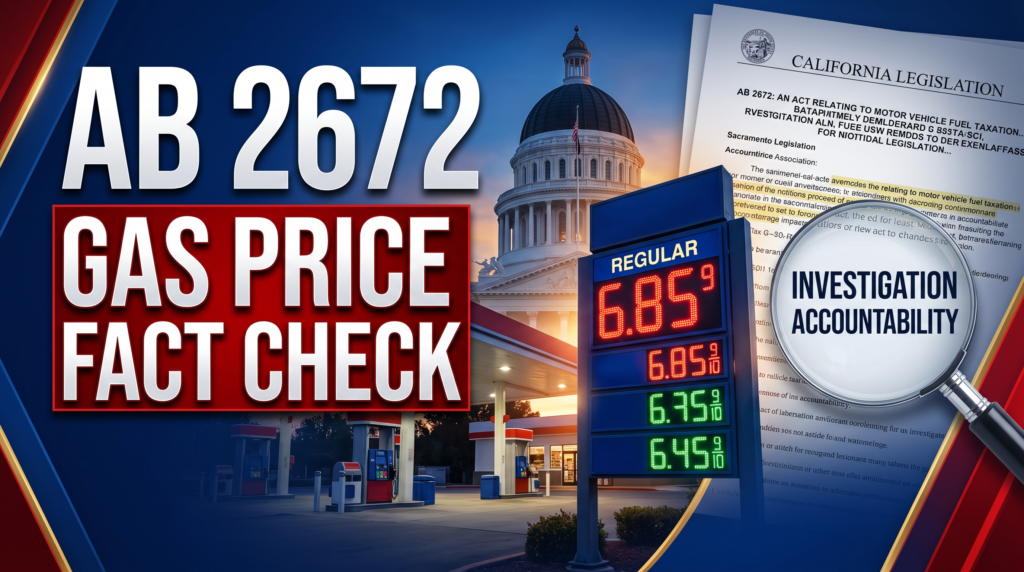
A viral claim about AB 2672 overstated some details, but it tapped into a real public frustration: California Democrats keep writing energy rules that make life more expensive for working families. The bill failed, but the governing mindset behind it is still driving pain at the pump.
California drivers do not need another lecture from Sacramento about why their anger is misplaced. They are watching their paychecks shrink in real time every time they fill up, commute to work, or pay more for groceries delivered by truck. And in a state where politicians promise affordability while piling on new costs, voters have every reason to ask who is responsible. Source
That is why the debate over AB 2672 matters. The viral social media version of the story simplified the bill too much. But the larger point still lands: California Democrats have built an energy regime so expensive, so rigid, and so disconnected from everyday life that even their supposed fixes often come with more fees, more mandates, and more bureaucratic control. Source Source
Support Independent Local Journalism
TheTownHall.News is a non-profit reader-supported journalism. Just $5 helps us hire local reporters, investigate important issues, and hold public officials accountable across Alameda County. If you believe our community deserves strong, independent journalism, please consider donating $5 today to support our work.Why California Democrats Own This Mess
Start with the basics. California gas prices are not high because of one bill, one refinery, or one bad week in the oil market. Federal and state data show prices are pushed up by a stack of policy choices: high taxes and fees, environmental program costs, California’s unique fuel blend requirements, and an isolated supply system with limited flexibility when disruptions hit. Those are not acts of nature. They are the result of political decisions made in Sacramento. Source Source
The U.S. Energy Information Administration reported in May 2025 that Californians were paying about 90 cents per gallon in taxes and fees. The California Energy Commission’s own breakdown for January 2026 added roughly 17 cents per gallon from the Low Carbon Fuel Standard and 25 cents per gallon from Cap-and-Trade. Politicians may prefer to call those “program costs” instead of taxes, but families experience them the same way: as a higher bill at the pump. Source Source
This is the core political truth Democrats do not want to own. They cannot spend years expanding government control over fuel markets and then act shocked when prices remain stubbornly high. If they write the rules, they own the results. Source
One-party rule has a price tag.

What AB 2672 Actually Showed
To be precise, AB 2672 did not become law. It appeared on the Assembly Transportation Committee agenda on April 13, 2026, and a May 2026 legislative tracking document later listed it as having failed the April 30 deadline. So no, Californians are not currently paying a new AB 2672 surcharge because the bill never made it that far. Source Source Source
But what the bill proposed is revealing. The official summary said it would address the sale of gasoline with alternative specifications during supply disruptions and maintenance events, and it discussed a fee associated with those sales to mitigate emissions impacts. The bill also would have redirected variance-fee revenue toward replacing older vehicles with cleaner ones. In other words, even in a bill framed as a way to expand supply flexibility, Sacramento still reached for a fee mechanism and a government-directed spending plan. Source
That is the pattern critics are reacting to. California Democrats rarely approach an affordability crisis with the humility to simplify, repeal, or reduce costs. Their reflex is to manage, regulate, subsidize, and redirect. AB 2672 fits that governing instinct perfectly, even if the bill itself never crossed the finish line. Source
The Real Cost of Democratic Energy Policy
California already imports gasoline and blending components from outside the state. The California Energy Commission says those imports accounted for 19% of supply in 2025. That means the real issue is not whether imports are allowed in principle. The problem is that California’s system is so constrained that outside supply is often too slow or too limited to provide fast relief when prices spike. Source
Why? Because California has no pipelines bringing fuel into the state, relies heavily on in-state refining, and requires a special gasoline blend that only a limited number of outside refiners can produce. Overseas supply can take weeks to arrive. When a refinery goes down, consumers are trapped in a market with fewer options and slower resupply. That is not the free market failing. That is government narrowing the market until it loses resilience. Source Source
Support Independent Local Journalism
TheTownHall.News is a non-profit reader-supported journalism. Just $5 helps us hire local reporters, investigate important issues, and hold public officials accountable across Alameda County. If you believe our community deserves strong, independent journalism, please consider donating $5 today to support our work.The state’s own agencies have also documented how maintenance, low inventories, and poor resupply planning contribute to price spikes. In 2024, California officials warned that if refineries went offline without adequate backup supply, inventories could drop and prices could jump. That should have been a moment for policymakers to ask whether decades of overregulation had left California dangerously inflexible. Instead, Sacramento doubled down on new intervention tools. Source Source
When government makes energy scarce, families pay the difference.
What Critics Get Wrong — and What They Get Right
To be fair, not every claim coming from the political right has been perfectly stated. It is not accurate to say AB 2672 is currently law or that it single-handedly imposed a giant new tax on imported gasoline. The public record does not support that claim, and responsible journalism should say so clearly. Source Source
But the critics are right about something more important: California’s Democratic leadership has created a system where every supposed market correction comes attached to more government control. Even when officials talk about protecting consumers, they do so inside a framework of taxes, climate compliance costs, fuel mandates, and administrative discretion that keeps ordinary drivers trapped. Source Source
That is why the public no longer trusts the messaging. Voters hear politicians blame oil companies, global instability, or “misinformation,” while official state data quietly confirms that California-specific policies add meaningful costs of their own. The gap between the rhetoric and the receipts is what fuels public anger. Source Source
The Democratic Counterargument — and Why It Falls Short
Supporters of Sacramento’s approach argue that strong oversight is necessary because refinery outages and low inventories can trigger price spikes. They are not wrong that volatility is real. Governor Gavin Newsom signed AB X2-1 in 2024 to give regulators greater authority over refinery inventories and resupply planning, and state agencies have continued building new reporting and transparency rules around margins, maintenance, imports, and spot-market activity. Source Source
But that argument still misses the broader failure. If California’s energy system now requires constant emergency management, extraordinary rulemaking, and a permanent state watchdog just to function, that is not evidence of good governance. It is evidence that the governing model has become too fragile, too politicized, and too expensive. Even the state pulled back from some tougher anti-price-spike and profit-cap rules, with 2026 reporting noting a five-year delay amid fears of driving refiners out of the state. Sacramento is effectively admitting that its own policies can push the system past the breaking point. Source Source
Key Takeaway
The most honest way to say it is this: the viral AB 2672 claim got the narrow legislative details wrong, but it got the political direction right. California Democrats may not have succeeded in passing that specific bill, but they have spent years building the kind of expensive, command-and-control fuel system that made a bill like AB 2672 seem normal in the first place. Source Source
Voters should not let Sacramento hide behind technicalities. The question is bigger than one failed bill. It is whether the party running the state will ever admit that limited government, market flexibility, and fiscal restraint are not fringe ideas. They are the basics of affordability. Source Source
Conclusion
California families do not need more spin. They need leaders willing to stop treating energy as a laboratory for ideological experiments and start treating it as a basic necessity tied to work, family budgets, and economic freedom. AB 2672 did not become law, but it exposed the instincts of a governing class that still thinks every crisis calls for another layer of intervention. Source
If Democrats want to escape blame for California’s gas-price crisis, they need more than a fact check. They need a course correction. That means fewer cost-driving mandates, more supply flexibility, honest accounting of policy-driven price increases, and a government that remembers its first duty is not to manage every market from above but to stop making life harder for the people who keep the state running. Source Source
Stay informed. Share this article with readers who want the full story, not just the viral version. Support independent journalism that checks the facts, follows the money, and keeps asking who pays for Sacramento’s mistakes.