California FAIR Plan Rate Hike Shows the Real Cost of a Broken Insurance Syste
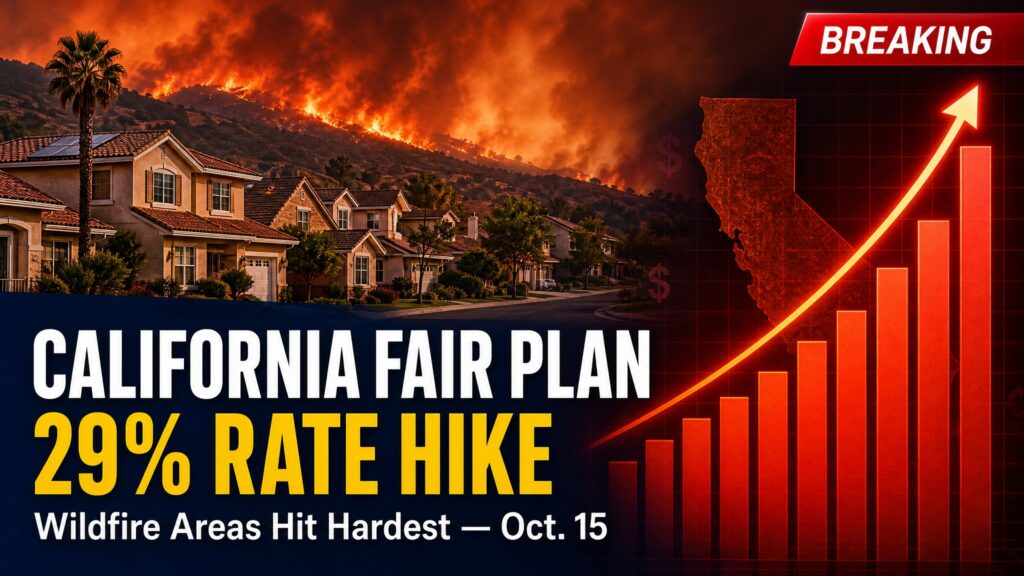
California’s insurer of last resort is raising rates by roughly 29% starting October 15, with the steepest increases expected in wildfire-prone areas. The bigger story is not just one premium hike, but what happens when public policy delays hard choices, private carriers retreat, and homeowners are left to absorb the consequences.
For years, California officials treated the home insurance crisis as if it could be managed with press releases, temporary fixes, and political messaging. Now the bill is arriving in mailboxes. Homeowners who turned to the FAIR Plan because they had no other option are learning that “last resort” coverage comes with first-order costs. ABC10 Orange County Register
That matters beyond insurance. In California, insurance is now a kitchen-table issue tied directly to mortgage qualification, monthly housing costs, family budgets, and whether a community remains financially livable. A state that refuses to price risk honestly does not protect homeowners. It traps them. California Department of Insurance
Support Independent Local Journalism
TheTownHall.News is a non-profit reader-supported journalism. Just $5 helps us hire local reporters, investigate important issues, and hold public officials accountable across Alameda County. If you believe our community deserves strong, independent journalism, please consider donating $5 today to support our work.Why This Issue Matters Now
The immediate headline is straightforward: the FAIR Plan will impose an average rate increase of about 29% on certain homeowner renewals beginning October 15, 2026. The approved figure was lower than the FAIR Plan’s original 35.8% request, but state and media reports make clear that many families in high wildfire-risk areas will still face substantial increases. Some lower-risk policyholders may see smaller changes or even decreases, yet that does little to ease the shock for households already stretched by housing, utility, and tax burdens. ABC10 Orange County Register Sacramento Bee
The FAIR Plan’s own growth explains why this is happening. Legislative hearing materials reported that by December 2025 the FAIR Plan had roughly 668,609 policies in force and $724 billion in total exposure. Official FAIR Plan data show the numbers kept rising into March 2026, reaching 684,388 policies and $750 billion in exposure. That is not a normal safety valve. That is a warning light flashing on the dashboard of the state’s housing economy. California Assembly Insurance Committee California FAIR Plan
The FAIR Plan was built to be a backstop. It is becoming a way of life.
The California FAIR Plan Was Supposed to Be a Backstop, Not the Market
California’s FAIR Plan exists for one reason: to provide basic property coverage when homeowners cannot find insurance in the regular market. Even the state acknowledges nobody wants to be on it for long. It is limited coverage, often more expensive than traditional insurance, and many homeowners must buy separate policies for standard protections such as water damage liability and other common risks. California Department of Insurance ABC10 California Department of Insurance

That limitation matters because the FAIR Plan is no longer serving a narrow slice of unusual properties. It is absorbing a growing share of ordinary Californians who have been pushed out of the admitted market after non-renewals, stricter underwriting, or outright withdrawals by private carriers. The FAIR Plan’s latest data show hundreds of thousands of policies and exposure levels that have surged more than 200% since 2022. When a state-run fallback expands that fast, it is not proof of stability. It is proof the underlying market is badly distorted. California FAIR Plan California Assembly Insurance Committee
A safety net is not a housing strategy.
The Real Cost of Delayed Reform and Fiscal Evasion
California’s insurance leadership now speaks openly about modernization, but even Commissioner Ricardo Lara has acknowledged that “30 years of stagnant regulations” helped create today’s danger. That admission should matter. It means this crisis did not appear overnight, and it was not caused by wildfire risk alone. It was worsened by a political culture that postponed honest pricing, resisted structural reform, and allowed pressure to build until families had fewer choices and higher bills. California Department of Insurance
The clearest example came after the Southern California wildfires. In February 2025, Lara approved a $1 billion assessment to ensure the FAIR Plan could continue paying consumer claims. The Department said insurers would be responsible for half under an earlier agreement, while any temporary consumer surcharge would still require approval. That may have been necessary in the short term, but it also exposed a deeper problem: once a public backstop grows too large, financial risk does not disappear. It migrates. Eventually, someone pays. California Department of Insurance
For readers who care about fiscal accountability, that is the central lesson. Government cannot suspend actuarial reality. It can only delay it, disguise it, or transfer it.
Support Independent Local Journalism
TheTownHall.News is a non-profit reader-supported journalism. Just $5 helps us hire local reporters, investigate important issues, and hold public officials accountable across Alameda County. If you believe our community deserves strong, independent journalism, please consider donating $5 today to support our work.What California Department of Insurance Is Trying Now—and Why Skepticism Is Healthy
To its credit, the state is no longer pretending the status quo can continue unchanged. California’s Sustainable Insurance Strategy now allows insurers to use forward-looking catastrophe modeling tied to wildfire and climate risk, while expecting them to write more business in wildfire-distressed areas. The Department says insurers are expected to write at least 85% of their statewide market share in underserved wildfire zones, a tradeoff meant to restore private-market participation and gradually move people off the FAIR Plan. California Department of Insurance
Officials also point to early evidence that FAIR Plan growth has slowed in recent quarters. ABC10 reported that the Department believes reforms are beginning to lure carriers back, and the Sacramento Bee noted the state’s argument that new FAIR Plan additions have moderated from earlier surges. In February 2026, Lara and Assemblymember Lisa Calderon also announced the Make It FAIR Act, a reform package aimed at stronger claims handling, more staffing, better transparency, improved financial planning, and broader coverage options. ABC10 Sacramento Bee California Department of Insurance
Those are meaningful steps. But skepticism is not cynicism. It is prudence. California homeowners have every reason to ask whether promises of expanded coverage will materialize fast enough to matter—and whether regulators will enforce those promises with real transparency rather than celebratory headlines. California Department of Insurance
What Critics Get Wrong—and What They Get Right
Consumer advocates are right about one thing: higher premiums hurt, especially when households already feel overcharged for limited protection. The Orange County Register quoted Consumer Watchdog calling the approved increase “a real blow for consumers,” and that concern is legitimate. Families are not spreadsheets. A 29% jump is painful even when it is actuarially defensible. Orange County Register
But critics go wrong when they imply that suppressing prices or resisting risk-based tools is a serious alternative. If wildfire exposure is rising and the FAIR Plan’s liabilities are exploding, pretending otherwise does not create affordability. It creates insolvency risk, market exits, and even fewer choices. The responsible answer is not to hide costs. It is to pair honest pricing with stronger mitigation, clear rules, real competition, and public accountability. California FAIR Plan California Department of Insurance
Hiding risk does not make housing affordable. It makes the eventual bill larger.
How This Affects Families, Buyers, and Communities
For current homeowners, this debate is no longer abstract. Insurance now directly shapes escrow payments, refinancing math, and whether a family can comfortably stay in a home they already own. For buyers, especially in higher-risk areas, FAIR Plan coverage can mean paying for stripped-down fire insurance plus additional wraparound coverage, turning a seemingly manageable mortgage into a far more expensive monthly obligation. California Department of Insurance ABC10
There is also a civic cost. Communities depend on stable homeownership, predictable housing expenses, and functioning private markets. When families cannot insure homes affordably, local tax bases weaken, property transactions slow, and neighborhood resilience suffers. Personal responsibility still matters, and homeowners should harden properties where possible. But government has a duty to tell the truth about risk and to stop making policy promises it cannot sustainably finance. California Department of Insurance
Key Takeaway for California Homeowners
The California insurance crisis is no longer just about wildfires. It is about governance. A state that waits too long to modernize rules, allows a backstop plan to swell, and then announces painful premium hikes should not ask for blind trust. It should earn confidence through transparency, discipline, and results. California Department of Insurance California Department of Insurance
The strongest takeaway is simple: California needs a real insurance market again, not a permanently expanding emergency substitute. Until that happens, families should scrutinize every home purchase, every renewal, and every political promise tied to “affordability.”
Conclusion
The FAIR Plan’s October rate hike is not a one-off event. It is the visible consequence of a deeper policy failure that allowed risk, regulation, and delayed reform to collide. State leaders are finally attempting serious changes, and some may help. But the public should measure those changes by outcomes, not slogans.
California homeowners deserve honest numbers, solvent institutions, and a market where responsibility is rewarded instead of punished. If this article resonated with you, stay informed, share it with friends and neighbors, support independent journalism, and stay engaged in civic life. Insurance policy may sound dry in Sacramento. In real communities, it determines who can afford to stay.