California Oil Imports Expose Sacramento’s Failed Energy Policy
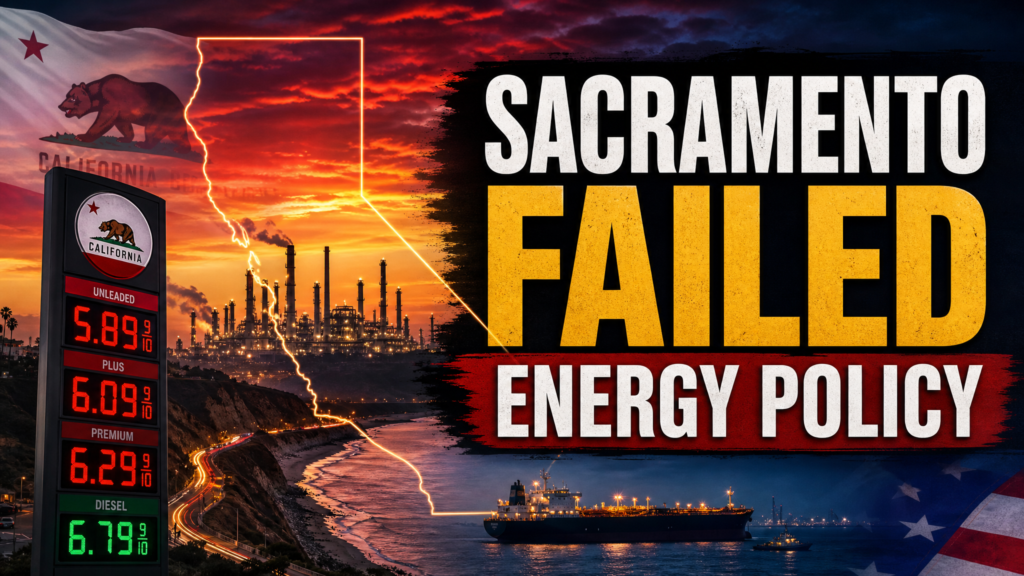
The final Middle East tanker to reach California did not create the state’s energy vulnerability. It exposed it. After years of one-party rule in Sacramento, Californians are paying more at the pump for a system that depends on foreign crude, shrinking refinery capacity, and political denial.
The image was hard to ignore: a tanker carrying roughly 2 million barrels of Iraqi crude arriving in Long Beach as the last planned California-bound shipment to clear the Strait of Hormuz before the route was disrupted. State officials told lawmakers California could cover demand for about six weeks. After that, replacement barrels could still be found, but almost certainly at a higher price. That is not energy security. That is a warning flare. The Guardian KCRA
What matters now is not just the war-related shock abroad. It is the policy failure at home. California still has more than 1.2 billion barrels of proved crude oil reserves and roughly 1.48 million barrels per day of refining capacity, yet the state got 63.3% of refinery crude supply from foreign sources in 2024. That gap between what California has and what California uses is not an accident. It is the product of years of decisions by Democrats in Sacramento who controlled the governor’s office, the Senate, and the Assembly while the state became more dependent, more isolated, and more expensive. U.S. Energy Information Administration California Energy Commission California Energy Commission California State Senate California State Assembly
Support Independent Local Journalism
TheTownHall.News is a non-profit reader-supported journalism. Just $5 helps us hire local reporters, investigate important issues, and hold public officials accountable across Alameda County. If you believe our community deserves strong, independent journalism, please consider donating $5 today to support our work.Why This Issue Matters Now
California’s fuel market is uniquely exposed. The state energy commission says there are no inbound fuel pipelines feeding California from the rest of the country. Gasoline is either refined in-state or shipped in by marine vessel, often from faraway suppliers. California also requires a specialized gasoline blend, which limits how quickly outside refineries can step in when supply gets tight. In plain English, when something breaks, Californians wait longer and pay more. California Energy Commission
That vulnerability is becoming more dangerous because refinery capacity is shrinking. The U.S. Energy Information Administration said California was set to lose 17% of its refinery capacity over roughly a year because of the Phillips 66 Wilmington closure and the planned idling of Valero’s Benicia refinery. Those two facilities alone account for an outsized share of California and West Coast capacity, which means any shortfall is harder to replace and more likely to show up in volatile gasoline prices. U.S. Energy Information Administration
This is the part too many political leaders refuse to say plainly: California’s energy model now depends on a fragile chain of imported crude, imported finished fuel, and fewer refineries able to keep the state moving. When a crisis hits overseas, California families feel it in their wallets almost immediately. ABC7 California Energy Commission
Energy dependence is not a theory. It is a bill paid at the pump.

Sacramento Democrats Own the Policy Record
Blaming “the market” is convenient, but it dodges accountability. Democrats currently hold the governorship, a 60-20 majority in the Assembly, and a 31-9 edge in the Senate, according to official state listings. That means the same political coalition that promises affordability has been in charge while California’s foreign dependence deepened and its refinery system grew less resilient. California State Assembly California State Senate Governor of California
To be fair, no single law caused this mess. California’s own petroleum reports note that in-state crude production has been declining since 1985 because of geology, aging wells, and production costs. But those realities were not a surprise. They were known for decades. Responsible government would have planned around them by protecting reliable supply, preserving infrastructure, and reducing self-inflicted bottlenecks. Instead, Sacramento piled new restrictions and uncertainty onto an already isolated market. California Energy Commission California Energy Commission
Even the Newsom administration now admits the state must manage fuel stability more aggressively. The governor’s office says last year’s legislative package included transparency mandates for refineries and SB 237, which it says will increase crude oil production in Kern County while the transition continues. That is a striking concession: after years of climate-first rhetoric, Sacramento is quietly acknowledging that California still needs dependable in-state supply. Office of Governor Gavin Newsom
The Numbers That Undercut the Talking Points
The official numbers tell a story much sharper than the slogans. In 2024, California refineries got 63.3% of crude from foreign sources, 23.3% from California, and 13.4% from Alaska. Among foreign suppliers, Iraq ranked first at 21.26%, followed by Brazil, Guyana, Ecuador, Canada, Saudi Arabia, and the United Arab Emirates. California is not merely importing a little extra supply around the edges. It has built a system that leans on foreign barrels as a structural necessity. California Energy Commission California Energy Commission
And yes, California still has substantial resources of its own. EIA’s latest state reserve table shows 1,207 million barrels of proved crude oil reserves at year-end 2024. The California Energy Commission says the state’s refineries, as of January 2026, could process about 1.483 million barrels per day of crude oil. Those are not trivial figures. They are proof that California’s problem is not the absence of resources. It is the failure to align policy with reality. U.S. Energy Information Administration California Energy Commission
Support Independent Local Journalism
TheTownHall.News is a non-profit reader-supported journalism. Just $5 helps us hire local reporters, investigate important issues, and hold public officials accountable across Alameda County. If you believe our community deserves strong, independent journalism, please consider donating $5 today to support our work.Reserves in the ground do not help families when policy blocks supply above ground.
What Critics Get Wrong
Supporters of Sacramento’s approach make a serious point: California is trying to cut petroleum use over time, and demand is falling. The state says Californians consume about 36 million gallons per day, with demand projected to decline as electric vehicle adoption grows. Officials also argue that imports and better oversight can bridge the transition while protecting consumers from refinery manipulation and sudden shortages. California Energy Commission Office of Governor Gavin Newsom
But that argument ignores the present tense. California’s own energy commission says 81% of gasoline consumed in 2025 still came from in-state refineries, while imported gasoline and blending components made up 19% of supply. KCRA reported that nearly 90% of registered cars still rely on gas. A transition is not a license to neglect the system millions of families and workers still depend on every day. Policy should reflect current obligations, not just future aspirations. California Energy Commission KCRA
The Real Cost to Families and Communities
When Sacramento mismanages energy, the damage does not stop at the pump. Higher fuel prices ripple into food delivery, school commutes, public safety fleets, and small business costs. The state commission notes that California’s geographic isolation and longer resupply times make price spikes last longer here than in more connected markets. That means working families absorb the pain first and longest. California Energy Commission
This is where fiscal accountability matters. A government that talks constantly about equity should not force its residents into a system where overseas disruption and local scarcity combine to drain household budgets. Nor should it lecture the public about sacrifice while relying on crude from Iraq, Saudi Arabia, and other foreign producers to keep the state functioning. That is not climate leadership. It is political theater backed by expensive imports. California Energy Commission The Guardian
A state that prizes resilience should start with the basics: reliable infrastructure, honest accounting, and policies that do not punish the people who follow the rules, go to work, and keep communities running.
Key Takeaway
California’s oil crunch is not a one-off story about a tanker in Long Beach. It is a case study in what happens when ideology outruns infrastructure. The latest crisis was triggered by events overseas, but the weakness was built here at home. Official data show foreign crude dominance, declining in-state production, shrinking refinery capacity, and a political establishment that spent years dismissing those risks until they became impossible to hide. California Energy Commission U.S. Energy Information Administration
If readers take one point from this story, it should be this: California does not have an energy shortage nearly as much as it has a governance problem. And Democrats in Sacramento own that record.
Conclusion
The last Middle East shipment to reach California before the Hormuz disruption was not the whole story. It was the moment the story became undeniable. California still has resources. It still has refining capacity. What it lacks is the political honesty to admit that years of top-down policy, one-party control, and magical thinking left the state more exposed to foreign supply shocks than it needed to be. The Guardian U.S. Energy Information Administration California Energy Commission
Readers should stay informed, share this article, and keep pressing public officials for answers grounded in facts rather than slogans. If independent journalism is going to matter, it must keep doing what Sacramento often will not: connect the policy choices to the real-world cost. Share this piece, discuss it with others, and stay engaged in civic life while the decisions are still being made.