Uber Immunity Amendment Passed at 2 A.M. Sparks Outrage Over Sexual Assault Victims’ Rights
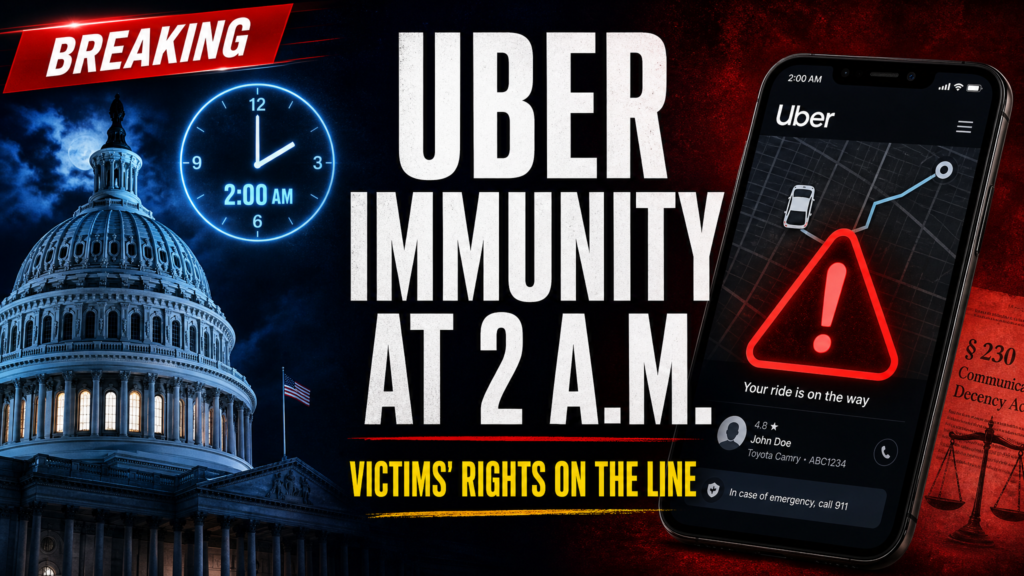
A late-night committee vote in Washington could wipe out thousands of pending sexual assault cases against Uber — and strip states of the power to protect their own citizens. Here’s what every American needs to know.
At 2:00 a.m. on May 22, 2026, while most Americans were asleep, the U.S. House Transportation and Infrastructure Committee quietly advanced an amendment that could erase the legal rights of thousands of sexual assault survivors. The provision, offered by Rep. Vince Fong (R-CA), would grant Uber and other rideshare giants sweeping federal immunity from state lawsuits — and apply retroactively to cases already in court.
The timing wasn’t an accident. Major corporate-friendly provisions rarely survive daylight scrutiny. And this one comes just weeks after California voters qualified a ballot initiative that would have forced rideshare companies to finally face accountability for the violence happening inside their cars.
Why This Issue Matters Now
The scale of the problem is staggering. Internal Uber data first reported by The New York Times found that between 2017 and 2022, the company received a report of sexual assault or sexual misconduct roughly every eight minutes on average — far more than what Uber had publicly disclosed.
Support Independent Local Journalism
TheTownHall.News is a non-profit reader-supported journalism. Just $5 helps us hire local reporters, investigate important issues, and hold public officials accountable across Alameda County. If you believe our community deserves strong, independent journalism, please consider donating $5 today to support our work.More than 3,700 plaintiffs across 30 states have joined a federal Multi-District Litigation (MDL No. 3084) in the Northern District of California. In February 2026, the first bellwether trial ended in an $8.5 million verdict against the company. A second federal jury soon followed with another finding of liability.
These are not abstract numbers. They represent women — and in many cases, men — who trusted a corporate brand to get them home safely and instead became crime victims.
What the Fong Amendment Actually Does
The amendment, attached to a broader surface transportation bill, would preempt state common carrier, non-delegable duty, and agency liability doctrines — the legal foundations that allow injured parties to hold companies accountable for harm caused by those operating on their behalf.
Under the new federal standard, Uber could only be held liable if a plaintiff proves the company itself was “grossly negligent” or engaged in “criminal wrongdoing.” That bar is dramatically higher than the ordinary negligence standard every other American industry has operated under for more than a century.

Most troubling, the amendment is retroactive. It would apply to any action commenced after enactment regardless of when the underlying harm occurred — gutting the legal basis for thousands of cases already filed and being litigated right now.
The Constitutional Problem With Retroactive Federal Preemption
Conservatives have long argued that the federal government should not steamroll state lawmaking authority, especially in areas of traditional state concern like tort law, public safety, and the regulation of common carriers. Rideshare liability is exactly that kind of issue.
By preempting state law nationwide, the Fong amendment doesn’t shrink government — it centralizes it. Washington would override the considered judgments of 50 state legislatures and the voters of California, who are scheduled to decide their own rideshare accountability measure on the November 2026 ballot.
“Uber couldn’t kill California’s accountability initiative at the ballot, so a California congressman is trying to do it in Washington — at 2 a.m.” — Alex Stack, Alliance Against Corporate Abuse
That’s not federalism. That’s corporate favoritism dressed up as policy.
A Question of Law and Order
Law and order isn’t just about prosecuting individual criminals. It’s about ensuring that institutions — including powerful corporations — face consequences when their negligence enables harm.
Support Independent Local Journalism
TheTownHall.News is a non-profit reader-supported journalism. Just $5 helps us hire local reporters, investigate important issues, and hold public officials accountable across Alameda County. If you believe our community deserves strong, independent journalism, please consider donating $5 today to support our work.Consumer Watchdog has documented cases involving Uber drivers with prior DUI convictions, criminal histories, and patterns of misconduct who were nonetheless approved through the company’s background-check system. In one Santa Barbara case, a driver on probation for his second DUI killed two pedestrians while allegedly traveling at 120 mph in a 40 mph zone.
Uber currently uses name-based background checks. The California ballot measure that the Fong amendment would undermine — the Sexual Assault Against Rideshare Passengers and Drivers Prevention and Accountability Act — would require fingerprint-based checks, the same standard applied to taxi drivers, school bus drivers, and most professionals entrusted with public safety.
Fingerprint checks are not a radical idea. They are the baseline civic expectation for anyone driving strangers — including children, the elderly, and intoxicated passengers — at all hours of the night.
Personal Responsibility Cuts Both Ways
The principle of personal responsibility is foundational. Individuals who commit crimes should be prosecuted. But responsibility also applies to corporations that profit from public trust.
When a company markets itself as a safe ride home, collects fees from every transaction, sets the rules drivers must follow, controls the technology, and decides who gets to drive, it cannot credibly claim that drivers are total strangers for whom it bears no responsibility. That isn’t conservatism. That’s having it both ways.
Traditional American legal doctrine — the kind that built our commercial system — has long held that those who profit from a service bear reasonable duties of care to the public they serve. The Fong amendment doesn’t restore that tradition. It carves out a special exemption for one of the most valuable companies on the planet.
What Critics of the Amendment Get Right
Supporters of the Fong amendment argue that without federal protection, rideshare companies face an unpredictable patchwork of state laws that could threaten the viability of the gig economy. They warn of higher fares, reduced driver supply, and the loss of a service millions rely on.
These concerns deserve a serious response — not dismissal. A national framework for rideshare safety standards could indeed bring consistency. But consistency does not require immunity. Congress could establish minimum safety requirements — fingerprint checks, mandatory incident reporting, transparent complaint systems — without stripping victims of the right to seek justice in court.
The current amendment doesn’t raise the floor on safety. It lowers the ceiling on accountability. That’s the opposite of what reasonable reform looks like.
How This Affects Families and Communities
Parents put their teenage daughters in Ubers home from school events. Adult children call rides for aging parents leaving medical appointments. Spouses use the service to make sure a loved one who had one drink too many doesn’t drive.
Every one of those decisions is built on an implicit promise of basic safety. If the Fong amendment becomes law, that promise comes with a quiet asterisk: if something goes wrong, you are largely on your own. The corporation that brokered the ride will be shielded from most claims unless you can clear an extraordinarily high legal bar.
That is not a small change. It is a fundamental reordering of who bears risk in the modern economy — and the answer is increasingly the individual citizen, not the multibillion-dollar platform.
Key Takeaway
A bill that passes at 2 a.m., applies retroactively, and benefits a single industry is not reform. It is a giveaway. Voters across the political spectrum should demand better — from Republicans, Democrats, and every elected official who claims to stand for accountability.
The Counterargument — And the Response
Some will argue that trial lawyers, not victims, are the real drivers of rideshare litigation. There is a fair conversation to be had about lawsuit abuse and runaway verdicts. But the answer to that concern is targeted tort reform — caps on punitive damages, fee transparency, requirements for early disclosure — not blanket immunity for a single industry.
Stripping victims of standing to sue is not tort reform. It is corporate protectionism that happens to use the language of tort reform to advance its goals.
Conclusion: A Test of Civic Seriousness
The Fong amendment has only cleared committee. It still must pass the full House, survive the Senate, and be signed into law. There is time for citizens to weigh in — and history suggests that public pressure works when it is loud, organized, and bipartisan.
The question isn’t whether Americans want safe, affordable rideshare options. We do. The question is whether we are willing to accept a legal system that exempts the most powerful companies from the rules that apply to everyone else.
That answer should be a clear, confident no.
Call to Action
Stay informed. Share this article with family, friends, and neighbors who care about consumer rights and corporate accountability. Contact your senators and representatives — politely but firmly — and ask where they stand on the Fong amendment. Support independent journalism that does the late-night reporting establishment outlets often miss. And above all, stay engaged. Self-government only works when citizens show up.