Trump’s Iran Nuclear Deal: Tehran Must Surrender Enriched Uranium — Can America Trust the Regime?
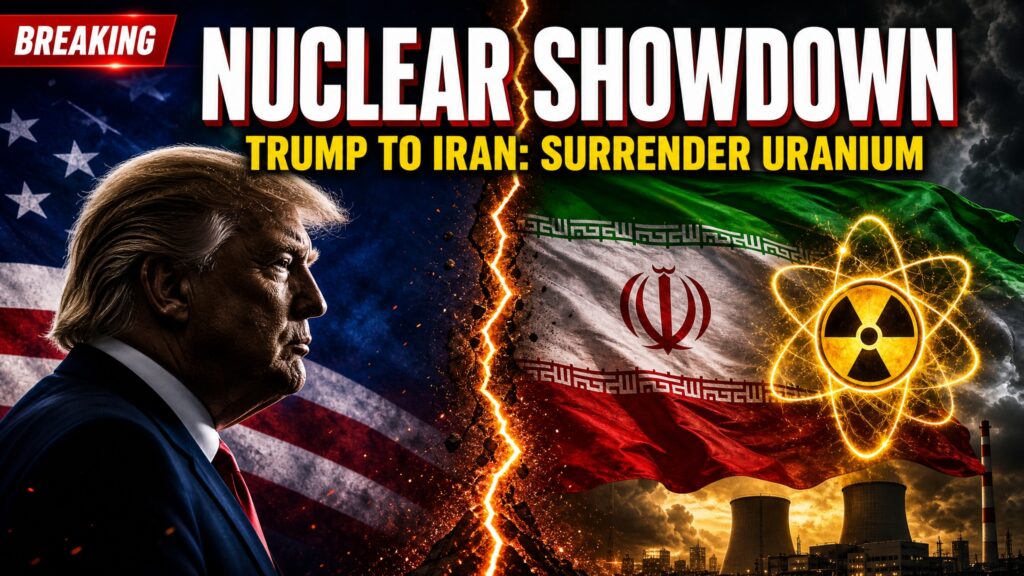
The White House claims Iran has agreed in principle to give up its highly enriched uranium stockpile. Tehran says it hasn’t. With $29 billion already spent and American lives lost, taxpayers deserve clarity — not another unverifiable agreement with a regime that has cheated before.
A president announces a near-finalized deal with America’s adversaries. His own party erupts in skepticism. The foreign regime denies key terms. And somewhere in between, the American taxpayer — already $29 billion into a three-month military campaign — waits to learn whether this agreement represents a genuine victory or a costly retreat dressed up as one
That is where the United States finds itself this Memorial Day weekend, as negotiations between Washington and Tehran have produced what the White House calls a “largely negotiated” framework — and what Iran insists does not yet include any commitment on its nuclear program.
Support Independent Local Journalism
TheTownHall.News is a non-profit reader-supported journalism. Just $5 helps us hire local reporters, investigate important issues, and hold public officials accountable across Alameda County. If you believe our community deserves strong, independent journalism, please consider donating $5 today to support our work.The stakes could hardly be higher. Iran’s stockpile of uranium enriched to 60% purity has grown to roughly 440 kilograms — material that, with further enrichment, puts Tehran within weeks of weapons-grade capability. The Strait of Hormuz, through which 20% of global energy supplies transit, remains closed by Iranian mines. And 13 American service members have been killed since Operation Epic Fury launched on February 28.
A deal that fails to permanently eliminate Iran’s nuclear breakout capability would render those sacrifices meaningless.
What the Reported Deal Actually Contains
According to multiple U.S. officials and regional intermediaries, the emerging framework — labeled the “Islamabad Declaration” by some Arab media — is structured as a two-phase Memorandum of Understanding.
Phase one delivers immediate relief: Iran reopens the Strait of Hormuz, clears its naval mines, and commits to never pursuing nuclear weapons. In exchange, the United States lifts its naval blockade of Iranian ports and waives certain sanctions, allowing Tehran to resume oil exports.

Phase two opens a 60-day window for what Secretary of State Marco Rubio described as “very real, significant, time-limited negotiation” over Iran’s nuclear program. This is where the actual work of uranium disposal, enrichment suspension, and verification would take place.
But that is also where the consensus collapses. The New York Times reported Saturday that two U.S. officials confirmed Iran had verbally agreed to surrender its highly enriched uranium. Within hours, an Iranian source told Reuters the nuclear issue “is not part of the preliminary agreement” and that Tehran had “not yet accepted any action” on its stockpile.
This is not a minor misunderstanding. It is the central question of the entire exercise.
Why This Issue Matters Now
The economic cost of inaction is staggering. By late March, the Pentagon had already spent an estimated $25 billion on Operation Epic Fury, with the Defense Department requesting a further $200 billion. CSIS analysts pegged the six-day cost alone at $11.3 billion. The Strait of Hormuz closure has sent oil prices soaring above $150 per barrel by some estimates, triggering supply shocks that have rippled through every American household in the form of higher gasoline and goods prices.
Every day the blockade remains in effect, American consumers pay more and the federal debt climbs higher.
Support Independent Local Journalism
TheTownHall.News is a non-profit reader-supported journalism. Just $5 helps us hire local reporters, investigate important issues, and hold public officials accountable across Alameda County. If you believe our community deserves strong, independent journalism, please consider donating $5 today to support our work.And yet, rushing into a bad deal carries consequences that dwarf even these costs. A nuclear-armed Iran — or an Iran that merely preserves the capacity to break out within weeks — alters the security calculus of the entire Middle East permanently.
This is not an argument for endless war. It is an argument for clarity, verification, and accountability before celebration.
What Critics Get Wrong
Some Republican lawmakers have suggested that any negotiation with the current Iranian regime is inherently capitulation. Senator Ted Cruz warned that if the result is an “Islamist” regime “now receiving billions of dollars, being able to enrich uranium & develop nuclear weapons,” the outcome would be a “disastrous mistake.”
The concern is legitimate, but the absolutist position overlooks a fundamental reality: wars end through negotiation, not through one side’s total annihilation. Senator Rand Paul of Kentucky, often at odds with the administration, captured this truth when he wrote, “War virtually always ends with negotiations. Critics of President Trump’s peace negotiations should give President Trump the space to find an American First solution.”
The question is not whether to negotiate. It is what terms Americans accept — and whether those terms are enforceable.
The Real Cost of Trusting Without Verifying
The Obama-era Joint Comprehensive Plan of Action (JCPOA) provides a cautionary tale. That 2015 agreement allowed Iran to retain uranium enrichment capability, imposed time-limited restrictions, and relied heavily on international inspections that Tehran repeatedly obstructed.
President Trump rightly withdrew from that deal in 2018, calling it “the worst deal ever negotiated.” His stated goal — then and now — was an agreement that permanently prevents Iran from acquiring nuclear weapons, addresses its ballistic missile program, and curbs its support for terrorist proxies.
The current framework, by the administration’s own acknowledgment, addresses none of these latter two concerns and defers the nuclear mechanism to later talks. A 60-day negotiation window with a regime that has spent decades obfuscating its nuclear ambitions is not a guarantee. It is a gamble.
“The idea that somehow this president… is going to somehow agree to a deal that ultimately winds up putting Iran in a stronger position when it comes to nuclear ambitions is absurd,” Rubio said from India. “That’s just not going to happen.”
He may be right. But the American people have heard similar assurances before — and paid for them.
How This Affects Families and Communities
For ordinary Americans, the Iran conflict has ceased to be an abstract foreign policy debate. Gasoline prices have spiked. Supply chains disrupted by the Hormuz closure have driven up costs on everything from groceries to construction materials. Military families have buried their dead.
Thirteen service members killed. $29 billion spent, with hundreds of billions more requested. A global economy rattled.
These are not just numbers on a spreadsheet. They represent real sacrifices borne disproportionately by working-class communities — the very Americans who deserve the most transparency from their government about what their sacrifices are purchasing.
When a government asks its citizens to bear the costs of war, those citizens have every right to demand that the peace be worth the price.
Counterargument: The Case for Pragmatism
Supporters of the emerging framework rightly note that the alternative to a negotiated settlement is continued military escalation. Military planners have reportedly developed options to bomb Iran’s uranium stockpile at the Isfahan nuclear site — a facility already struck by U.S. Tomahawk missiles in June 2025.
Bombing buried nuclear material carries uncertain outcomes. A ground campaign would entail far greater costs in blood and treasure. And neither approach addresses the Hormuz closure or the broader regional instability.
The administration’s phased approach — immediate economic relief paired with a time-limited nuclear negotiation — represents a defensible middle path. It secures the Strait reopening while preserving the military option if Iran proves unserious about its nuclear commitments.
One U.S. official told Axios that the deal “might not last the full 60 days if the US believes that Iran is not serious about the nuclear negotiations.” That is the right posture — conditional, skeptical, and prepared to walk away.
What Comes Next
The path forward demands several things from Washington.
First, the White House must be transparent about what Iran has actually committed to — and what remains aspirational. The discrepancy between American and Iranian accounts of the uranium commitment is not a minor detail. It is the entire ballgame.
Second, any final agreement must include rigorous, intrusive verification mechanisms. Trusting the word of a regime that has systematically concealed its nuclear activities from international inspectors is not statecraft. It is folly.
Third, Congress must exercise its constitutional role. Senator Roger Wicker, chairman of the Armed Services Committee, called a 60-day ceasefire a “disaster” that would render the accomplishments of Operation Epic Fury “for naught.” Whether one agrees with Wicker or not, his voice — and the voices of other elected representatives — must be part of this process. A deal of this magnitude cannot be executed by executive fiat alone.
Fourth, the American people must remain engaged. Foreign policy conducted in the dark inevitably produces outcomes that serve narrow interests rather than the national good.
Key Takeaway
A deal that permanently eliminates Iran’s nuclear weapons capability, reopens global energy routes, and costs no more American lives would be a historic achievement worthy of celebration. A deal that provides temporary relief in exchange for permanent risk is a betrayal of every service member who fought and every taxpayer who paid.
The burden of proof rests with the negotiators — and the verification must precede the victory lap.
President Trump has said he will not “rush into a deal” and that “time is on our side.” He is correct about the first part. On the second, time is on America’s side only if it is used wisely.
The blockade can remain. The pressure can be sustained. The terms can be improved. But once enriched uranium is allowed to remain in Iranian hands under a signed agreement, the leverage evaporates — and so does the chance to achieve what this costly campaign was supposed to secure.
Iran has cheated before. It has lied before. It has used negotiations as cover for nuclear progress before. The American people are not obligated to believe it has changed.
They are only obligated to demand that their government verifies it.
Stay informed. Share this article with friends, family, and anyone who believes that American foreign policy deserves scrutiny, not blind acceptance. Support independent journalism that asks hard questions regardless of who occupies the White House. And engage in civic life — because the decisions made in the coming weeks will shape the security of this nation for decades.