Minnesota Age Verification Bill Blocked by Democrats in 67-67 House Vote
Every single House Democrat — including a Democratic co-author of the bill itself — voted to stop common-sense age verification for adult websites, leaving Minnesota families exposed while other states move to protect their kids.
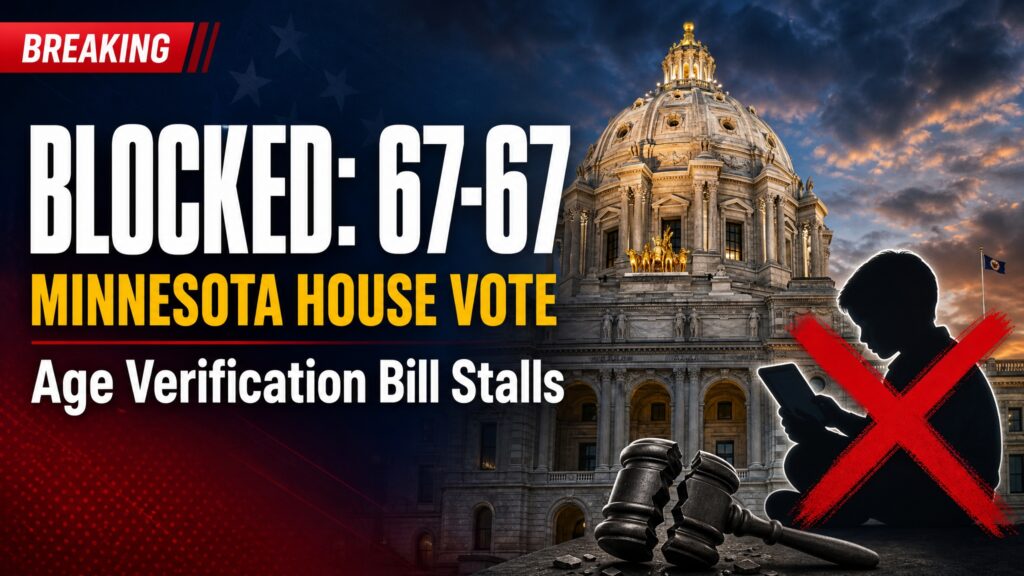
In a vote that should alarm every parent in Minnesota, all 67 Democrats in the state House recently blocked a procedural motion that would have advanced legislation requiring adult websites to verify that visitors are at least 18 years old. The motion failed 67-67, strictly along partisan lines, with every Republican voting to protect children and every Democrat voting against advancement. Alpha News
The bill in question, HF 1434, is not radical. It is not novel. It is not even legally untested. It is a straightforward measure modeled after laws already upheld by the United States Supreme Court. And yet, in 2026, Minnesota Democrats decided that this modest protection for children was a bridge too far.
Support Independent Local Journalism
TheTownHall.News is a non-profit reader-supported journalism. Just $5 helps us hire local reporters, investigate important issues, and hold public officials accountable across Alameda County. If you believe our community deserves strong, independent journalism, please consider donating $5 today to support our work.What the Bill Actually Does
HF 1434, authored by Republican Rep. Ben Bakeberg, would require websites where 25 percent or more of the content is pornographic to verify that users are 18 or older before granting access. The enforcement mechanism would rest with the state attorney general, with a private right of action also available. BillTrack50
In other words, the bill applies the same standard already in place at every brick-and-mortar adult store, liquor establishment, and tobacco retailer in America. You must prove you are an adult before purchasing adult products. The bill simply extends that decades-old principle into the digital realm where, as any honest parent will admit, children today actually spend most of their time.
“This is a bill to protect kids,” Rep. Bakeberg said on the House floor. “All it is doing is taking what happens in the physical world and bringing it into the digital world.” Alpha News
The Supreme Court Has Already Settled This
Opponents of age-verification laws frequently argue that such measures violate the First Amendment. That argument is no longer credible. Last summer, the U.S. Supreme Court upheld a nearly identical Texas law, ruling that requiring age verification for pornographic websites is a constitutionally permissible way for states to protect minors.

That ruling demolished the central legal objection to bills like HF 1434. More than twenty states have since enacted or advanced similar legislation, including Louisiana, Utah, Arkansas, Mississippi, Virginia, Montana, and Texas itself. Minnesota is rapidly becoming an outlier — not in protecting free expression, but in refusing to act on a clear constitutional pathway to safeguard children.
Why the “Wrong Approach” Argument Falls Apart
Democratic Rep. Erin Koegel called HF 1434 the “right idea” but the “wrong approach,” citing unspecified concerns. Yet when pressed, those concerns dissolved into vague procedural complaints about needing more committee time — despite the bill having moved through the standard hearing process. Alpha News
Here is the inconvenient fact for Democrats: one of their own colleagues, Rep. Kari Rehrauer, is a co-author of HF 1434. Yet even she voted against advancing the bill she helped write. That kind of party-line discipline reveals what the floor speeches obscured — this was not a debate about policy refinement. It was a calculated effort to keep the bill from reaching a final vote.
Quotable: “When a Democrat votes against her own bill to protect children, the issue isn’t the legislation. The issue is the politics.”
The LGBTQ Argument That Stunned Parents
The most revealing moment came from Rep. Leigh Finke, who argued in committee that age-verification laws in other states are being used by attorneys general to block “young people from accessing content that could be educational if they are queer.” Alpha News
Let that sink in. In a debate about whether children should be required to prove their age before accessing pornography, a sitting state legislator pivoted to arguing that some of that content may be “educational” for minors. Parents across Minnesota — of every political persuasion — should ask themselves whether this reflects the values they want shaping state law.
Support Independent Local Journalism
TheTownHall.News is a non-profit reader-supported journalism. Just $5 helps us hire local reporters, investigate important issues, and hold public officials accountable across Alameda County. If you believe our community deserves strong, independent journalism, please consider donating $5 today to support our work.Republican Rep. Walter Hudson offered the appropriate response on the House floor: “If you want to make the argument that there’s a lack of LGBT sex education, then make that argument. Bring that bill. But in the context of a bill that says we’re simply going to ensure that you’re an adult before you access pornographic material, to bring that up, that’s going to raise some eyebrows.” Alpha News
The Real-World Cost to Families
The cost of inaction is not theoretical. Research from Common Sense Media has documented that a majority of American teenagers have encountered online pornography, with the average age of first exposure dropping into the pre-teen years. Pediatric and mental health researchers have linked early exposure to a range of harms, including distorted views of relationships, anxiety, and compulsive behavior patterns.
These are not abstract policy concerns. They are conversations happening in homes, schools, and pediatricians’ offices across Minnesota right now. Parents are doing everything they can to protect their children in a digital environment designed to capture attention at any cost. The least the state legislature could do is hold pornographic websites to the same standard already imposed on every other purveyor of adult material.
Parental Rights and the Limits of Government
There is a deeper principle at stake here. The role of government is not to make moral decisions on behalf of families — but it is to enforce the basic legal protections that allow parents to do their job. Age verification is one of those protections. It does not censor adults, it does not ban content, and it does not regulate speech. It simply asks the same question every bartender, casino, and vape shop is required to ask: are you old enough to be here?
Rejecting that minimal standard is not a defense of liberty. It is an abdication of the most basic responsibility a legislature has — to ensure that the laws protecting children in the physical world also apply in the digital one.
The Counterargument, Honestly Considered
To be fair, some critics raise legitimate questions about implementation. How is age data stored? Who has access to it? Could verification systems create privacy risks for adult users? These are reasonable concerns and deserve serious answers.
But the Texas model, now affirmed by the Supreme Court, addresses many of them through narrow data-retention rules and third-party verification options. The solution to imperfect legislation is amendment, not obstruction. If Democrats genuinely believed HF 1434 needed refinement, they could have offered amendments. Instead, they killed the procedural motion entirely.
Key Takeaways
- The vote: A 67-67 tie killed a procedural motion to advance HF 1434, with all Republicans voting yes and all Democrats voting no.
- The bill: Requires age verification on websites where 25 percent or more of content is pornographic.
- The precedent: The U.S. Supreme Court upheld a nearly identical Texas law in 2025.
- The contradiction: A Democratic co-author of the bill voted against advancing it.
- The stakes: Minnesota children remain unprotected by a law already in place in more than twenty other states.
What Happens Next
The Minnesota House is currently split 67-67, making every partisan vote a stalemate. HF 1434 is not technically dead — it remains in the legislative pipeline — but it cannot advance without Democratic cooperation. That means voters, parents, and community leaders have an opportunity to make their voices heard before the next legislative session.
Elections have consequences. So do procedural votes that never make the evening news. Minnesotans who believe children deserve at least the same protections online that they have in the physical world should pay close attention to which legislators stood up and which ones stood in the way.
Stay Informed. Stay Engaged.
The fight over HF 1434 is not just about one bill. It is about whether common-sense protections for children can survive a political environment where partisanship too often overrides parental rights. If this article informed or challenged you, share it. Talk to your neighbors. Contact your state legislator. And support independent journalism that reports on the votes the mainstream press is content to ignore.
The future of childhood in the digital age may very well depend on it.