Hayward Budget Gap Forces City Workers to Defer and Modify Pay Raises
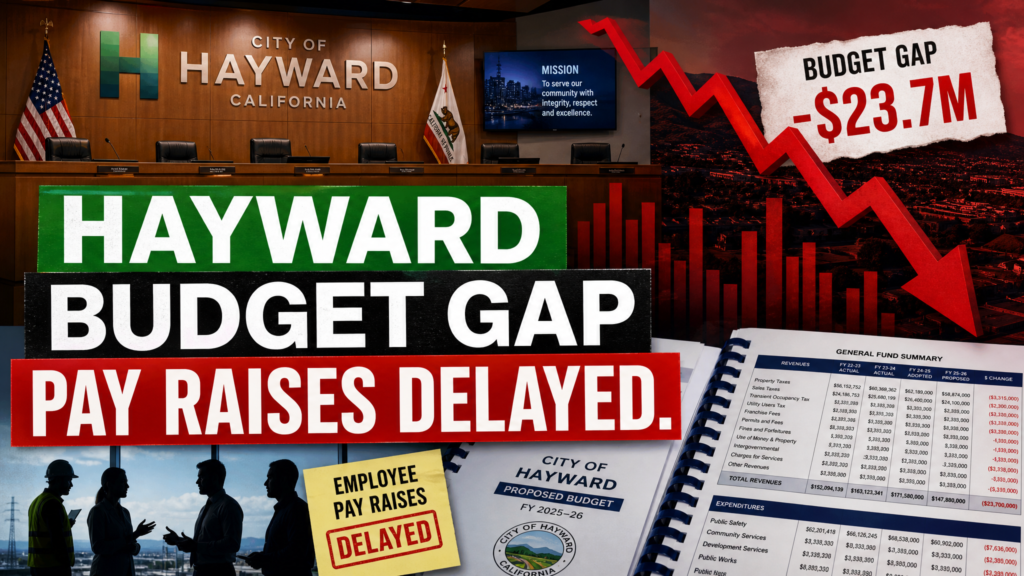
Hayward officials are framing the move as shared sacrifice and fiscal stabilization. But the deeper story is harder to ignore: years of budget pressure, shaky assumptions, and delayed discipline have now reached the point where city workers, elected officials, and residents are all being asked to absorb the cost. Source
There is nothing glamorous about a city balancing its books by delaying raises. It is not the kind of announcement that wins applause, and it certainly is not the kind of headline public employees want to read after years of inflation and rising living costs. But in Hayward, the April decision to defer and modify pay increases was more than a labor story. It was a warning flare for taxpayers and residents who want local government to live within its means before the bill gets even bigger. Source
The city says the newly approved labor agreements and related measures will save more than $7.5 million in Fiscal Year 2027 and help close the projected General Fund gap. According to the city’s April 22 announcement, most employee unions agreed to defer until the end of FY 2027 all or part of cost-of-living adjustments that were due July 1, with deferred COLAs ranging up to 4 percent of salary. Executives and other unrepresented employees also agreed to defer raises, while the mayor and City Council agreed to forgo a salary increase entirely. Source
Support Independent Local Journalism
TheTownHall.News is a non-profit reader-supported journalism. Just $5 helps us hire local reporters, investigate important issues, and hold public officials accountable across Alameda County. If you believe our community deserves strong, independent journalism, please consider donating $5 today to support our work.Why This Issue Matters Now
The immediate reason this matters is simple: Hayward’s budget challenge is not small, temporary, or theoretical. During a Feb. 28 special budget work session, city officials and council members discussed a projected FY 2027 deficit of about $32.5 million. Even with roughly $20 million in Measure C funding, the city still faced a remaining shortfall of about $12.5 million, according to the meeting summary. That is not a rounding error. That is a structural warning sign. Source
The city’s own watchlist, compiled from official agenda materials and council records, framed the spring labor side letters as part of a broader “fiscal-stabilization” effort tied to a looming five-year budget problem, revenue reviews, and long-term structural pressures. In other words, this was not a random adjustment. It was part of a larger scramble to confront costs that had already been building for months. Source
When local government reaches the point where raises must be delayed to preserve basic balance, residents should ask a basic question: why did it take this long to face reality? That is not anti-worker. It is pro-accountability. Public employees deserve honest budgeting, and taxpayers deserve a city hall that does not pretend problems will solve themselves. Source
A budget crisis delayed is a budget crisis made more expensive. Source

What the City Actually Did
The city’s April 22 statement offered the clearest public summary of what happened. Most Hayward employee unions agreed to defer until the end of FY 2027 all or part of the COLAs their members were supposed to receive at the start of the fiscal year on July 1. The deferred increases range up to 4 percent. Firefighter and police unions also agreed to continue staffing adjustments that the city says are helping reduce overtime costs. Source
The concession extended beyond union labor. City executives agreed to defer COLAs worth 4 percent of salary, while other unrepresented employees agreed to defer raises equal to 3 percent of salary. The mayor and council gave up a scheduled salary increase based on the Consumer Price Index, and the city manager agreed to forego benefits equal to 4.5 percent of salary for FY 2027. The city attorney and city clerk also deferred 4 percent COLAs. That matters, because the city is clearly trying to show that the pain is being shared up and down the chain of command. Source
The watchlist adds another important layer. It notes that the April council actions involved multiple labor side letters tied to the city’s effort to stabilize its long-term budget while balancing fiscal restraint with employee retention. It also places those labor deals in the context of earlier budget work sessions in January and February, when officials reviewed revenue sources, financial policies, and a five-year forecast. Source
The Real Cost of Avoiding Hard Choices
What makes this story bigger than one round of deferred raises is what city officials themselves said about how Hayward got here. At the February budget session, the city manager described a “perfect storm” that included overreliance on one-time federal or grant funds for ongoing expenses, labor contracts not aligned with fiscal reality, slowing tax revenues, and inaccurate budgeting practices. Officials also acknowledged relying on salary savings from vacant positions as a crutch and failing to budget accurately for overtime, leave payouts, and contract increases. Source
That is the part residents should not overlook. A budget gap does not appear out of nowhere. It is usually the result of years of optimistic assumptions, delayed corrections, and political reluctance to say no. When those habits continue too long, the eventual fixes become more painful for everyone: workers lose raises, taxpayers face pressure for new revenue, and service cuts start landing in neighborhoods. Source
Support Independent Local Journalism
TheTownHall.News is a non-profit reader-supported journalism. Just $5 helps us hire local reporters, investigate important issues, and hold public officials accountable across Alameda County. If you believe our community deserves strong, independent journalism, please consider donating $5 today to support our work.Hayward’s own April statement says actions taken in November, December, and January — including layoffs and staffing reductions — helped close a $26 million General Fund deficit in the current fiscal year. That should sharpen the public debate, not calm it. If one large deficit was followed almost immediately by another major gap for the next fiscal cycle, residents have every right to ask whether city hall is making one-time fixes or solving the underlying problem. Source
Fiscal discipline is not anti-government. It is the only way local government stays credible. Source
What Critics Get Wrong
Some critics will say that deferring raises is unfair to public employees who did not create the problem. There is truth in that concern. Inflation is real, the Bay Area is expensive, and city workers perform core services residents depend on every day. The city itself emphasized employee dedication in announcing the agreements, and it is reasonable to worry about morale and retention if concessions become the new normal. Source
But the alternative cannot simply be denial. If the numbers no longer work, someone eventually pays. Either the city reins in costs, or residents get hit through service cuts, fee increases, tax hikes, or a mix of all three. The watchlist makes clear that Hayward’s broader fiscal debate already includes hotel-tax increases, business-license tax modernization, fee updates, and other revenue strategies. That means the burden is not isolated to city workers. It is already moving outward toward the public. Source
The better argument is not that workers should absorb everything. It is that city government should face structural reality early, publicly, and honestly — before the only choices left are bad ones. That is what fiscal accountability looks like in practice. Source
Key Takeaway
The core lesson from Hayward’s pay-deferral story is not merely that raises were postponed. It is that local government can no longer rely on soft assumptions, vacancy savings, and future revenue hopes to paper over recurring costs. By the time raises are being deferred across multiple employee groups, the problem is no longer abstract. It has arrived. Source
For readers who care about competent government, this is the real test: whether city hall now follows through with transparent budgeting, realistic labor planning, and clear priorities for core services. Hayward officials said the city council would begin public deliberations on the upcoming budget in May, starting with a General Fund operating budget work session. Residents should treat that process as required watching, not inside baseball. Source
What Residents Should Watch Next
The next phase of this story is just as important as the April agreements themselves. Residents should watch whether the city continues to present monthly financial actuals, tighter overtime forecasting, and more realistic long-term projections, all of which were discussed during the February budget session. They should also watch whether savings from labor concessions are matched by structural reforms rather than swallowed by the next round of shortfalls. Source
They should also ask the basic watchdog questions the source watchlist recommends for high-impact council items: What changed from staff recommendations? Who bears the cost and who gets the benefit? What deadlines or performance metrics should the public check next? Those are not partisan questions. They are the minimum standard for responsible civic oversight. Source
In the end, Hayward’s deferred pay raises are about more than labor. They are about whether a city can restore trust by confronting fiscal reality before residents are asked to pay more and receive less. If you want accountable local government, this is exactly the kind of story worth following, discussing, and sharing. Stay informed, stay engaged, and support independent journalism that treats city budgets as public business — because that is exactly what they are. Source
Related video source: Special Hayward City Council Budget Work Session Meeting, Feb. 28, 2026