Hayward Hotel Tax Jumps to 14% as City Eyes Business License Tax Ballot Measure
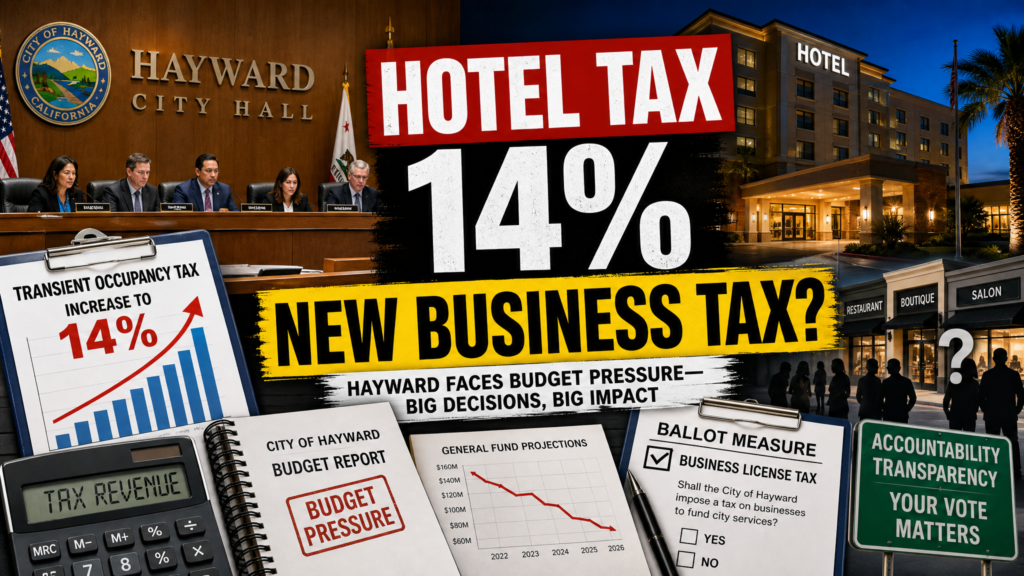
Hayward officials say the moves are part of a broader strategy to stabilize city finances and close a deep structural budget gap. But for residents and business owners, the bigger question is whether City Hall is modernizing revenue policy responsibly — or simply reaching for more money after years of fiscal drift. Source
Hayward’s decision to raise its hotel tax to 14 percent might sound like an easy political sell. Visitors pay, local voters feel less of the direct sting, and city officials can present the increase as a practical step during a difficult budget season. But the hotel-tax hike is only part of the story. The more important development may be what comes next: a possible ballot measure to modernize the city’s business license tax as officials search for new revenue to confront a projected long-term budget gap. Source Source
Taken together, the two moves reveal the same uncomfortable truth. Hayward is no longer talking about minor belt-tightening. It is reworking how the city raises money at a moment when staff have warned of a structural deficit in the tens of millions of dollars. That makes this more than a tax story. It is a test of whether local government can make a credible case for asking more from the economy after failing to keep spending and budgeting on a sustainable path. Source
Support Independent Local Journalism
TheTownHall.News is a non-profit reader-supported journalism. Just $5 helps us hire local reporters, investigate important issues, and hold public officials accountable across Alameda County. If you believe our community deserves strong, independent journalism, please consider donating $5 today to support our work.Why This Issue Matters Now
The fiscal backdrop is what gives this story its urgency. In a November 2025 budget update, Hayward staff projected a FY 2025-26 budget deficit of about $26.45 million and said the city would bring forward a December item to raise the Transient Occupancy Tax, or hotel tax, from 12 percent to 14 percent, the voter-authorized maximum. Staff estimated that increase would generate about $500,000 annually, or about $250,000 for the remainder of FY 2025-26. Source
The city’s watchlist confirms the council did approve the hotel-tax increase during the December 2025 council cycle, raising the rate from 12 percent to 14 percent with an effective date of Feb. 1, 2026. The watchlist frames the move as part of Hayward’s larger revenue strategy during a period of visible budget pressure. Source
Then came the bigger warning. In a Feb. 28, 2026 budget work session, staff told the council the city faced a baseline structural deficit of $32.6 million for FY 2026-27, assuming no new revenue and no one-time balancing actions. Staff also said subsequent annual deficits could range from $41.6 million to $46.6 million in later years. At that same session, officials asked for direction on taking the initial steps toward putting a business license tax modernization measure on the November 2026 ballot. Source
That is the key point. The hotel-tax increase was not an isolated adjustment. It was an early sign that Hayward was preparing to rethink its entire revenue structure. Source

What the Hotel Tax Increase Really Means
The city made a straightforward case for the hotel-tax hike. Staff said moving to the 14 percent ceiling authorized by voters would produce additional revenue at a time of severe fiscal stress. The same November report argued the timing was favorable because of upcoming major Bay Area events, specifically the Super Bowl and the FIFA World Cup, which staff believed could increase hotel demand and therefore tax collections. Source
Staff also acknowledged the political tradeoff. With the city’s existing 2 percent Emergency Services Facilities Tax layered on top, Hayward’s lodging taxes would sit at the high end of Bay Area cities. That may not bother officials who see the burden as falling mainly on visitors. But higher hotel taxes still matter for the local economy. They can influence how competitive a city looks to travelers, event planners, and local hospitality businesses that do not have the same margin for error as City Hall. Source
This is where public accountability matters. A city can justify a hotel-tax increase during a budget crunch. What it cannot do is pretend that “visitors pay” ends the debate. Taxes aimed at outsiders still shape local business conditions, city reputation, and the long-term temptation to treat every fiscal problem as a revenue opportunity. Source
When budget discipline comes late, new taxes start looking like the fastest answer. Source
Why City Hall Is Now Looking at Business License Taxes
If the hotel tax was the immediate play, the business license measure is the more revealing one. In the Feb. 28 budget work-session report, staff said Hayward’s current Business License Tax is one of the lowest in the region and noted that many Bay Area cities have recently updated their systems. Staff said consultant Blue Sky would present findings and a proposed framework for a possible ballot measure in November 2026, including draft ballot language for a planned poll of registered voters in March. Source
Support Independent Local Journalism
TheTownHall.News is a non-profit reader-supported journalism. Just $5 helps us hire local reporters, investigate important issues, and hold public officials accountable across Alameda County. If you believe our community deserves strong, independent journalism, please consider donating $5 today to support our work.The watchlist places this discussion in the April 2026 council cycle and describes it as a potential ballot measure tied directly to Hayward’s public revenue strategy and broader budget pressure. That framing matters because it tells residents what this really is: not a technical administrative cleanup, but a major revenue-policy choice that could shift costs onto local businesses and, ultimately, consumers and workers. Source
There is a legitimate argument for modernization. Tax codes can become outdated. Classifications can become irrational. A city that has grown and changed economically may need a fairer and clearer system than the one it inherited. But modernization should mean transparency and sound policy — not simply using the word “modernize” as a softer synonym for “raise more money.” Source
The Real Cost of Government Drift
Hayward’s own budget documents make clear that taxes are not the whole story. The city’s November 2025 budget update described a major fiscal hole, use of Measure C revenue for operating costs, a zero-interest loan to the General Fund, one-time transfers, staffing reductions, and other steps aimed at stabilizing the city’s finances. By February, staff were presenting a five-year forecast that assumed no new revenue and showed large structural deficits continuing for years. Source Source
That is why taxpayers and business owners should be skeptical of easy narratives. If City Hall wants public trust for tax changes, it has to show it has first done the harder work: honest forecasting, realistic labor planning, disciplined spending, and a clear definition of core services. Revenue modernization without spending discipline is not reform. It is just a more polished way of passing the bill forward. Source
A city cannot tax its way out of a credibility problem. Source
What Critics Get Wrong
Some will argue that opposing new taxes or questioning revenue increases is unrealistic when a city is trying to protect police, fire, libraries, permitting, and other core services. That concern is real. Local government has obligations, and collapsing revenues or depleted reserves do not disappear just because voters dislike tax hikes. Hayward officials are not inventing the fiscal stress. Their own documents show it plainly. Source Source
But critics of unchecked tax expansion are right about one thing: the burden rarely stays neatly contained. A hotel tax falls on travelers, but it can affect local hospitality businesses. A business-license tax may be levied on firms, but costs can flow to workers, customers, and investment decisions. That is why the watchlist urges residents and reporters to ask who bears the cost, who gets the benefit, and what changed from the staff recommendation. Those are the right questions for any city considering more revenue. Source
Key Takeaway
Hayward’s hotel-tax increase is significant, but the larger story is the city’s visible turn toward revenue restructuring as a response to long-term budget pressure. The council has already moved hotel taxes to the voter-authorized ceiling, and city staff have openly laid the groundwork for a business-license-tax ballot measure as part of a broader strategy for fiscal stabilization. Source Source
For residents, that means the real issue is not whether one tax sounds reasonable in isolation. It is whether Hayward can persuade the public that any new revenue will be matched by better budgeting, clearer priorities, and genuine accountability. If city leaders want voters to accept modernization, they need to prove modernization is not just another word for higher extraction. Source
What Residents and Business Owners Should Watch Next
The next steps are clear. Watch for how Hayward defines the structure of any business-license-tax ballot measure, which industries or firm sizes would be most affected, and whether officials explain how the new model compares with neighboring cities. Watch, too, for whether City Hall continues to rely on one-time solutions while seeking recurring new revenue. That combination would be a red flag, not a reform plan. Source
Hayward residents should stay informed, read the staff reports, and pay attention before the issue reaches the ballot stage. Local tax policy is never just about numbers on paper. It shapes business confidence, household costs, and public trust in whether government is serving the community or simply asking it to pay more for past mistakes. Share this story, discuss it, and support independent journalism that follows the money at City Hall. Source