Inside Hayward Wastewater Project and the State Loan Funding It
Hayward’s Water Resource Recovery Facility overhaul is not just a public-works upgrade. It is a high-stakes, long-horizon financing story that will test whether city leaders can deliver a legally required infrastructure megaproject without losing control of costs, timelines, and ratepayer trust. Source Source
Most residents never think much about wastewater infrastructure until something fails. That is exactly why projects like this can grow so large, so expensive, and so politically insulated before the public fully grasps what is at stake. In Hayward, the city’s Water Resource Recovery Facility Phase II project has become one of the biggest public-interest stories on the council agenda — a roughly half-billion-dollar undertaking tied to environmental compliance, long-term utility planning, and a financing strategy that will stretch years into the future. Source Source
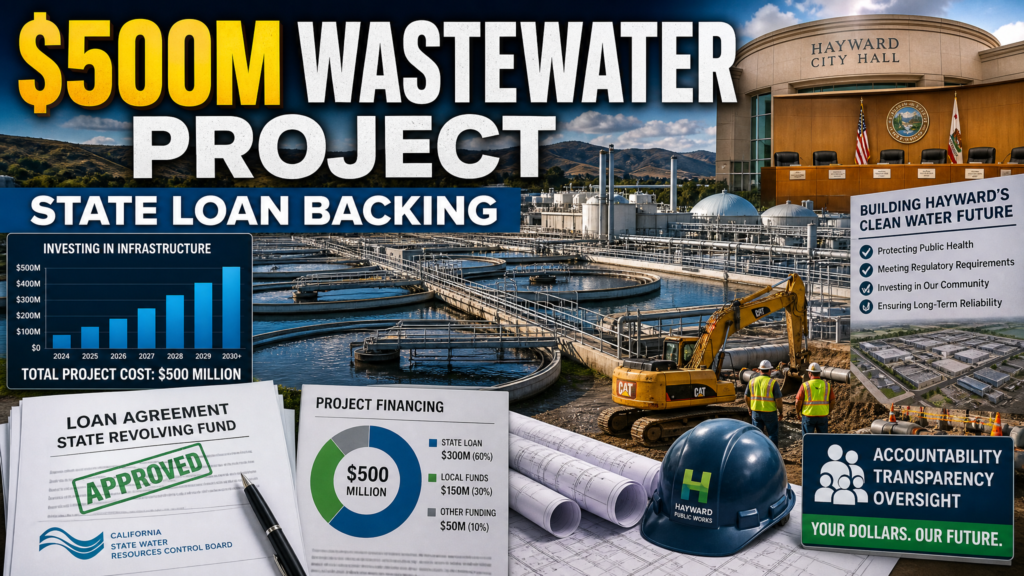
The numbers alone demand attention. The watchlist describes the project as a “wastewater megaproject” with an estimated cost of about $498 million, while Hayward’s FY 2026 adopted budget book says the wastewater treatment plant expansion is currently estimated at approximately $490 million. The city’s official WRRF project page gives a broader estimated total project range of $394 million to $594 million. However one slices the estimate, the conclusion is the same: this is one of the largest infrastructure bets Hayward has in motion, and it is being financed through multiple layers of borrowing, including a state revolving-fund loan, federal lending, and bond financing. Source Source Source
Support Independent Local Journalism
TheTownHall.News is a non-profit reader-supported journalism. Just $5 helps us hire local reporters, investigate important issues, and hold public officials accountable across Alameda County. If you believe our community deserves strong, independent journalism, please consider donating $5 today to support our work.Why This Issue Matters Now
This project matters because it is not optional in the way some city ambitions are optional. Hayward says the facility currently treats an average of 11 million gallons of wastewater per day, and the city is upgrading treatment processes to comply with upcoming nutrient-discharge rules and to accommodate future population growth. Specifically, the city says upcoming Regional Water Quality Control Board requirements are expected to require removal of 50 percent of nutrients by 2034, a response to concerns about excessive nitrogen levels and harmful algae blooms in the Bay. Source
That is the first essential fact: this is not a cosmetic project. It is tied to regulatory compliance, environmental performance, and the continued reliability of an essential utility. The second essential fact is just as important: “required” does not mean “immune from scrutiny.” Once a project climbs toward half a billion dollars, taxpayers and ratepayers have every reason to ask hard questions about financing, oversight, contracting, and whether the city is maintaining discipline as the work unfolds. Source
Big infrastructure projects are where public trust is either earned or squandered. If City Hall wants confidence, it has to show not just that the project is necessary, but that it can be delivered with transparency, realistic budgets, and a clear explanation of who ultimately pays. Source
When public works reach half a billion dollars, oversight is not optional. Source

What the Council Actually Approved
The financing trail began to come into clearer public view in late 2025. According to Hayward’s council action minutes, on Dec. 2, 2025, the City Council approved two resolutions authorizing the city manager to apply for a State Water Resources Control Board State Revolving Fund loan and approving a reimbursement resolution in support of the application for the WRRF Improvements Phase II project. The resolutions were RES 25-205 and RES 25-206. Source
The watchlist adds the missing public-interest scale: it describes that financing path as an SRF loan of up to $50 million tied to the WRRF Phase II project. It also notes that the project returned to council in February 2026 for an informational update and again in March 2026, when the council approved a professional-services contract amendment with Brown and Caldwell for the new administration building and laboratory portion of the project. Source
That sequence tells residents something important. This is not one vote and done. It is a rolling megaproject, with financing decisions, contract amendments, and design or construction steps that will keep surfacing over time. That is exactly the kind of project that can escape notice in fragments while accumulating huge long-term obligations. Source
How the State Loan Fits Into the Bigger Financing Stack
The state loan is only one piece of the funding picture. Hayward’s FY 2026 adopted budget book says that, in FY 2024-25, the city issued a $125 million wastewater revenue bond and secured a $244 million federal WIFIA loan through the U.S. Environmental Protection Agency. The same budget document says another approximately $90 million bond is planned for FY 2026-27. Source
That means the state revolving-fund loan should be understood not as a stand-alone rescue, but as part of a layered debt-and-financing strategy supporting a project of extraordinary scale. The attraction of state and federal infrastructure financing is obvious: it can spread costs over time and make legally required upgrades feasible. But the risk is just as obvious. Borrowing does not make the cost disappear. It shifts it forward, and eventually someone pays through rates, fees, or both. Source
Support Independent Local Journalism
TheTownHall.News is a non-profit reader-supported journalism. Just $5 helps us hire local reporters, investigate important issues, and hold public officials accountable across Alameda County. If you believe our community deserves strong, independent journalism, please consider donating $5 today to support our work.The watchlist gets this right by framing the WRRF as a major ratepayer-exposure story, not just an engineering story. The central watchdog question is not whether wastewater treatment is important. It is whether the city can manage a financing path this large without letting cost escalation, opaque amendments, or delivery delays weaken public confidence. Source
The Real Cost of Delay, Drift, and Scope Creep
Hayward’s official project page shows just how long and complicated this effort is. The city says the administration-building construction runs from early 2025 to early 2027, while the broader Phase II improvements are expected to run from fall 2025 to early 2030. That means residents are looking at a multi-year buildout with many opportunities for schedule drift, pricing changes, and contract modifications. Source
This is where government often gets itself into trouble. Not necessarily through a single scandalous decision, but through an accumulation of incremental approvals that the public barely notices until the final price tag feels locked in. A contract amendment here, an updated estimate there, a financing adjustment later — and suddenly a project that was once described in the abstract has become an unavoidable long-term burden. Source
To be clear, that does not mean Hayward should abandon the project. It means the city should treat transparency as part of the project itself. Residents should be able to track original estimates against revised figures, financing assumptions against actual borrowing, and construction timelines against real delivery milestones. If city officials want trust, they should invite that scrutiny rather than resent it. Source
Infrastructure necessity does not excuse financial complacency. Source
What Critics Get Wrong
Some critics of aggressive oversight will argue that this kind of utility project is too technical for ordinary public debate. They will say the city has no choice because regulators are tightening nutrient-removal rules and the Bay’s ecological health is at stake. On the substance, they are largely right. Hayward’s own materials make clear the project is driven by compliance obligations and environmental performance, not vanity spending. Source
But that is exactly why oversight matters. The more necessary a project is, the less room the public has to walk away from it if leaders make poor financing choices. Residents cannot simply opt out of wastewater treatment. That means they deserve more transparency, not less. Accountability is not anti-infrastructure. It is the only way infrastructure remains politically and financially legitimate when the numbers become this large. Source
Key Takeaway
Hayward’s wastewater megaproject is the kind of city-building investment that can shape public finances for years. The city has already tied the project to state and federal financing, approved resolutions to pursue a state revolving-fund loan, and continued moving contract pieces through council as the broader buildout advances. The official rationale is clear: meet nutrient-reduction rules, protect the Bay, and expand treatment capacity for the future. Source Source
The real public-interest test is whether City Hall can do all of that while keeping the cost story honest. On a project measured in the hundreds of millions, residents should not settle for vague assurances. They should expect regular updates, clear financing explanations, and a simple answer to a simple question: is this project still on time, on scope, and financially under control? Source
What Residents Should Watch Next
The next things to watch are concrete. First, watch for future council items involving WRRF contract amendments, reimbursement actions, or new borrowing decisions. Second, watch whether project estimates continue to cluster around the city’s roughly $490 million to $498 million near-term framing or drift toward the higher end of the official total project range. Third, watch for how city leaders explain long-term ratepayer exposure as financing layers continue to accumulate. Source Source Source
This is precisely the sort of local-government story that deserves sustained attention even when it lacks the drama of electoral politics. Wastewater systems are easy to ignore — until the price, the debt, or the delivery problems become impossible to ignore. Stay informed, share this article, and support independent journalism that follows infrastructure money with the same intensity used to cover campaigns and culture-war fights. In a city budget, buried utilities can shape the future just as much as visible headlines. Source