Hayward Awards $10.06 Million Pavement Contract to Repair City Streets
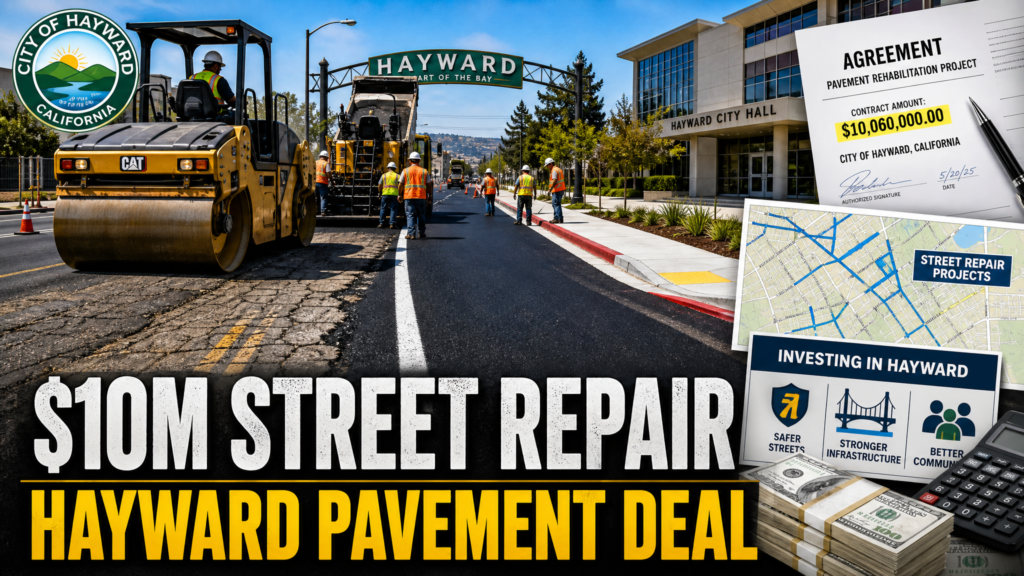
Hayward leaders are touting a major street-repair push that will touch more than 129 lane-miles of roadway. But the real public-interest question is not whether smoother roads are needed — it is whether City Hall can deliver a large infrastructure contract on time, on budget, and with clear accountability for every neighborhood affected.
Bad roads are one of the few government failures that every resident can feel immediately. You do not need a staff report to notice crumbling pavement, rough rides, or neglected curbs. In that sense, Hayward’s decision to award a $10.06 million contract for its Fiscal Year 2026 Pavement Improvement Project is easy to understand politically: fixing streets is visible, broadly popular, and overdue in many places. Source
But large public-works contracts deserve more than applause. They deserve scrutiny. The Hayward City Council moved this project from the bid stage in February 2026 to a formal award in April 2026, giving Bay Cities Paving & Grading, Inc. the contract for $10,063,947.60 and authorizing a separate $1,436,052.40 administrative change-order budget, for a total not-to-exceed amount of $11.5 million. That makes this not just a road-repair story, but a taxpayer-accountability story with real implications for cost control, project scope, and neighborhood equity. Source Source
Support Independent Local Journalism
TheTownHall.News is a non-profit reader-supported journalism. Just $5 helps us hire local reporters, investigate important issues, and hold public officials accountable across Alameda County. If you believe our community deserves strong, independent journalism, please consider donating $5 today to support our work.Why This Issue Matters Now
Hayward’s official project materials show the city maintains 679 lane-miles of pavement across 292 centerline miles of roadway. The FY 2026 pavement project is scheduled to treat 129 lane-miles, including 24 lane-miles of rehabilitation, 13 lane-miles of micro-surfacing, and 91 lane-miles of crack sealing — roughly 19 percent of the city’s maintained lane-miles. In plain English, this is a major annual intervention, not a cosmetic patch job. Source
The city’s public-facing project page adds more practical context. Hayward says the work will bring more than $10 million in street and curb repairs, resurfacing, striping, and upgrades to bike lanes, crosswalks, and other roadway features across 123 street segments. Construction was set to begin in late May 2026 and is expected to run through the end of November, with residents receiving 72-hour notice before work begins in their neighborhoods. Source Source
That matters because street maintenance is one of the clearest tests of basic local governance. Residents may disagree on ideology, but they understand what functioning streets look like. When a city spends eight figures on roads, voters are entitled to ask whether the work was prioritized fairly, whether the contract was competitively bid, and whether the final outcome actually improves daily life rather than just producing another ribbon-cutting headline. Source
Potholes are local government’s report card — and everyone can read the grade. Source

What the Council Actually Approved
The official record is unusually clear. According to Hayward’s Legistar page, the City Council’s April 21, 2026 agenda included a consent item to award the FY 2026 Pavement Improvement Project, Project No. 05347, to Bay Cities Paving & Grading, Inc. for $10,063,947.60 and to authorize an administrative change-order budget of $1,436,052.40. Staff recommended approval of addenda revising plans and specifications and asked the council to authorize a total not-to-exceed contract amount of $11,500,000. Source
The same official page says the project received seven bids on March 17, 2026, and that six of the seven bids came in below the engineer’s estimate of $11,650,000. Bay Cities’ low bid was $1,586,052.40, or 13.6 percent, under that estimate. That is a meaningful figure because it gives the city a straightforward case that the award was not just large, but competitively favorable relative to internal cost expectations. Source
The watchlist prepared from Hayward council materials flags this item as one of April 2026’s biggest infrastructure contracts and explicitly treats it as a “major road-condition story.” It also notes the council had already approved plans and called for bids in February 2026, underscoring that this was a staged public decision rather than a sudden one-off approval. Source
How This Affects Families and Neighborhoods
Street-repair spending may sound abstract in city budget documents, but its effects are highly local. Better pavement means less wear and tear on personal vehicles, fewer hazards for cyclists and pedestrians, clearer striping, safer crosswalks, and more reliable curb access. When the city says this year’s project includes repairs, resurfacing, striping, and bike-lane and crosswalk upgrades, it is talking about changes residents will see block by block. Source
The city also says the included streets were selected based on a combination of current pavement conditions, input from the public and City Council, grouping by neighborhood for cost and schedule efficiency, and available funding. That sounds sensible, but it also opens the door to the central fairness question: which neighborhoods made the list, which ones did not, and why? A city can have a logical process and still leave residents asking whether their area was overlooked or pushed back yet again. Source
Support Independent Local Journalism
TheTownHall.News is a non-profit reader-supported journalism. Just $5 helps us hire local reporters, investigate important issues, and hold public officials accountable across Alameda County. If you believe our community deserves strong, independent journalism, please consider donating $5 today to support our work.That is why this contract deserves more attention than a typical consent-calendar item. Roads are universal infrastructure, but improvements are never truly universal at any one moment. Someone gets paved first. Someone waits. If city leaders want trust, they need to show that decisions are being driven by objective need and transparent planning rather than inside pressure or political convenience. Source
The Real Cost of Government Overreach — and Underreach
There is a tendency in local politics to treat any infrastructure spending as automatically virtuous. That is a mistake. Spending money on a real need can still be wasteful if oversight is weak, project scopes drift, or administrative contingencies quietly become back doors for expansion. In Hayward’s case, the authorized change-order budget of $1.44 million is not trivial. It exists for a reason, but it also deserves close attention because change orders are often where public confidence begins to erode. Source
At the same time, there is also a cost to underinvestment. Deferred maintenance does not save money forever; it often multiplies future bills. If roads deteriorate past a certain point, cities move from cheaper preservation strategies to far more expensive rehabilitation or reconstruction. In that sense, Hayward’s annual pavement program reflects a basic truth of fiscal accountability: government should do the maintenance it is supposed to do before neglect becomes more expensive than action. Source
The right approach is not blind hostility to public works or blank-check enthusiasm for them. It is disciplined oversight. Residents should want the streets fixed — and they should also want every dollar tracked. Source
Good infrastructure policy means fixing roads before neglect becomes a luxury the public cannot afford. Source
What Critics Get Wrong
Some critics will argue that questioning a pavement contract is nitpicking when the city is clearly doing something residents have long demanded. There is some truth to that. This project is not speculative social engineering or a symbolic initiative with fuzzy deliverables. It is concrete work on real streets, funded through identifiable transportation and road-repair sources including Alameda County Measure BB sales tax revenue, gas tax revenue, state vehicle registration fees, street system improvement funds, and the California Road Repair and Accountability Act of 2017. Source
But critics of scrutiny miss the larger point. The more legitimate a project is, the easier it can be for government to hide behind its legitimacy. That is why the watchlist frames this contract as part of a broader infrastructure cost-tracking story. Residents and reporters are urged to watch original budgets against actual spending, monitor amendments and change orders, and ask which neighborhoods bear the disruptions and receive the benefits. Those are not anti-government questions. They are the exact questions responsible local journalism should ask. Source
Key Takeaway
Hayward’s FY 2026 pavement contract is both good news and a test. It is good news because the city is moving forward on a large, visible street-repair effort that will affect more than 129 lane-miles and 123 street segments. It is a test because City Hall is now on the hook to prove that a contract awarded below the engineer’s estimate still delivers quality work, neighborhood fairness, and disciplined use of a seven-figure change-order cushion. Source Source
For residents, the bottom line is simple: smoother streets matter, but so does how government gets there. A city serious about public trust should not merely announce where crews are headed. It should also keep the public informed about costs, timelines, scope changes, and whether promised improvements actually materialize on the ground. Source
What Residents Should Watch Next
Residents should watch three things over the coming months. First, whether the project stays on schedule for completion by the end of November 2026. Second, whether the administrative change-order authority remains a contingency or becomes a vehicle for substantial scope expansion. Third, whether the city clearly communicates where work is happening and why certain streets were prioritized over others. Source Source
Hayward has already provided one useful public tool: the city’s FY 2026 pavement project page and related materials let residents see the project scope and prepare for street-level work in their neighborhoods. That kind of transparency should not be the exception. It should be the standard. Stay informed, share this article, and support independent journalism that treats local contracts like public business — because that is exactly what they are. Source