Hayward Approves $4.15 Million A Street Sewer Line Replacement Contract
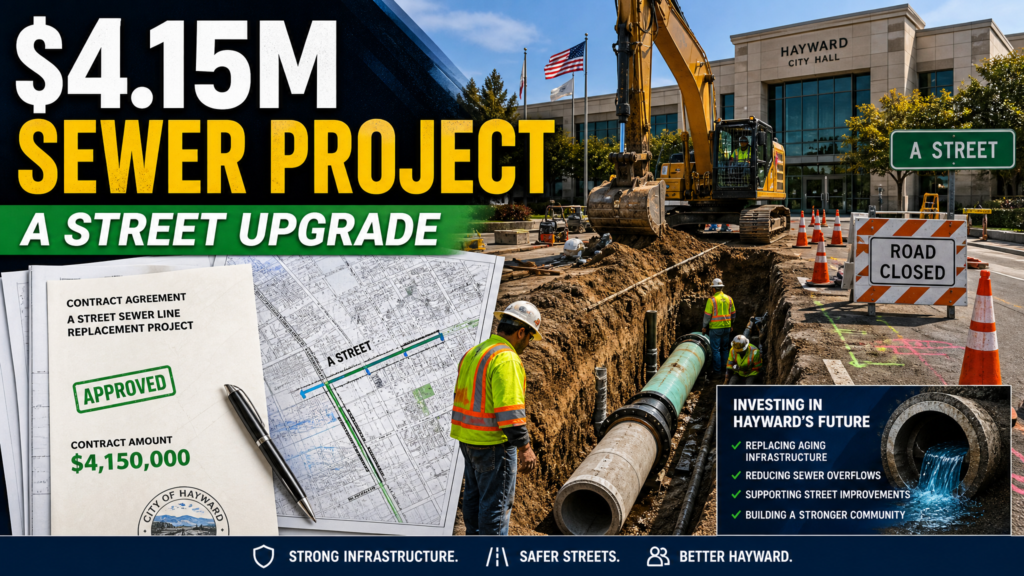
Hayward’s A Street sewer project may run underground, but its stakes are anything but invisible. City leaders say the work is needed to replace aging infrastructure before new pavement goes down — and that makes this a telling test of whether local government can coordinate costly utility work before taxpayers end up paying twice. Source Source
Sewer projects rarely generate the public attention that police budgets, housing fights, or ballot measures do. But they are exactly the kind of local-government decisions that shape daily life long after the headlines fade. When a city waits too long to replace failing underground infrastructure, the result is familiar: emergency repairs, torn-up streets, service problems, and bigger bills later. That is why Hayward’s decision to approve a $4,150,449 contract for the A Street Sewer Line Replacement Project deserves more scrutiny than a routine consent-calendar item. Source
The city moved this item in two steps. On Feb. 17, 2026, the City Council approved plans and specifications and called for bids. Then, in April 2026, the council awarded the contract to SubTerra Construction. The watchlist frames it as a major underground-infrastructure story with implications for construction disruption, utility reliability, and long-term sewer-rate pressure. In other words, this is not just a pipe-replacement project. It is a public-accountability story about whether Hayward can manage infrastructure the smart way instead of the expensive way. Source Source
Support Independent Local Journalism
TheTownHall.News is a non-profit reader-supported journalism. Just $5 helps us hire local reporters, investigate important issues, and hold public officials accountable across Alameda County. If you believe our community deserves strong, independent journalism, please consider donating $5 today to support our work.Why This Issue Matters Now
The strongest immediate reason this project matters is timing. According to Hayward’s Feb. 17 staff report, the A Street sewer work was pulled forward as a standalone project because it conflicts with the FY26 Pavement Improvement Project scheduled for construction in summer 2026. Staff explicitly said they wanted the sewer work completed before new paving goes down. That is the kind of sequencing decision residents should expect from competent local government: fix what is underground before spending millions to beautify what is above it. Source
That alone makes this more than a technical utility item. It is a basic test of fiscal discipline. If cities pave first and dig later, taxpayers effectively pay for the same corridor twice — once for the surface upgrade and again for the disruption and restoration that follow utility work. Hayward’s handling of A Street suggests officials understand that risk. The public should now expect them to follow through by delivering the work efficiently and without unnecessary cost creep. Source
The broader system context matters too. A city environmental study says Hayward’s sewer collection system includes about 325 miles of sewer mains and nine sewage lift stations, carrying wastewater to the city’s treatment facility. Replacement priorities are driven by master planning and by practical problems such as aging pipes, structural damage, breaks, sags, and obsolete materials. That means A Street is not an isolated repair. It is part of a much larger infrastructure burden that will keep surfacing in city budgets for years. Source
What the Council Actually Approved
The official trail begins with the Feb. 17, 2026 council agenda. The Legistar record shows the council considered CONS 26-038, a resolution approving plans and specifications and calling for bids for the A Street Sewer Line Replacement Project, Project No. 07831. The staff report says bids were to be received on March 24, 2026. Source Source

That same report provides unusually useful detail about the city’s rationale. Hayward said the broader Sewer Line Replacement Project FY24 is designed to replace undersized or structurally damaged sewer mains through annual capital improvements. The full multi-year project is described as replacing about 5.6 miles of existing pipe at 29 locations across the city, using new PVC or HDPE pipe in sizes ranging from 8 to 24 inches. The A Street segment was separated from the rest because of the coming pavement work. Source
By April 2026, the next stage was complete. The watchlist says the City Council awarded the construction contract to SubTerra Construction for $4,150,449. It places the project squarely in Hayward’s “infrastructure and utility exposure” category and treats it as a significant public-interest item because of both its construction impact and its longer-term ratepayer implications. Source
How This Affects Residents and Neighborhoods
Sewer work is invisible when it works and highly visible when it does not. Residents near A Street are likely to experience the project through traffic impacts, construction noise, lane disruptions, and temporary inconvenience. The watchlist explicitly notes that residents may notice the project through construction disruption, which is often the public’s first direct encounter with underground utility spending. Source
But the neighborhood impact is not only about inconvenience. It is also about reliability. Hayward’s own planning documents say sewer lines are selected for replacement based on problems such as recurring breaks, structural damage, pipes reaching the end of useful life, and the need to replace older materials with more suitable ones. That means projects like A Street are not cosmetic upgrades. They are meant to prevent failures before they become emergencies that cost more and damage more. Source
This is one reason infrastructure stories deserve more public attention than they usually get. A city that quietly replaces weak sewer lines before a crisis is doing one of the most basic jobs of government. A city that delays too long usually ends up shifting the cost of neglect onto future budgets, future ratepayers, and future residents. Source
Support Independent Local Journalism
TheTownHall.News is a non-profit reader-supported journalism. Just $5 helps us hire local reporters, investigate important issues, and hold public officials accountable across Alameda County. If you believe our community deserves strong, independent journalism, please consider donating $5 today to support our work.Invisible infrastructure still produces visible bills. Source
The Real Cost of Waiting Too Long
What makes this article more than a narrow utility brief is the lesson embedded in the scheduling. Hayward’s staff report makes plain that the A Street sewer work had to move now because a pavement project was already approaching. That is a quiet admission of a larger truth about city budgeting: deferred infrastructure eventually collides with everything else. When those collisions happen, governments must either coordinate well or waste money badly. Source
Hayward appears, at least on paper, to have made the better choice here. Doing the sewer work before the road surface is improved is smarter than laying fresh pavement and reopening the street later. But good sequencing at the front end does not eliminate the need for oversight at the back end. Residents and reporters should still watch for schedule slippage, cost changes, and whether the finished work actually prevents the kind of follow-up disruptions that make people cynical about public-works planning. Source Source
There is also a bigger financial issue. The watchlist specifically flags this project as having long-term sewer-rate implications. That does not mean this one contract alone will determine future bills, but it does mean underground utility work is part of a cumulative cost story that residents should not ignore. Sewer systems age. Compliance expectations grow. Replacement costs rise. If city leaders are not candid about that, the public conversation becomes less honest than the budget reality. Source
What Critics Get Wrong
Some critics will dismiss sewer replacement stories as dry process journalism. They will say the project is too technical, too buried, or too inevitable to deserve sustained attention. There is an element of truth there: unlike a tax hike or a council scandal, a sewer contract does not naturally invite outrage. It is supposed to be boring. Source
But that is precisely why it matters. The most expensive and consequential local-government decisions are often the ones least likely to trend online. When infrastructure work takes place below ground, officials can count on the public tuning out unless there is a visible disaster. That is a mistake. Good watchdog reporting does not wait for sewage backups or blown budgets. It pays attention when the contracts are awarded, when the sequencing decisions are made, and when the city still has a chance to prove it is acting responsibly. Source
A serious local-news outlet should treat this kind of item as core civic coverage. Pipes may be buried, but public accountability should not be. Source
Key Takeaway
The A Street Sewer Line Replacement Project is the kind of local infrastructure story that reveals whether a city is planning ahead or merely reacting. Hayward’s official record shows the council approved plans in February, called for bids, and then awarded a $4.15 million contract in April. The city’s own rationale was straightforward: replace aging sewer infrastructure before summer paving creates a bigger and more expensive conflict. Source Source
That is the right principle. Now comes the harder part: execution. Residents should want the city to finish the work efficiently, minimize disruption, and avoid turning a prudent utility upgrade into a drawn-out budget problem. Competent government is not just about approving projects. It is about finishing them well. Source
What Residents Should Watch Next
The next questions are practical and important. Does the project stay on schedule? Does construction disruption remain manageable for nearby residents and businesses? Are there amendments, added costs, or scope changes after the award? And does the city clearly explain how this project fits into the larger pattern of sewer-system needs and future ratepayer exposure? Those are the exact kinds of oversight questions the watchlist recommends residents and reporters keep asking. Source
Hayward’s Public Works and Utilities Department says its mission includes operating and maintaining roads, water service, wastewater service, stormwater management, and related infrastructure in a safe, reliable, and efficient manner. That is a reasonable standard. The public should hold the city to it. Stay informed, share this article, and support independent journalism that covers underground infrastructure with the same seriousness it gives visible politics. Cities depend on both. Source