Hayward Commits $1.2 Million to High Injury Network Street Safety Plan
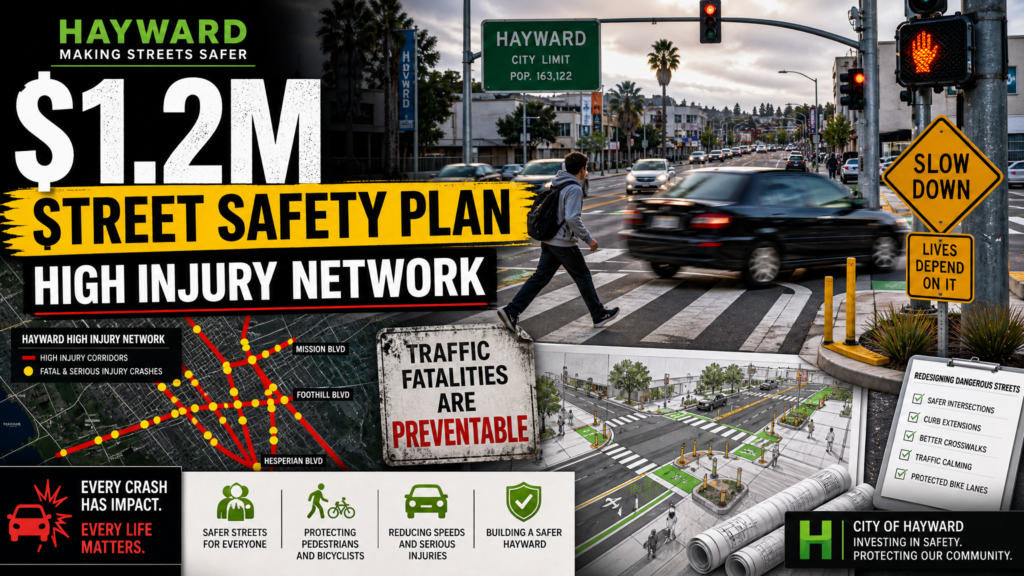
Hayward officials are putting serious money behind a new traffic-safety push aimed at the streets where the worst crashes happen. The plan promises action on dangerous corridors, but the real test will be whether City Hall turns studies and strategy into visible changes that actually reduce deaths and severe injuries. Source
Traffic safety is one of those issues that becomes impossible to ignore only after tragedy strikes. Residents may not follow every council agenda, but they understand dangerous intersections, speeding on neighborhood arterials, and the fear that comes with crossing a street that feels designed more for fast traffic than for families, seniors, cyclists, or schoolchildren. That is why Hayward’s decision to authorize a not-to-exceed $1.2 million consulting agreement for Phase 2 of its High Injury Network Safety Plan deserves real attention. This is not a symbolic gesture. It is a substantial public-safety commitment tied directly to how city streets are designed and managed. Source
The council’s January 2026 action, which the watchlist says authorized the agreement with Kittelson & Associates, did not arrive in a vacuum. It followed a $264,000 Measure BB appropriation in December 2025 for Safe Streets Hayward work tied to the High Injury Network, the Speed Management Plan, and Downtown Loop alternatives. It was followed by a March 2026 traffic-safety work session and the formal approval of a citywide Speed Management Plan in April 2026. Together, those actions show Hayward trying to move from piecemeal safety talk to a more systematic approach. The public now has every right to ask whether that approach will produce safer streets — or just more planning documents. Source
Support Independent Local Journalism
TheTownHall.News is a non-profit reader-supported journalism. Just $5 helps us hire local reporters, investigate important issues, and hold public officials accountable across Alameda County. If you believe our community deserves strong, independent journalism, please consider donating $5 today to support our work.Why This Issue Matters Now
The reason this story matters is simple: the streets where the most serious crashes happen are not random. A “High Injury Network” is, by definition, a set of corridors where traffic deaths and severe injuries are concentrated. Hayward’s watchlist treats the issue as part of a broader rethinking of public safety — one that goes beyond policing and looks at the built environment itself. In that framing, traffic danger is not just bad luck or bad driving. It is a civic problem that can be shaped by street design, speed management, and targeted investment. Source
That is an important shift. For years, cities have often responded to deadly roads with isolated fixes, enforcement campaigns, or vague promises to “raise awareness.” Hayward now appears to be aiming for something more comprehensive. The December 2025 Measure BB allocation supported early work on the High Injury Network and speed management. The January agreement funded the next planning phase. The April speed plan added another formal piece of the policy structure. That kind of sequencing suggests a city trying to build a framework rather than just react to the latest complaint. Source
Still, residents should be careful not to confuse planning with results. A city can spend heavily on studies and consultants and still leave dangerous streets largely unchanged if implementation lags, political will fades, or the recommended fixes prove controversial. When the topic is traffic deaths and serious injuries, people should demand more than strategy. They should demand outcomes. Source
A safer street is not a press release. It is a measurable result. Source

What the Council Actually Did
According to the watchlist built from Hayward’s official agenda materials, the City Council in January 2026 authorized a not-to-exceed $1.2 million agreement with Kittelson & Associates for Phase 2 of the High Injury Network Safety Plan. The same source identifies the item as one of the city’s more significant public-safety and contract decisions during the six-month period covered by the report. Source
The agreement did not stand alone. In December 2025, the council approved $264,000 in Measure BB funding for Safe Streets Hayward work tied to the High Injury Network, the Speed Management Plan, and Downtown Loop alternatives. In March 2026, the city held a work session on traffic-safety initiatives and also accepted $300,000 in Caltrans Highway-Railway Crossing Safety Program funding for preliminary engineering on the Tennyson Road crossing. Then, in April 2026, Hayward formally approved its citywide Speed Management Plan. Source
That timeline matters because it shows this was not a one-off consultant contract slipped through on autopilot. It was part of a broader city effort to reorganize how Hayward thinks about dangerous roads, traffic speed, and neighborhood-level street safety. The policy logic is coherent. The question now is whether the execution will be. Source
How This Affects Families and Communities
For residents, traffic safety is not abstract. It shows up in the simplest routines: walking to school, crossing a commercial corridor, biking to work, pulling out of a driveway, or trying to make a left turn onto a fast-moving arterial. If Hayward’s High Injury Network work is effective, the payoff should be felt in the places people use every day, not merely in staff presentations or engineering memos. Source
That is why this story has such broad civic relevance. Street design influences who feels safe using public space and who does not. Fast, forgiving roads often reward speed while pushing risk onto pedestrians, cyclists, older adults, and families with children. A city that says it is addressing its High Injury Network is effectively acknowledging that some parts of the transportation system are producing unacceptable outcomes and need redesign, not just better messaging. Source
Support Independent Local Journalism
TheTownHall.News is a non-profit reader-supported journalism. Just $5 helps us hire local reporters, investigate important issues, and hold public officials accountable across Alameda County. If you believe our community deserves strong, independent journalism, please consider donating $5 today to support our work.There is also an equity question embedded in the issue. The watchlist explicitly encourages residents and reporters to ask which neighborhoods bear the costs and which receive the benefits of safety projects. That is exactly the right instinct. If dangerous conditions are concentrated in certain corridors, then meaningful reform should be visible there first — not just where change is easiest or least controversial. Source
The Real Cost of Government Drift
The best case for Hayward’s spending is straightforward: ignoring dangerous streets is costly in every sense that matters. Crashes impose human costs first, but also legal, financial, and political ones. Cities that delay street-safety fixes often end up paying more later through emergency interventions, liability exposure, or rushed projects after public outrage peaks. In that sense, early planning and targeted redesign can be an example of government doing its job before failure becomes more expensive. Source
But there is a real danger on the other side as well: planning drift. Local governments sometimes become too comfortable funding plans, frameworks, and consultant reports without forcing decisions about what actually gets built, where, and by when. Hayward’s traffic-safety package is now far enough along that residents should stop accepting broad aspirations as the main deliverable. A $1.2 million consulting agreement is large enough to justify very specific public expectations. Source
That is where fiscal accountability comes in. The city is entitled to argue that planning is necessary before redesign. Fair enough. But taxpayers are equally entitled to ask what milestones, timelines, and measurable improvements will follow. If the city cannot answer that clearly, then “safety planning” risks becoming one more expensive holding pattern. Source
Public safety spending should buy safer streets, not just thicker reports. Source
What Critics Get Wrong
Some critics will say redesigning streets is a distraction from individual responsibility and enforcement. That view gets part of the story right: drivers do have responsibilities, and bad decisions behind the wheel remain a serious problem. But it gets another part wrong. Street design influences behavior more than many officials are willing to admit. Wide lanes, long sightlines, and poorly protected crossings can encourage speeds and movements that make deadly mistakes more likely. Source
On the other side, some advocates act as though approving a plan is itself a victory. That is also wrong. Residents are not safer because a city passed a resolution or signed a consulting agreement. They are safer when dangerous corridors are fixed, speeds actually come down, crossings improve, and crash outcomes change. Hayward deserves credit for taking the problem seriously. It has not yet earned credit for solving it. Source
Key Takeaway
Hayward’s $1.2 million High Injury Network agreement is one of the clearest signs that the city is trying to treat traffic safety as a core public-safety issue rather than a side topic. It is tied to earlier Safe Streets funding, later speed-management approval, and related crossing-safety work. That gives the city a plausible framework for action. Source
The public-interest test now is much simpler: will this produce visible changes on the streets where the worst crashes happen? Residents should not settle for elegant strategy language or process-heavy updates. They should expect a timeline, measurable goals, and proof that the most dangerous corridors are becoming less dangerous. Source
What Residents Should Watch Next
The next things to watch are concrete. Which corridors are identified for priority treatment? What engineering or design changes are recommended? How does the new Speed Management Plan interact with the High Injury Network work? What deadlines does the city set for moving from planning to implementation? And how will Hayward report whether the effort is working? Those are the oversight questions the watchlist itself says residents and reporters should keep asking. Source
If City Hall is serious about this initiative, it should make answers to those questions easy to find. Safer streets are one of the most basic promises local government can make to its residents. Stay informed, share this article, and support independent journalism that keeps watching whether that promise is actually being kept. Source