U.S. Launches Self-Defense Strikes on Iran Amid Ceasefire Talks — Tehran Vows Retaliation
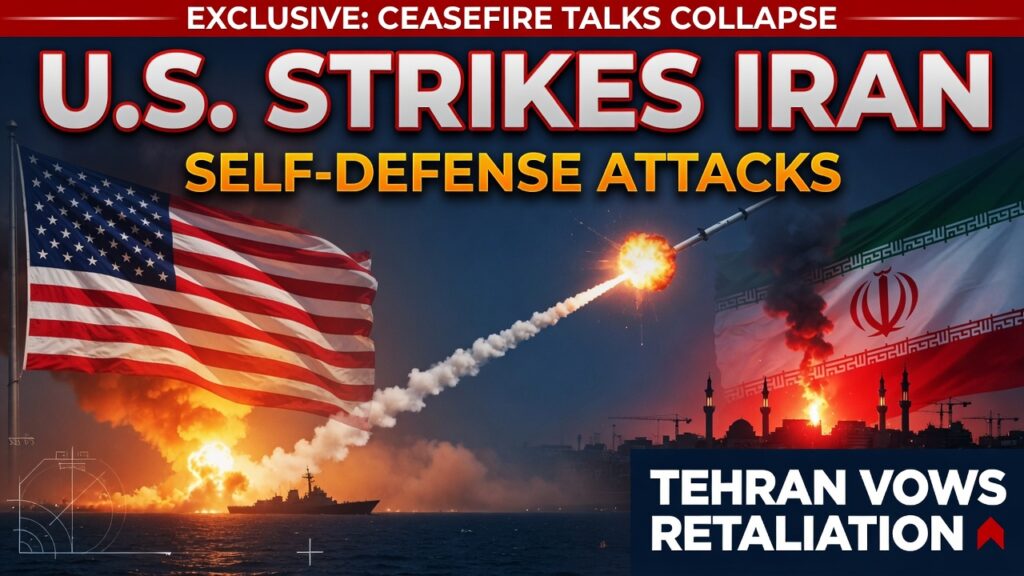
America’s military acted to protect its troops. Iran was caught laying mines in the Strait of Hormuz. So why is Washington still being second-guessed?
The scene is as revealing as it is alarming. While U.S. diplomats sit at a table in Qatar negotiating a peace deal, Iranian forces were busy planting mines in the Strait of Hormuz and manning missile launch sites aimed at American personnel. On Monday, U.S. Central Command had seen enough. It struck back — and it was right to do so.
These latest “self-defense strikes” are not a violation of the ceasefire that took effect on April 8. They are the direct and foreseeable consequence of one side refusing to honor it. The question Americans should be asking is not whether the strikes were justified — they clearly were — but whether the broader strategy protecting U.S. forces in the region is being executed with the full accountability and transparency that the American people deserve.
Support Independent Local Journalism
TheTownHall.News is a non-profit reader-supported journalism. Just $5 helps us hire local reporters, investigate important issues, and hold public officials accountable across Alameda County. If you believe our community deserves strong, independent journalism, please consider donating $5 today to support our work.Why These Strikes Were Both Necessary and Lawful
Let’s be precise about what happened. U.S. Central Command (CENTCOM) confirmed that its forces carried out targeted strikes on missile launch sites and Iranian boats that were actively attempting to lay mines in the Strait of Hormuz — one of the world’s most critical waterways for global oil and commerce.
CENTCOM spokesperson Navy Captain Tim Hawkins stated plainly: the strikes were conducted “to protect our troops from threats posed by Iranian forces.” That is not aggression. That is the most fundamental obligation of any government — the protection of its own citizens and military personnel from imminent harm. A government that fails at this basic duty has failed at its core purpose.
Iran’s response? Accuse the United States of a “clear violation of the ceasefire” while simultaneously claiming its Revolutionary Guard shot down a U.S. MQ-9 drone and fired on an F-35 fighter jet. Tehran cannot have it both ways: it cannot plant mines in international waterways and then cry foul when the United States defends itself.
The Fragile Ceasefire and What’s Really at Stake
This is not the first flashpoint since the April 8 ceasefire took effect. U.S. Marines previously seized the Touska, an Iranian cargo ship, after ceasefire violations, and both sides traded fire in the Strait of Hormuz in May — with each blaming the other. A pattern has emerged, and it is not subtle.

The broader conflict began on February 28, 2026, when U.S. and Israeli forces launched coordinated strikes on Iran following the breakdown of diplomatic talks. Iran responded with missile and drone attacks on U.S. bases and regional allies, and closed the Strait of Hormuz — triggering a global trade disruption that every American family felt at the gas pump and grocery store.
That economic damage was real. Fiscal accountability demands that we ask how much this conflict has cost American taxpayers — and whether every dollar has been spent with the strategic clarity the mission demands. Military strength is non-negotiable, but so is spending discipline.
America’s military does not need permission from Tehran to protect its own people. But it does need a clear-eyed strategy — and the American public deserves to know what that strategy is.
The Negotiation Paradox: Talking Peace While Fighting
Here is the uncomfortable contradiction at the heart of this situation. President Trump posted Monday that negotiations with Iran were “proceeding nicely,” while simultaneously warning that failure to reach an agreement would mean going “Back to the Battlefront and shooting, but bigger and stronger than ever before.”
Within hours, CENTCOM was conducting strikes on Iranian territory.
Support Independent Local Journalism
TheTownHall.News is a non-profit reader-supported journalism. Just $5 helps us hire local reporters, investigate important issues, and hold public officials accountable across Alameda County. If you believe our community deserves strong, independent journalism, please consider donating $5 today to support our work.This is not hypocrisy — it may, in fact, be effective diplomacy. History shows that adversaries negotiate seriously only when they believe there are real consequences for bad faith. Ronald Reagan understood this. Peace through strength is not a slogan; it is a doctrine proven by decades of American foreign policy. Iran laying mines while its diplomats sit at a negotiating table in Qatar is not a good-faith effort — it is a pressure tactic. Matching it with force, proportionately and deliberately, sends the only message Iran’s leadership has historically respected.
Trump also signaled Monday that Iran’s stockpile of enriched uranium must be “immediately turned over to the United States” as part of any final deal. That is a high bar — and a necessary one. A regime with nuclear weapons capability and a demonstrated willingness to mine international shipping lanes is a regime that cannot be trusted with fissile material.
What Critics Get Wrong
Critics of the strikes will argue that military action risks derailing ongoing peace talks and escalating a conflict that has already destabilized the region. That is a reasonable concern — and it deserves a serious answer.
The answer is this: restraint is not the same as passivity. CENTCOM’s own statement acknowledged the military was “using restraint during the ongoing ceasefire.” The targets were specific — missile sites and mine-laying boats — not population centers, not civilian infrastructure. This is the disciplined application of force, not recklessness.
Furthermore, allowing Iranian forces to lay mines in the Strait of Hormuz unchallenged would not preserve the ceasefire. It would signal that the ceasefire is a one-sided arrangement where the United States absorbs provocations while Tehran faces no consequences. That is not a ceasefire. That is submission.
Law and order — whether domestic or international — depends on the credible enforcement of rules. When enforcement disappears, rules disappear with them.
The Cost of Inaction: Lessons from History
Americans who lived through the late 1970s and early 1980s remember what happens when the United States projects weakness toward Iran. The 1979 hostage crisis lasted 444 days. Iranian-backed forces have targeted American personnel across the Middle East for decades. Appeasement has never produced lasting security — only emboldened adversaries.
The real cost of inaction is measured not only in strategic terms, but in the lives of the men and women in uniform stationed in the region. Their safety is not a diplomatic bargaining chip. Personal responsibility — one of this nation’s founding values — means that those who put on a uniform to defend this country have a right to be defended in return. That obligation is sacred.
Key Takeaway
Iran was caught laying mines and manning missile sites while its diplomats were at the negotiating table. The United States struck back to protect its troops. That is not escalation — that is exactly what a sovereign nation with a functional military is supposed to do.
What Comes Next — and Why You Should Stay Informed
The next few weeks will be decisive. Negotiations in Qatar continue. Iran’s Revolutionary Guard has vowed to “respond decisively” to any ceasefire violation. Whether the fragile April 8 agreement survives will depend on decisions made in the coming days — decisions that will affect energy markets, global trade, and the safety of American service members.
This is not a distant foreign policy abstraction. It is a story about American strength, fiscal accountability for wartime spending, transparent governance, and the fundamental duty of a government to protect its own people. Citizens who care about these values have every reason to stay informed and engaged.
Conclusion
The United States did not start this exchange. It responded to an adversary that was actively threatening its forces while simultaneously sitting at a peace table — a bad-faith combination that cannot go unanswered. The strikes on southern Iran were targeted, legally grounded in self-defense, and consistent with the rules of engagement under an active ceasefire.
The harder question — whether the overall strategy will deliver a durable agreement that protects American interests, prevents nuclear escalation, and ends a costly conflict — remains open. That question demands vigilance from every citizen, not just from policymakers.
Strength and accountability are not opposites. America can — and must — project both.
Stay Informed. Stay Engaged.
This story is moving fast. Share this article with someone who needs the full picture. Subscribe to independent journalism that puts facts before narratives. And if you believe in civic accountability and a strong, transparent national defense — make your voice heard. Democracy requires an informed citizenry. Be one.