Business-Friendly Hayward Zoning Rewrite Could Reshape Development Citywide
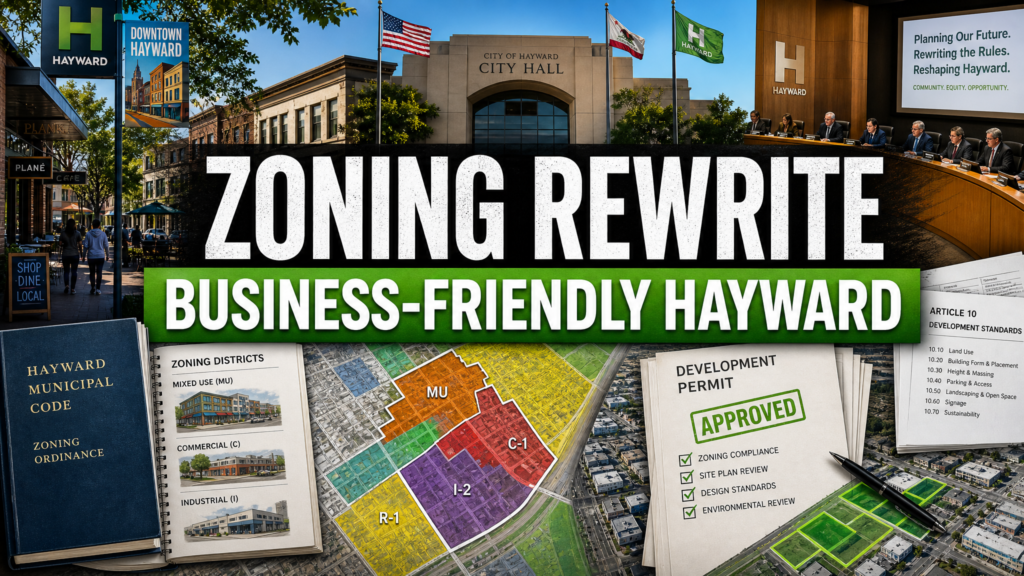
Hayward officials say the “Business-Friendly Hayward” project is about making it easier for businesses to open, grow, and fill vacant storefronts. But when a city rewrites zoning maps, use rules, and permit pathways at the same time, the real story is bigger: who gets to build what, where, and on whose terms. Source Source
Zoning stories rarely go viral, but they quietly shape the future of a city more than most headline-grabbing council votes. They decide what kinds of businesses can open, how quickly projects move, whether vacant storefronts stay empty, and how much friction local government adds to investment, redevelopment, and neighborhood change. That is why Hayward’s “Business-Friendly Hayward” initiative deserves far more attention than a routine planning update. It is not just a code cleanup. It is a citywide rewrite of commercial and mixed-use rules that could alter how development happens across Hayward. Source
The timeline alone shows this is no minor administrative exercise. Hayward publicly launched the effort in 2025 as a strategy to make it easier for businesses to locate and thrive in commercial and mixed-use areas, activate underused properties, and strengthen the local economy. In January 2026, the City Council held a work session titled “Business-Friendly Hayward Project Update: Review of Draft Municipal Code and Zoning Maps Revisions Related to the Business-Friendly Hayward Project.” By April 2026, the watchlist says the city had moved into formal public hearings covering text amendments, zoning map revisions, and Master Fee Schedule updates. Source Source Source
Support Independent Local Journalism
TheTownHall.News is a non-profit reader-supported journalism. Just $5 helps us hire local reporters, investigate important issues, and hold public officials accountable across Alameda County. If you believe our community deserves strong, independent journalism, please consider donating $5 today to support our work.That makes this one of the most consequential land-use stories in the six-month watchlist. A city that rewrites its zoning code is rewriting the rules of economic opportunity and neighborhood change. Residents, business owners, landlords, and developers should all treat that as a high-stakes public-interest issue — because it is. Source
Why This Issue Matters Now
Hayward’s official project page frames the initiative in straightforward, attractive language. The city says the Business Friendly Hayward Plan is a strategic initiative designed to make it easier for businesses to locate and thrive in commercial and mixed-use areas while helping revitalize vacant and underused properties. The listed objectives include streamlining entitlement and permitting, activating empty storefronts downtown, promoting commercial corridors as destinations, and growing and retaining small and midsized businesses. Source
On its face, that sounds hard to oppose. Most residents want fewer dead storefronts, more viable business districts, and less bureaucratic delay for legitimate investment. In a city facing budget pressure and trying to strengthen its tax base, a more functional commercial code has obvious appeal. Hayward’s July 2025 public outreach repeated that same message, saying the initiative aimed to create a supportive environment for local businesses, attract new investment, and strengthen the local economy. Source
But zoning rewrites are never just about making things easier. They are also about deciding which uses get favored, which standards get loosened, which neighborhoods absorb change, and how much discretion government keeps or gives up. That is where this story moves from pro-growth branding into real civic consequence. “Business-friendly” can mean more predictable and efficient. It can also mean lower friction for projects that nearby residents may not welcome, or a new set of fee and permitting rules that shift costs in less visible ways. Source

What the City Is Actually Trying to Change
Hayward’s own project materials show the rewrite is broad. The public review page links draft revisions for commercial districts, the Mission Boulevard use table, general regulations, the Downtown Development Code, the industrial district use table, definitions, a new section on accessory commercial units, a new limited entertainment permit, and a map of properties proposed to be rezoned. That is not a narrow amendment. It is a comprehensive restructuring of how the city regulates commercial and mixed-use land. Source
The city’s code-updates report is even more revealing. It says the project is intended to streamline entitlement and permitting processes, facilitate desirable businesses in commercial and mixed-use districts, activate vacant and underused storefronts downtown, and improve overall business friendliness. Among the specific best-practice ideas highlighted are flexibility for maker uses and brewery uses, allowing parklets for restaurant outdoor seating, creating a permit process for pop-up events, establishing support for live entertainment uses, requiring more active ground-floor uses, reducing the number of commercial zones, and allowing indoor recreation uses by right in more commercial zones. Source
That list matters because it reveals the real scope of the project. This is not merely about speeding up paperwork. It is about changing what is allowed, where it is allowed, and how much review it takes to get approval. That can be good policy if done carefully. It can also have lasting consequences for neighborhood character, traffic, parking pressure, nightlife, land values, and small-business competition. Source

From Temporary Freeze to Permanent Rules
The title of this article captures something larger than a single zoning hearing. During the same period Hayward was advancing its business-friendly code rewrite, the city was also dealing with a more specific land-use and business-regulation problem: new massage businesses. According to the January 27, 2026 council agenda, the city extended an interim urgency ordinance imposing a temporary moratorium on new massage businesses for up to 10 months and 15 days. The watchlist later says that by April 2026, Hayward had moved from that temporary freeze to a permanent massage-permit framework. Source Source
That juxtaposition is revealing. On one track, the city is trying to become more welcoming to business activity broadly. On another, it is tightening or formalizing rules where officials think guardrails are needed. That is not hypocrisy. It is the normal tension of land-use governance. Cities want growth, tax base, and activated commercial corridors — but they also want to control nuisance, public-safety risk, and politically sensitive uses. Source
Support Independent Local Journalism
TheTownHall.News is a non-profit reader-supported journalism. Just $5 helps us hire local reporters, investigate important issues, and hold public officials accountable across Alameda County. If you believe our community deserves strong, independent journalism, please consider donating $5 today to support our work.In that sense, the Business-Friendly Hayward story is not really about deregulation versus regulation. It is about selective re-regulation: streamlining some uses, codifying others, rezoning targeted sites, and updating the fee structure around the whole system. Residents should understand that clearly before accepting the branding at face value. Source
When City Hall rewrites the rulebook, every business corridor becomes a policy battleground. Source
How This Could Reshape Commercial and Industrial Development
The watchlist says the January 2026 review was an early-warning item for local businesses and land-use stakeholders, and the April 2026 hearings were poised to reshape commercial and industrial rules. That matters because commercial and industrial zoning is where cities often decide whether they are serious about job growth, flexible reuse, and reinvestment — or trapped in outdated categories that make revitalization harder than it should be. Source
Hayward’s project page suggests the city wants more activation in downtown and other commercial corridors. The code-updates document points in the same direction by highlighting pedestrian-oriented uses, pop-ups, entertainment, and active street-level storefront standards. If implemented well, that could help reduce vacancy, bring more foot traffic, and make underused areas more economically productive. Source Source
But the upside does not eliminate the tradeoffs. More flexible use rules can mean more conflict between neighbors and businesses. More by-right approvals can reduce delay, but they can also reduce opportunities for public input. Fewer commercial zones can simplify the code, but they can also blur distinctions that some neighborhoods rely on. This is why zoning reform always deserves close reading: the broad promise of “business friendliness” often hides a series of highly specific winners, losers, and value judgments. Source
The Real Cost of Government Overreach — and Government Drift
There are two bad ways for a city to approach economic development. One is bureaucratic overreach: too many categories, too much delay, too much friction for ordinary business activity, and a permitting culture that chokes off reinvestment before it begins. Hayward’s project is explicitly aimed at reducing that kind of drag. If the current code truly is outdated or overly fragmented, reform may be overdue. Source
The other bad way is government drift disguised as reform. That happens when officials use positive language about streamlining and revitalization to push through sweeping code changes without giving residents a clear explanation of what is really changing, parcel by parcel and use by use. The watchlist gets this point right by framing the rewrite as something residents and reporters should track for neighborhood effects, affordability implications, business impacts, and what changed from staff recommendations during the hearing process. Source
That is the standard Hayward should be held to. If city leaders want support for the rewrite, they should not hide behind slogans. They should clearly show which properties are proposed for rezoning, what standards are being loosened or tightened, how permit pathways are changing, and who stands to benefit most. If the project is genuinely good for Hayward, that case should survive transparency. Source
A pro-growth policy should still be honest about who profits, who adapts, and who pays. Source

What Critics Get Wrong
Some critics of zoning reform reflexively assume every code rewrite is a giveaway to developers. That can be an oversimplification. Cities do need modern land-use rules. Vacant storefronts, underused parcels, and rigid outdated categories can discourage precisely the kind of small and midsized business growth residents say they want. Hayward’s stated goals — filling empty spaces, streamlining permits, and supporting commercial corridors — are not inherently suspect. Source
At the same time, reform cheerleaders often get something wrong too. Streamlining is not a synonym for accountability. A city can move faster and still make poor choices, overlook neighborhood impacts, or lock in rules that benefit some interests more than others. That is why zoning changes should not be sold as technical housekeeping. They are policy choices with real consequences for community life, economic opportunity, and the city’s long-range growth pattern. Source
Key Takeaway
Hayward’s Business-Friendly Hayward initiative may end up being one of the city’s most important behind-the-scenes policy shifts of the year. It has already moved from community outreach in 2025 to a January 2026 council work session reviewing draft code and zoning-map revisions, and then into April 2026 hearings on text amendments, map changes, and related fee updates. That is a serious citywide land-use rewrite, not a branding exercise. Source Source Source
For residents and business owners, the key question is not whether “business friendly” sounds good. Of course it does. The real question is whether Hayward’s rewrite will produce more opportunity without sacrificing transparency, predictability, and neighborhood trust. A city can modernize its code and still preserve public accountability — but only if the public keeps watching. Source
What Residents Should Watch Next
Watch the rezoning maps. Watch the final text amendments. Watch how the city updates commercial, industrial, and downtown use rules. Watch whether fee changes and permit reforms actually help smaller operators, not just well-connected applicants with consultants and lawyers. And watch whether the city explains, in plain language, what changed from the January draft review to the final public-hearing phase. Those are the kinds of watchdog questions the underlying watchlist urges readers to keep asking. Source
If Hayward is truly writing a more business-friendly future, that future should be legible to the public before it is locked into code. Stay informed, share this story, and support independent journalism that treats zoning the way it deserves to be treated: not as dry process, but as one of the most powerful ways local government shapes daily life. Source