Hayward Accepts $1.9 Million Prop. 47 Grant for Navigation Center Services
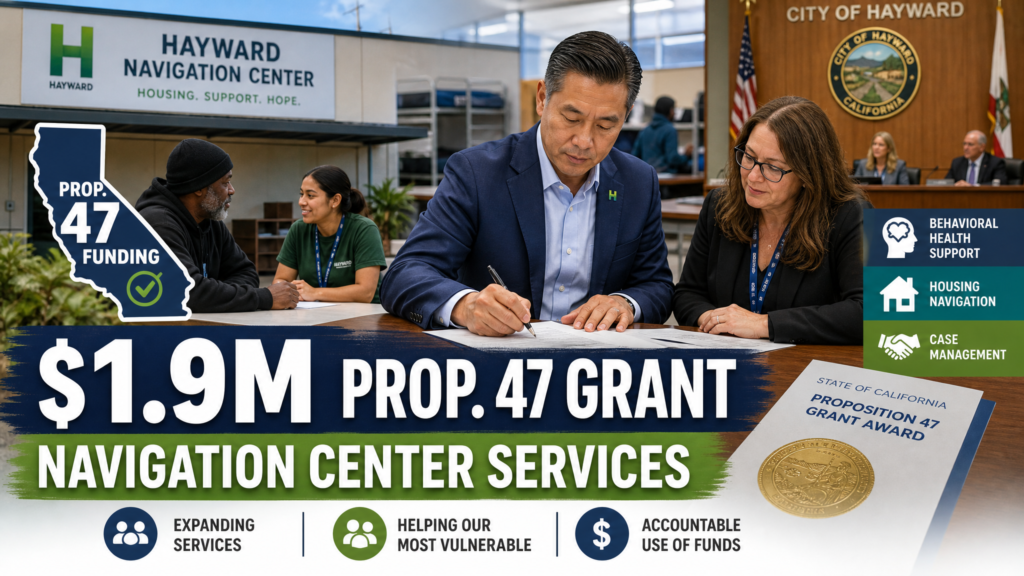
Hayward officials say the new Proposition 47 funding will strengthen Navigation Center services, behavioral-health support, and crime-prevention efforts tied to homelessness. The bigger civic question is whether City Hall can turn nearly $2 million in state money into measurable results the public can actually track. Source
Homelessness policy is where local government often makes its biggest promises and faces its toughest accountability test. Residents want compassion, order, and visible results. They want fewer encampment crises, fewer people cycling through instability, and fewer headlines about public money being spent without clear evidence of progress. That is why Hayward’s decision to accept $1,908,067 in Proposition 47 grant funding deserves real attention. This is not a symbolic resolution. It is a sizable public investment tied directly to the city’s Navigation Center and its broader approach to homelessness, behavioral health, and public safety. Source
According to the Hayward City Council watchlist, the March 2026 council action accepted and appropriated the full $1,908,067 grant, with $1,528,600 specifically allocated to Bay Area Community Services for enhanced services at the Hayward Navigation Center. The watchlist frames the funding as part of a broader “public safety beyond policing” agenda that links homelessness response, behavioral-health services, and crime prevention. That framing matters, because it tells residents this was not sold merely as shelter funding. It was presented as part of a larger civic strategy. Source
Support Independent Local Journalism
TheTownHall.News is a non-profit reader-supported journalism. Just $5 helps us hire local reporters, investigate important issues, and hold public officials accountable across Alameda County. If you believe our community deserves strong, independent journalism, please consider donating $5 today to support our work.Why This Issue Matters Now
The most immediate reason this matters is that Hayward is not starting from scratch. The city’s official Navigation Center page says the center exists to help address Hayward’s homelessness crisis and is located on city-owned land at the corner of Depot Road and Whitesell Street. It is designed to provide outreach services, short-term housing for 45 people at a time, intensive case management, and housing placement services for people living in encampments. In other words, the city already has an operating platform. The Prop. 47 grant is meant to strengthen and extend that platform, not invent one from the ground up. Source
The operator matters too. Hayward says the Navigation Center is staffed by Bay Area Community Services (BACS) 24 hours a day, seven days a week. The city’s housing documents say BACS was selected through a competitive process and that the center’s operations have been supported by multiple funding streams over time, including one-time homelessness aid, Permanent Local Housing Allocation funds, and Proposition 47 funds. That means this latest grant should be understood as part of an ongoing system of support rather than a one-time burst of emergency spending. Source Source
That also raises the accountability stakes. If a city has an established center, an established operator, and an established funding framework, the public should expect more than aspirational language. It should expect specific performance, clearer reporting, and a candid explanation of what this newest round of state money will materially improve. Source
What the Council Actually Approved
The watchlist’s summary of the March 2026 action is direct. Hayward accepted and appropriated $1,908,067 in Proposition 47 grant funds, with $1,528,600 directed to BACS for enhanced Navigation Center services. The document connects that spending to crime prevention, homelessness, and behavioral health, signaling that city leaders were not treating the grant as a narrow social-services item but as part of a broader public-order and community-wellness strategy. Source

That framing is consistent with Hayward’s own long-running Prop. 47 language. The city’s Navigation Center page says the center is partially funded through Proposition 47, which draws from state savings generated by reducing certain low-level drug and property crimes from felonies to misdemeanors. Hayward also notes that a local advisory committee tied to the Prop. 47 program includes stakeholders with expertise in homelessness, behavioral health, substance use, criminal justice, and diversion. That structure suggests the city has, at least formally, tried to integrate multiple systems around the same problem. Source
What the public still needs, however, is clarity about the practical effects of this particular grant cycle. “Enhanced services” is a real phrase in the record, but it is also a vague one. Residents should want to know whether enhanced means more staffing, more case management capacity, better behavioral-health support, stronger housing placement outcomes, or some combination of all four. A city can be technically transparent and still leave the public unsure what success is supposed to look like. Source
How This Affects Families and Neighborhoods
For many residents, the Navigation Center debate is not abstract. It sits at the center of competing public expectations. Neighbors want humane treatment for people living unhoused, but they also want public spaces that feel orderly and safe. Business owners want fewer encampment-related disruptions, but they also want confidence that the city’s response is more than temporary churn. Families want solutions that are compassionate without becoming permissive toward visible civic breakdown. Source
That is why Hayward’s Prop. 47 grant matters beyond the center itself. The city’s official materials say the Navigation Center is intended to provide a pathway to permanent housing, not just a place to temporarily hold people. The PLHA plan says residents can receive immediate shelter, intensive case management, and even transitional support after being housed, including help understanding rental obligations, setting up utilities, and planning for housing stability. If those services work as designed, they can reduce the costly cycle in which people move from street homelessness to temporary shelter and back again. Source
But this is also where skepticism is justified. Navigation centers are often politically easier to fund than to evaluate. It is easy for officials to cite good intentions. It is much harder to show how many people are actually stabilized, how many remain housed, how many high-need clients receive behavioral-health support, and whether neighborhoods experience real improvement rather than just displacement of visible homelessness from one block to another. Source
Support Independent Local Journalism
TheTownHall.News is a non-profit reader-supported journalism. Just $5 helps us hire local reporters, investigate important issues, and hold public officials accountable across Alameda County. If you believe our community deserves strong, independent journalism, please consider donating $5 today to support our work.Compassion without accountability becomes drift. Accountability without compassion becomes failure. Source
The Real Cost of Looking Away
The strongest argument for the grant is obvious: doing nothing is expensive too. Unaddressed homelessness imposes costs on emergency systems, hospitals, law enforcement, sanitation, and the wider civic fabric. A city that can use outside state money to strengthen case management, behavioral-health coordination, and housing navigation is making a rational bet that early intervention can be less costly than perpetual crisis response. Source
But government overpromising is also costly. When officials describe programs as linking homelessness, public safety, and behavioral health, residents naturally assume there will be measurable benefits across all three. If those benefits are not defined up front, public trust erodes. The watchlist itself urges residents and reporters to ask the right follow-up questions: What changed from the staff recommendation? Which neighborhoods receive the benefits? What performance metrics or deadlines should the public check next? Those are exactly the right questions for this grant. Source
That is especially true because the Navigation Center is already embedded in Hayward’s broader homelessness response. The center opened in November 2019, according to the city’s housing documents, and has been funded through multiple public sources since then. A new $1.9 million state grant should therefore be judged not as a hopeful experiment but as another serious investment in an established policy model. Source
What Critics Get Wrong
Critics on one side of this debate often assume homelessness-service funding is little more than a soft substitute for enforcement. That is too simplistic. Hayward’s own documents show the Navigation Center is not a walk-in drop-in site with no standards. The city says guests must go through intake and be routed through Alameda County’s Coordinated Entry System, and the center is staffed continuously by a nonprofit operator with experience in homelessness and behavioral-health services. This is a structured intervention, not a symbolic gesture. Source
But defenders of this kind of spending sometimes make the opposite mistake. They treat the mere existence of a grant, a service provider, or a navigation center as proof that the problem is being meaningfully solved. That is not good enough. A public program can be well-intentioned, professionally run, and still fall short of producing the level of visible improvement residents were promised. The right standard is not ideology. It is performance. Source
Key Takeaway
Hayward’s decision to accept $1,908,067 in Proposition 47 funds is a major local-government action because it reinforces one of the city’s central homelessness-response tools: the Navigation Center. The city already presents that center as a structured pathway to shelter, services, and housing placement. The new grant, including $1,528,600 for BACS, gives Hayward more resources to push that model forward. Source Source
The public-interest test is now straightforward. Will residents see evidence that the money improved service delivery, housing stability, behavioral-health coordination, and neighborhood conditions? Or will they hear broad claims about success without clear data behind them? The grant is real. The need is real. The accountability burden should be just as real. Source
What Residents Should Watch Next
Residents should watch for specific outcome measures: how many people the enhanced services reach, how many clients are placed into housing, how long placements are sustained, what role behavioral-health support actually plays, and whether the city publicly reports those results in a way ordinary residents can understand. They should also watch how Hayward explains the relationship between Navigation Center services and broader public-safety claims, since the record connects the grant to crime prevention but does not, on its own, establish a numerical crime-reduction result. Source
The city has made a serious funding decision. Now it owes the public serious follow-through. Stay informed, share this article, and support independent journalism that treats homelessness spending the way it treats any other major civic investment: with empathy, seriousness, and relentless attention to whether promises turn into outcomes. Source