Selling the Core: Hayward Designates Prime Downtown Properties at City Center Drive and Cinema Place as ‘Surplus Land’
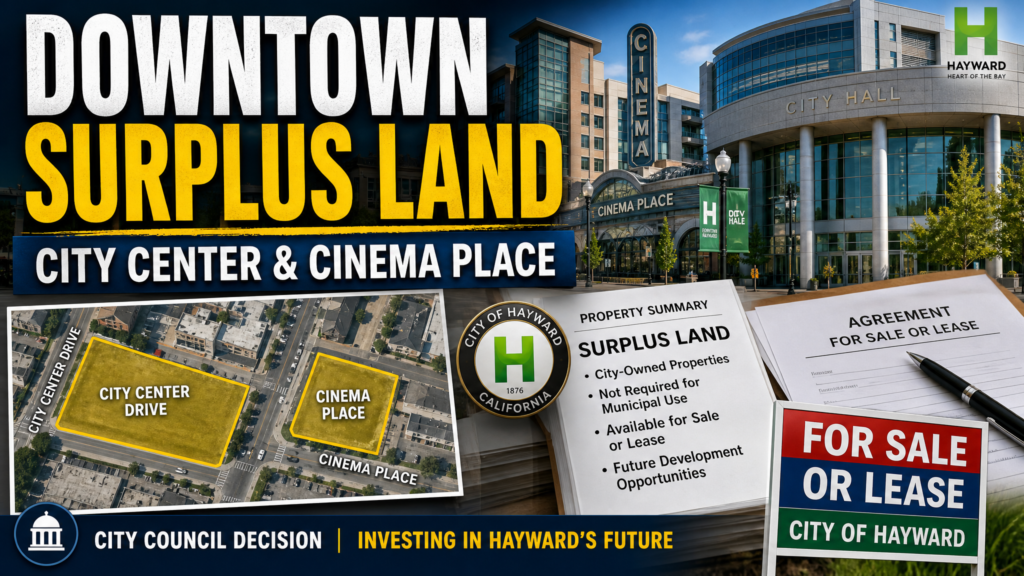
Hayward officials say the surplus-land designations open the door to future development in the city’s downtown core. But when City Hall starts preparing key public assets for sale or long-term lease, the real public-interest question is whether residents will see genuine public benefit — or simply watch prime civic land leave public hands. Source
When a city labels downtown land “surplus,” it is making more than a technical real-estate decision. It is signaling that some of its most valuable public property may no longer be needed for direct municipal use and could instead be sold or leased into private development. In Hayward, that signal now hangs over some of the city’s most strategically located downtown properties, including sites at City Center Drive and Cinema Place, after the City Council in April 2026 designated them as surplus land. Source
That action may sound procedural, but it is anything but minor. The watchlist built from Hayward’s official council materials identifies the move as a major public-land and future-development story because it opens the door to possible transfer, redevelopment, or long-term lease of publicly controlled sites in the heart of the city. Those sites are not remote leftovers. They are downtown assets that could shape Hayward’s core for decades. Once public land enters the disposition pipeline, the stakes change. Residents are no longer just debating planning theory. They are confronting the possibility that land held in common may become part of a market transaction whose long-term winners and losers are not yet fully known. Source
Support Independent Local Journalism
TheTownHall.News is a non-profit reader-supported journalism. Just $5 helps us hire local reporters, investigate important issues, and hold public officials accountable across Alameda County. If you believe our community deserves strong, independent journalism, please consider donating $5 today to support our work.Why This Issue Matters Now
The significance of the surplus-land decision becomes even clearer once the city’s later notices are read alongside the April designation. Hayward’s official surplus-land documents show that the City Center Drive site is described as an approximately 5.79-acre development opportunity made up of three adjacent parcels at 22300 Foothill Blvd., currently including a parking garage. The city says it may dispose of the property at fair market value through either a fee-simple sale or a long-term ground lease. Source
The Cinema Place site is also substantial. Hayward’s notice describes it as an approximately 1.54-acre mixed-use retail and entertainment property at 22631 Foothill Boulevard, improved with a two-story building totaling about 52,928 square feet. The city again says it intends to dispose of the property at fair market value through a sale or long-term ground lease. The notice also reveals an additional complication: the Hayward Economic Development Corporation already holds a long-term ground-lease interest in the property extending to 2057, with extension rights beyond that date. Source
That is why this story matters now. The April 2026 designation was not symbolic. By May, the city had moved to formal notices of availability and intent to dispose. What was framed in council materials as opening the door to future development quickly became a real estate process with deadlines, negotiations, and potentially irreversible consequences for the downtown core. Source Source
What the Council Actually Set in Motion
The watchlist says the City Council in April 2026 designated City Center Drive, Cinema Place, and C Street/Main Street as surplus land. It frames the decision as a major public-land item because these designations are intended to facilitate future development on city-owned property. That alone should command attention: a surplus-land designation is not the end of the story, but it is a clear declaration that the city is prepared to explore getting these sites out of the status quo and into a different development future. Source

Hayward’s official surplus-land page adds the legal structure around that move. The city says that, under California’s Surplus Land Act, interested parties generally have 60 days from notice to express interest in acquiring the property. That can trigger at least 90 days of good-faith negotiations, though the city is not obligated to sell if no acceptable terms are reached. The same page notes that priority is supposed to go to entities proposing housing developments in which at least 25 percent of units are affordable to lower-income households, if multiple qualifying proposals emerge. Source
That sounds reassuring at first glance, but the city’s updated notices for both City Center Drive and Cinema Place introduce an important caveat. In attachments answering questions from interested parties, Hayward says it has not established specific goals, requirements, or priority criteria related to an affordable housing component for either site beyond what is already listed in the legal notice. That is a significant point for anyone who assumed the downtown sites were being positioned with a clearly defined affordability outcome in mind. Source Source
Why the Downtown Core Is Different
Cities dispose of land all the time. But not all public land carries the same civic weight. Downtown land is different because it influences not just land value, but urban identity. Parking structures, retail-entertainment properties, and city-controlled parcels in the core affect walkability, public access, fiscal return, future housing potential, and who ultimately gets to shape the center of town. A city can afford to be casual about peripheral leftovers. It cannot afford to be casual about its core. Source
The watchlist captures that concern by treating the sites as part of a larger “housing and land tracker” that should be followed for affordability, displacement, and public-benefit terms. That is the right framing. Once public land is released to the market, residents should not judge the deal only by whether the city gets a price. They should judge it by whether the use serves downtown vitality, whether community benefits are real or cosmetic, whether housing terms are meaningful, and whether the public is giving up long-term leverage for short-term fiscal relief. Source
This is especially relevant in Hayward, where the surplus-land designations are unfolding alongside broader fiscal stress and a “Business-Friendly Hayward” zoning rewrite aimed at reshaping commercial and mixed-use rules. Public-land disposition in that setting does not happen in isolation. It becomes part of a much larger argument about how the city intends to grow, what role public assets play in balancing budgets, and how much of downtown’s future gets shaped through public planning versus private deal-making. Source
Support Independent Local Journalism
TheTownHall.News is a non-profit reader-supported journalism. Just $5 helps us hire local reporters, investigate important issues, and hold public officials accountable across Alameda County. If you believe our community deserves strong, independent journalism, please consider donating $5 today to support our work.When a city sells the core, it is also selling leverage over its own future. Source
The Real Cost of Public-Land Drift
The strongest argument for surplus-land disposition is easy to understand. If a city owns property it no longer needs for direct public use, then holding it indefinitely can look wasteful. Selling or leasing it may unlock development, produce tax revenue, activate underused blocks, and reduce the carrying costs of public ownership. Hayward’s notices plainly describe the sites as development opportunities, and many residents would reasonably prefer productive reuse to dead space or stagnant property management. Source Source
But there is another side to the ledger. Public land is not just an asset on paper. It is one of the few tools cities have to directly influence affordability, land use, civic space, and development terms without relying entirely on regulation after the fact. Once land leaves public control, that leverage shrinks. If the city has not clearly defined what it wants in return — affordable units, public amenities, stronger design standards, durable access, or a mix of those — then “surplus” can become a euphemism for forfeiting options. Source
That is why transparency matters so much here. Hayward says there is no predetermined fair market value and asks respondents to submit offer prices supported by appraisal. That may be standard practice. But for residents, the deeper question is not just price discovery. It is value discovery. What, precisely, is the city trying to maximize: cash, housing, activation, tax base, downtown revitalization, or some balanced package of all of them? Without a clear answer, surplus-land policy risks becoming reactive rather than strategic. Source Source
What Critics Get Wrong
Critics of public-land sales often act as though any disposition is automatically a giveaway. That can be too simplistic. Cities should not warehouse land forever without a plan, especially when downtown needs reinvestment and property can be used more productively. If Hayward can turn underused or municipally nonessential property into housing, mixed-use activity, or a better fiscal position, that is a legitimate public objective. Source
But defenders of disposition too often make an equal and opposite mistake. They assume market activity alone is proof of good policy. It is not. A city can sell prime land at fair market value and still strike a poor civic bargain if the resulting project weakens downtown access, fails to deliver affordability, produces little public benefit, or simply transfers upside from the public to private actors without adequate return. Good land policy is not anti-development. It is pro-accountability. Source
Key Takeaway
Hayward’s April 2026 surplus-land designations were a pivotal downtown decision, not a housekeeping formality. The official record shows the city quickly moved from designation to formal notices of intent to dispose of the City Center Drive and Cinema Place sites, both of which are significant downtown properties. That means the conversation is no longer theoretical. It is now about terms, priorities, and what public benefit Hayward is willing to demand before prime civic land changes hands. Source Source Source
Residents should not let the word “surplus” do too much rhetorical work. Land in the downtown core is rarely surplus in any ordinary sense. It is strategic. The only real question is whether Hayward will use this process to strengthen the public interest — or merely liquidate valuable leverage at a moment of fiscal and political pressure. Source